


Lawmakers will take another year to consider how to adjust state-level mineral taxes to counter an expected increase in federal royalty rates for oil and gas.
Senate File 84 – Mineral royalties-proportional severance tax relief was tabled in the House Minerals, Business and Economic Development Committee Friday by a vote of 5-3.
Despite broad support among lawmakers in both chambers, the bill’s demise is owed to uncertainty about when and how much the federal government might increase royalty rates and concerns over a complicated “refund” mechanism that would have added administrative costs.
“For me, there are a lot of unknowns and there’s a lot of assumptions in the bill,” Rep. Trey Sherwood (D-Laramie) said after 30 minutes of public comment on the bill. Sherwood offered the motion to table the bill. “My biggest concern is actually that this came out of the Senate without an appropriation.”
Lawmakers had heard testimony that administering the rebate system could add $145,000 annually in administrative efforts.
Of larger concern were unknown outcomes for state and county budgets and various programs that are tied to mineral taxes. Senate File 84 would have provided a refund from a portion of severance tax that a producer pays to the state with the intent of countering the industry’s burden from a federal royalty rate increase. The state would then backfill the severance tax pool with the anticipated increase in federal mineral royalties that are shared with the state.
But an increase in federal royalty rates would change how minerals are valued, potentially changing the calculation for ad valorem taxes at the county level.
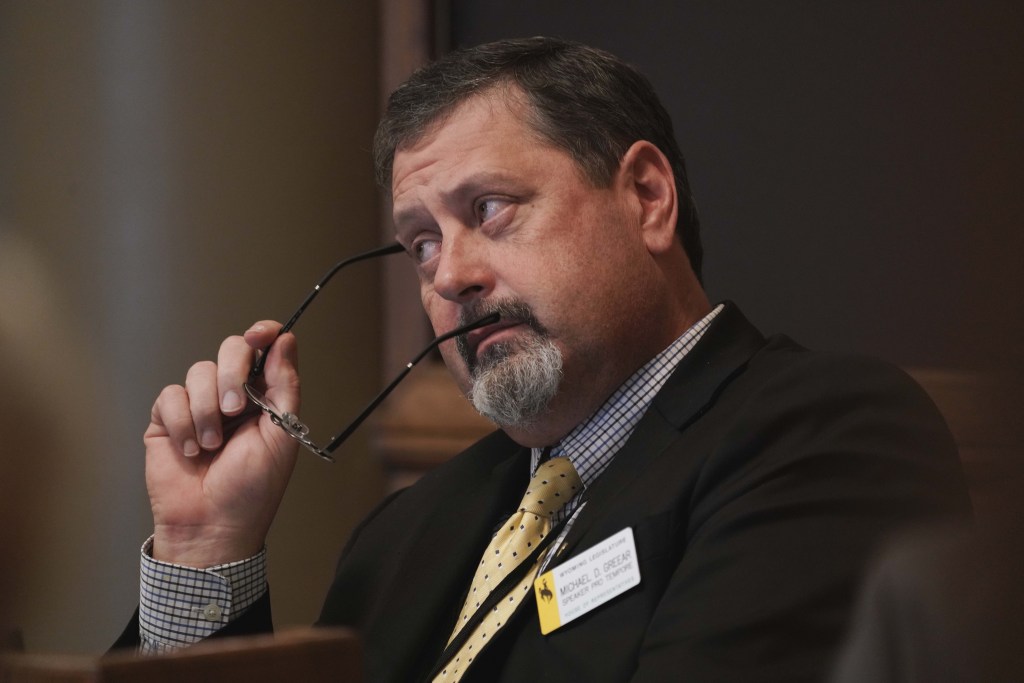
Committee Chairman Rep. Mike Greear (R-Worland) said Wyoming’s own outdated and complicated tax-and-revenue system makes it difficult to build a straight-forward tax relief effort for the industry.
“I sincerely believe our tax policy in Wyoming is awful,” Greear said. “The question is, how do we build and develop the information to have a tax policy that is broad and sustainable?”
Wyoming already imposes a hefty burden on the industry with its own suite of mineral taxes, SF 84 proponents argued. An increase in federal royalty rates would compound the industry’s cost of business and make the state less attractive to drill and develop because there’s a higher percentage of federal minerals in Wyoming than other states.
Wyoming has reaped about $3.6 billion in state and federal royalties in the past five years, Wyoming Petroleum Association President Pete Obermueller told committee members.
“Mr. Chairman, I think you would agree with me that that is probably a fair return to the taxpayers,” Obermueller said.
Opponents argued that markets and geology — not taxes or royalties — drive drilling activity, and that the Biden administration is considering higher royalty rates based on numerous studies that suggest the rates are too low.
“I sincerely believe our tax policy in Wyoming is awful.”
Rep. Mike Greear (R-Worland)
“It feels too early to enact policy that sets the stage to refund millions of dollars of potential state revenue back to private interest to offset increased royalties that they [producers] may not ever have to pay,” Wyoming Outdoor Council Conservation Advocate John Burrows told the committee. “It seems wiser to wait and see if these federal policies actually come to fruition.”
The Biden administration has punted on the past five quarterly federal oil and gas lease sales, which is already threatening future drilling activity in the state, Obermueller said. The actual intent of raising federal royalty rates, he added, is to further dissuade the industry from drilling on public lands.
“I think it’s important to understand that when some people talk about a fair return, what they’re saying is that it’s not fair unless it’s high enough that it stops the activity,” Obermueller said.
The Joint Minerals, Business and Economic Development Committee will likely take up the effort in the interim, Greear said.


Wyoming legislature is not capable of changing taxes. They just want to give oil and coal tax breaks. No concern for the people just for corporations.
“I sincerely believe our tax policy in Wyoming is awful.”
Finally . A single shaft of intellectual sunlight cuts thru the smoke and haze of the Wyoming Legislature.
Tax Reform should have been the most important item on every Wyoming legislative agenda since at least the 2009 financial meltdown. Total bottom up Tax Reform – not more guns, abortion , or hang the enviros invectives from the wingnuts…