


For more than a decade, the Ruby Pipeline has carried natural gas across the West, cutting through northern Utah with little public attention.
Now, the 683-mile pipeline has been thrust into the spotlight after developers touted it as a key piece of a project that could turn a remote Box Elder County valley into one of the nation’s largest energy and data center hubs.
State backers and developers have described the pipeline as a “catalyst,” saying it could fuel on-site natural gas generation needed to power energy-intensive artificial intelligence facilities at a proposed “hyperscale” data center and energy campus backed by celebrity investor Kevin O’Leary and Utah’s Military Installation Development Authority.
The data center project, however, has quickly drawn widespread opposition across the Beehive State, fueled by concerns over what the project could mean for air quality, water resources and the already stressed ecosystem around the Great Salt Lake.
The pipeline’s renewed attention comes years after the company that owned it filed for bankruptcy following the expiration of long-term shipping contracts, court records show, and a financial downturn that reshaped how much of its capacity was being used.
However, Vladimir Dvorkin, a power systems professor at the University of Michigan, said the massive data center project could effectively breathe new life into the pipeline by tapping some of its unused capacity.
Dvorkin said the pipeline has been underutilized over the years, but it “looks like the data center project is sort of a revival of this project.”
What is the Ruby Pipeline?
The pipeline stretches across the high desert from the Opal natural gas hub in southwestern Wyoming, crossing northern Utah’s remote rangelands and Nevada before ending in Malin, Oregon, a major hub for energy trading in the West.
It relies on four compressor stations along its route, including the Wildcat Hills station in western Box Elder County.
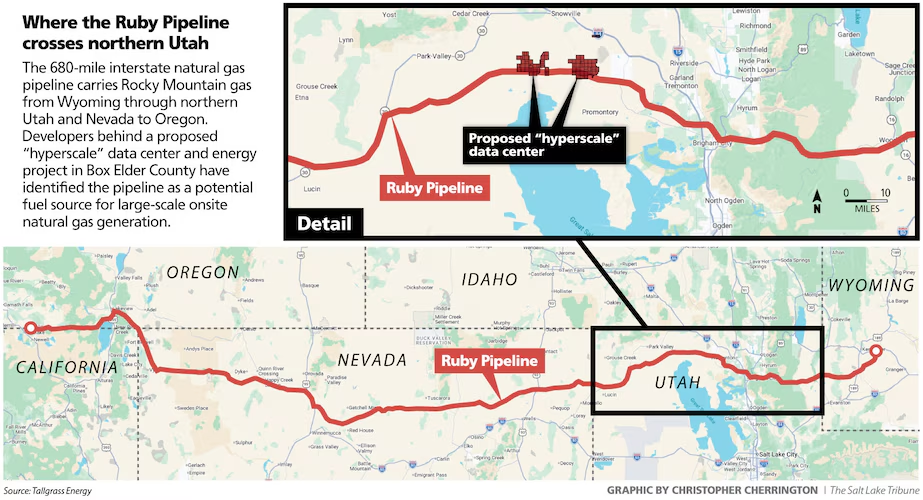
Built during the shale gas boom, the pipeline entered service in 2011 and was hailed as a major piece of Western energy infrastructure. According to the U.S. Energy Information Administration, it increased the region’s capacity to move natural gas west by more than 50% and expanded delivery into northern California.
The 42-inch interstate pipeline can transport up to 1.5 billion cubic feet of natural gas per day, according to the federal agency.
Debts pile up
But the economics that once supported the Ruby Pipeline began shifting soon after it was built.
In 2022, Ruby Pipeline LLC — the company that owns the pipeline — filed for Chapter 11 bankruptcy because it didn’t have enough cash to pay off $475 million in debt, according to bankruptcy court filings.
Ruby Pipeline was a joint venture between energy infrastructure giant Kinder Morgan and Calgary-based pipeline operator Pembina Pipeline Corporation.
In bankruptcy filings, Will Brown, vice president of business management for Kinder Morgan’s Natural Gas Pipelines West Region, wrote that market conditions changed in ways the project’s original business model had not anticipated.
When the pipeline was built in 2010, he wrote, the company signed long-term agreements with 12 customers to reserve about 1.1 million dekatherms of natural gas capacity per day — covering most of the pipeline’s capacity.
However, most of those agreements lasted 10 years and expired in July 2021, Brown wrote.
The company struggled to replace those contracts as Western energy markets changed, according to Brown. Growing natural gas production elsewhere drove down prices and weakened demand for Rocky Mountain natural gas, he wrote.
By March 2022, about 40% of the pipeline’s daily capacity remained under contract, Brown wrote. As those contracts expired without replacement customers, the company’s revenue declined, leaving it unable to meet upcoming debt obligations.
Later that year, Tallgrass Energy agreed to buy the pipeline out of bankruptcy for $282.5 million, according to court filings. In a court-ordered auction in December 2022, Tallgrass outbid competing offers, including a $276 million bid from a Kinder Morgan affiliate, filings show.
Will the data center raise gas rates?
The project’s backers initially said the first phase, which would be built in Hansel Valley where the pipeline runs through, would require about 3 gigawatts of power, nearly matching Utah’s average statewide electricity use of roughly 4 gigawatts. Amid growing public outrage over the project, Gov. Spencer Cox said developers had agreed to scale the first phase down to 1.5 gigawatts.
At full buildout, Paul Morris, MIDA’s executive director, said the campus would reach 9 gigawatts.
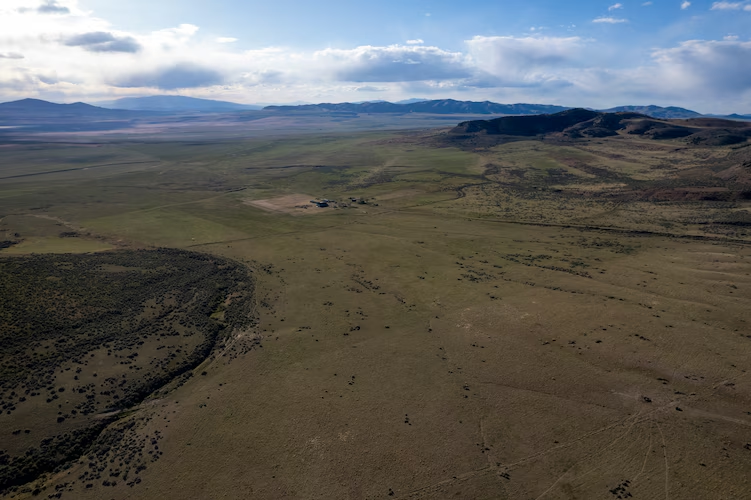
Austin Pritchett, co-founder of developer West GenCo and a partner with O’Leary on the project, said during an April 27 Box Elder County Commission meeting that the pipeline could help supply fuel for on-site natural gas generation to power energy-intensive AI computing facilities.
The data center would tap into some of the pipeline’s unused capacity not currently under contract, Pritchett said. Because of that, he said it should not affect existing gas customers or raise rates.
But Dvorkin, who studies how data centers interact with electrical grids, said tapping the pipeline’s unused capacity could have a broader effect on energy costs.
To generate more power than Utah’s current statewide electricity use, the project could require a substantial amount of natural gas, Dvorkin said. While the Ruby Pipeline may have capacity to move that fuel, he said the question is whether regional supply can keep pace with a major new source of demand.
Rocky Mountain Power’s gas-fired plants draw fuel from the same broader supply network connected to the Opal Hub in Wyoming, where the Ruby Pipeline begins, Dvorkin said.
If a large data center campus begins buying substantial amounts of natural gas, it could increase competition for gas and tighten supply, potentially pushing prices higher even though the project may never touch the grid, he said.
Those fuel costs, he said, can then be passed on to customers through electricity and heating bills.
“It feeds Oregon, California and Nevada’s gas utilities, meaning that the presence of such a large consumer in Utah will also affect gas prices for everyone downstream the pipeline,” Dvorkin said.
However, Dvorkin said any rate impacts depend on future gas production, how the gas is contracted and how much fuel the project ultimately uses.
While project backers have said the development would rely completely on the Ruby Pipeline to supply natural gas for on-site power generation, Gov. Spencer Cox said last week that the project would “never” run solely on natural gas and that later phases should incorporate other energy sources, including nuclear, geothermal and solar power.

Governor Cox issued an executive order last week establishing more regulatory control over the development. There is also a potential referendum in November to overturn the Box Elder County Commission approval. There is a growing sentiment against the project.