

These days I often feel what in British English is called “gobsmacked” — overwhelmed with wonder, surprise or shock; astounded. Many things cause this reaction — the billowing drift of clouds in the sky, the green of new leaves on the trees in spring, the silence of the night when the human world rests a little. These are things before which I feel wonder, things that help me leave myself behind.
Opinion
Living in a household with two cats gives me other lighthearted experiences of being gobsmacked — the cats wrestling and thundering through the house, jumping up on the bed and landing on me as I sleep, leaping straight up in the air after a fly or a miller moth, flipping backwards in midair to swat at whatever is in flight above them. More often than seems possible, they actually grab these creatures out of the sky. And when anything changes in their environment — a chair moved, a shoe left in the hallway, a book on my desk that wasn’t there the day before — they have to investigate; four-legged natural scientists seeking to understand their world. I’m gobsmacked by the power of what might be called inconsequential. Maybe there is no inconsequential.
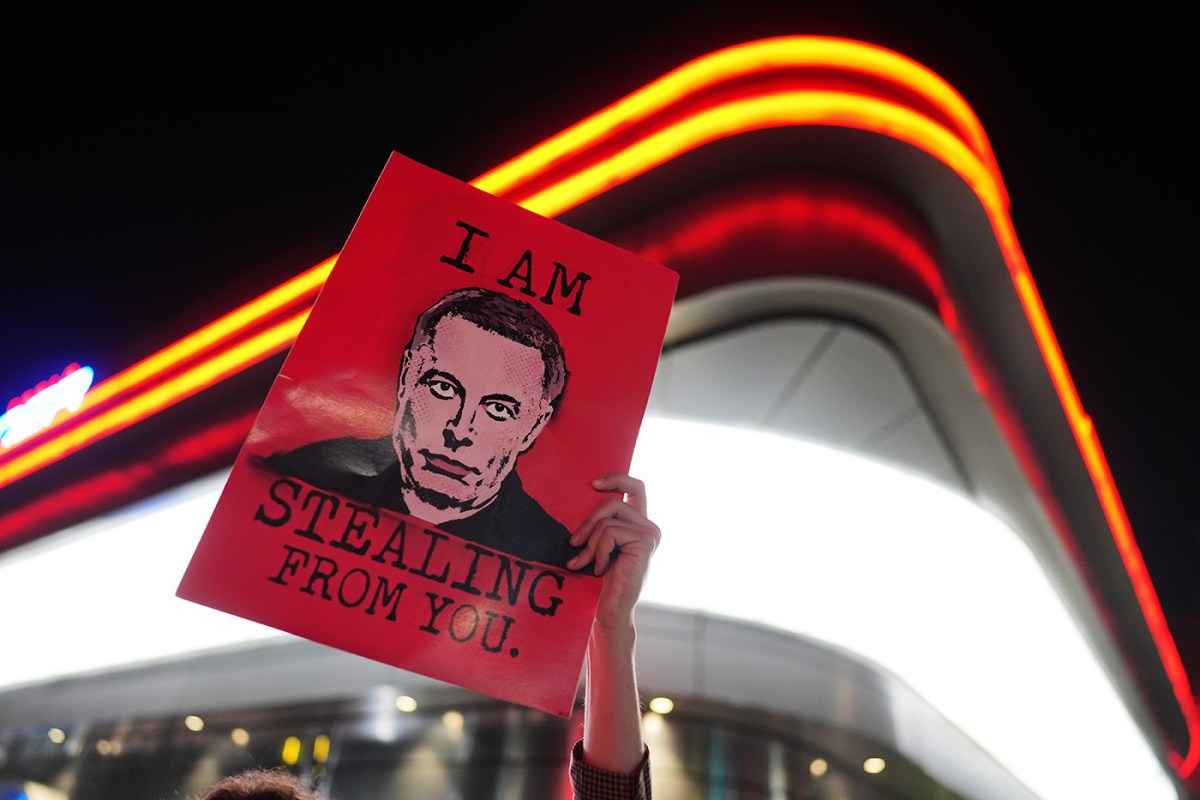
Other moments of being gobsmacked are darker. Take the news that Elon Musk is now a trillionaire. A single person possesses a trillion dollars. I don’t actually have the capacity to imagine a trillion dollars, so I asked my trusty computer search engine how much space a trillion dollars in one-dollar bills would fill. A variety of websites informed me that if you stacked the bills directly on top of each other, the paper tower would be 67,866 miles high. One source claimed that laid end to end, a trillion $1 bills would stretch from the Earth to the sun and beyond. But these explanations are merely distracting, the stuff of small talk at a cocktail party. How can I really get at what it means for a single person to have a trillion dollars?
I decided to add up the gross domestic product of the nations of the Earth starting with the lowest GDP country and moving up the list until their combined GDP totaled a trillion dollars. According to the International Monetary Fund as reported by Worldometer, there are 218 countries on earth. The combined total GDP of the lower 100 countries gets you a trillion dollars.
This is not to say that I’ve added up the GDPs of the hundred poorest countries. Some in that group of a hundred, mostly countries that are geographically small with low populations, are quite wealthy — Malta, the Bahamas, Bermuda, Liechtenstein, Monaco, the Cayman Islands, Andorra. Others, mostly in Africa, are quite poor — Burkina Faso, Guinea, Benin, Burundi, Chad, Niger, Mozambique, Madagascar, Malawi, Somalia, South Sudan, Liberia, Gambia, the Central African Republic, Eritrea, Yemen. A few of the poorest countries, Syria and Afghanistan, for example, are in the Middle East and Central Asia where war takes its perpetual share of whatever wealth there is. Yemen has a GDP of $384 per capita, while Afghanistan’s per capita GDP is not much higher at $448. Of the hundred countries, the two with the highest per capita GDP are Monaco at $256,581 and Liechtenstein at $226,809.
Here’s another element of my state of gobsmackedness — those hundred countries whose total GDP adds up to a trillion dollars have a population of 696,193,389. This, of course, is a vague estimate of the number of human beings living from the material possibilities of a trillion dollars, an estimate I’ve created by averaging statistics provided by the United Nations Population Fund, Worldometer, the World Bank, Population Pyramid and Macrotrends. Whatever the exact number, the GDP of nearly 700 million of us is equal to the amount of money Elon Musk has gathered to himself. I try to make sense of the numbers — nearly 700 million people in a hundred countries with a combined GDP of a trillion dollars, and a single person whose personal wealth is exactly the same — a trillion dollars.
As for Wyoming, the Bureau of Economic Analysis lists our state GDP as approximately $52 billion, and while that puts us very high in the list of a hundred, you’d still need to multiply our GDP by almost 20 to get a trillion. Twenty Wyomings to equal the wealth of one person. Meanwhile, the U.S. Census Bureau lists 58,000 Wyomingites as living below the poverty line while 59,400 have no health insurance.
Gobsmacked.

Gobsmacked really captures the moment. What was the most surprising thing you encountered while planning?
I read something that tried to compare a million dollars to a billion dollars that may help show what a trillion dollars looks like.
If you spent $1,000 per day, it would take roughly 3 years to spend $1,000,000. I remember being stunned to realize it would take 3,000 years to spend $1,000,000,000 at $1,000 per day.
Now I am indeed gobsmacked to realize it would take 3,000,000 years to spend $1,000,000,000,000 at the rate of $1,000 per day. That’s a lot of school lunches.
It may be time to send Elon Musk to Mars by himself with no return ticket. In the meantime he can enjoy swimming around in his money like some demented Scrooge McDuck.
Nothing prevents Elon Musk from “earning” a trillion bucks, of course, just as nothing prevents us from taxing it away from him and putting the money to better use such as helping the least among us.
I am hoping some of our resident alleged christians will wonder how Elon Musk would have responded to Jesus in Matthew 6:24 (KJV): “No man can serve two masters: for either he will hate the one, and love the other; or else he will hold to the one, and despise the other.
“Ye cannot serve God and mammon,” Jesus said. Mammon being money.
I have a feeling Elon Musk would have denounced Jesus as a, you guessed it, filthy Jew and ordered him slapped in some squalid Roman jail to await execution. Come to think of it that’s sort of what happened.
Paul, I am a Christian, and I’m not wondering much at all about how Elon would respond to Matthew 6:24.
Elon literally dressed as “Satan’s Champion” for an adult halloween party a few years back.
I dont think he has ever claimed to be a Christian, and everyone knows what he $erve$.
I do wonder why you felt the need to throw in “alleged” when mentioning Christians, probably same reason another commenter always prefaces his mentioning of Christians with “Fake”.
A real Christian is honest. They don’t change their name to fool people.
One way to visualize a really large number is to divide it by a relevant number. $1 trillion divided by the population of the USA is $2,910. From your pocket to his.
I just think one person having a trillion dollars and not doing anything to make the world a better place is obscene. To me it shows his true character when he doesn’t see the need in the world. Greed! Money truly is the root of all evil. It’s on plain display in our current government and it is not a pretty picture. I don’t want for anything because I saved well in my work life but there are so many ways the money these people have and wouldn’t even miss if they were to do something good with it. Pay off all medical debt. Give less fortunate kids scholarships to help lift them up. Clean up our dirty world. Fix climate change. Be people we look up to!
I wonder if in 1913 Americans held of pictures of JD Rockefeller, JP Morgan. etc. when the “Federal” Reserve was created.
Those families and that collection of Private banks have stolen more from the American People in 100+ years than Elon could ever dream of stealing.
Absolutely, by that logic we should all be trillionaires!
I’m far from being a fan of Elon, but in his defense, how much of that [briefly] trillion $ of net worth did he actually steal?
Like him or hate him, any fair assessment of him would have to admit that he made much, if not most of his wealth by ushering in tremendous innovations and new technologies. PayPal, Tesla and SpaceX all are or were on the cutting edge of innovation and invention. Western capitalism has a long history of handsomely rewarding those who take great chances in finding ways to put new technologies to productive use. Regardless of whether Elon Musk is a historically great man or a total freak, or a combination of both, the impacts of his efforts on our world are undeniable and will be with us for a very long time. I’ll leave it to others to argue over how much wealth he should or should not be allowed to possess.
So? Good for him!
Absolutely, by that logic we should all be trillionaires!
I’m gobsmacked by the fact that people would vote for a super dishonest grifter that made 2 billion dollars during his presidency. How much did you make, or maybe I should say, how much in the hole are you?
Like you, I can’t envision a trillion dollars. But look at it this way: a dollar here and a dollar there, and soon it adds up to some money.