

CASPER—Natrona County commissioners took no action Tuesday after developers of the proposed Prometheus Hyperscale data center asked them to consider an industrial park zoning designation, which would speed up build time by exempting the $500 million project from state industrial siting review.
At the Natrona County Courthouse, Prometheus founder Trenton Thornock and Build Wyoming Director Eric Schlidt presented the request during the workshop portion of the board’s meeting — during which no decisions are made — in front of a packed house of supporting and skeptical residents alike. Per the presentation, Prometheus intends to apply for a planned unit development to zone 940 acres south of Interstate 25 on the Falls Ranch property situated between Casper and Glenrock.

Thornock told commissioners that an industrial park designation allows developers to seek an exemption from the Wyoming Industrial Siting Council while keeping county-level oversight. He described industrial siting processes as “cumbersome and time-consuming,” adding the exemption would not remove “any applicable environmental or regulatory requirements.”
State agencies like the Department of Environmental Quality and the Wyoming Department of Transportation would still regulate air, water and roads, Thornock said, adding that the DEQ’s Industrial Siting Division has three employees and the seven-person siting council meets quarterly, which slows project reviews.
“Local control in my opinion is much better than state siting oversight,” he said. “You, the county commissioners and local officials, know your community and their needs better than a state siting council.”
Thornock added that county-level permitting allows local officials to negotiate directly with developers for road maintenance and infrastructure funding rather than waiting on state formulas from Cheyenne.
Project background and design
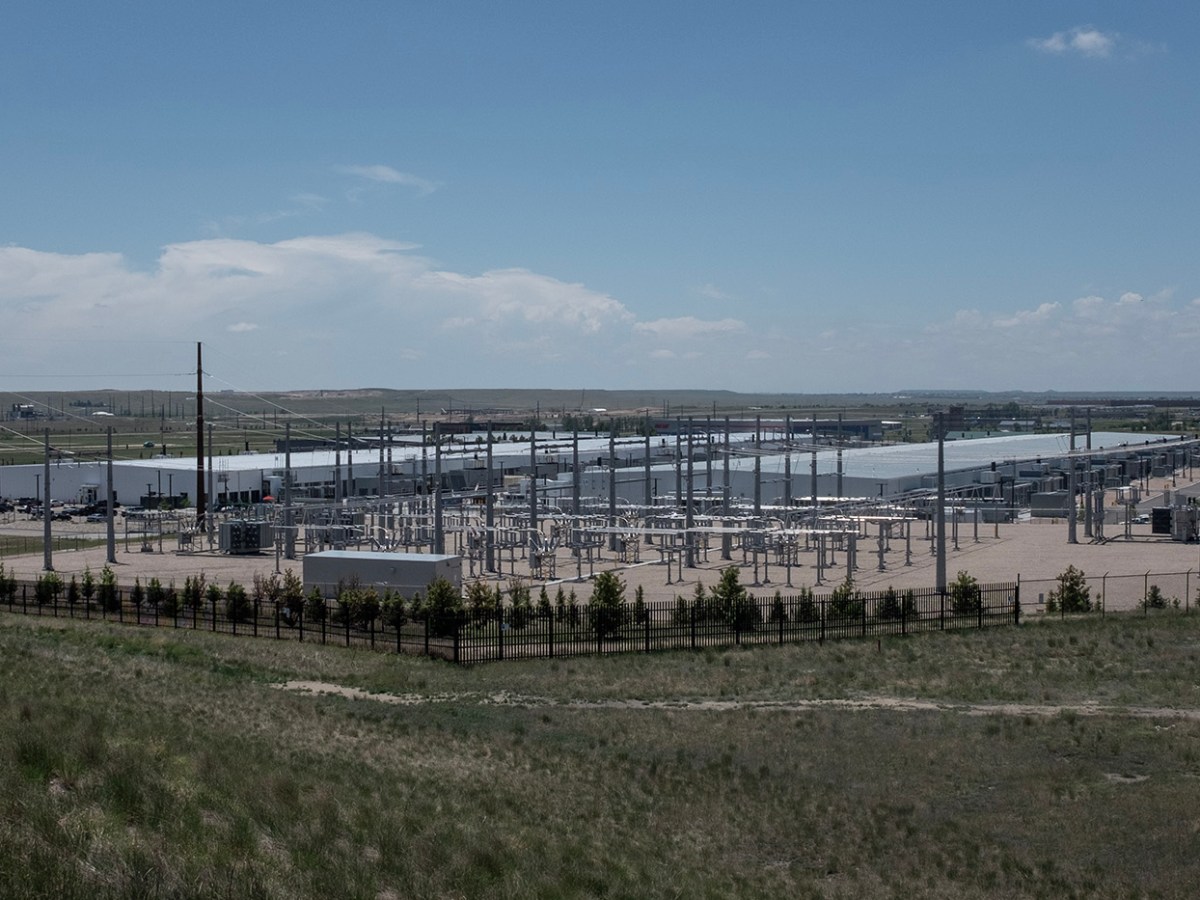
Prometheus announced plans in late 2025 to build a 1.5-gigawatt data center campus on Falls Ranch property — owned by Texas billionaire Russell Gordy — north of Interstate 25. Plans at the time would have placed the data center portion in Converse County and the power generators in Natrona County.
County officials said after pushback from neighbors regarding noise, heat and traffic, developers shifted the site to other Falls Ranch property south of the interstate, bringing the $500 million campus entirely within Natrona County.
Converse County commissioners previously adopted a policy to streamline industrial park designations for the project in April, but rescinded it a month later after the Wyoming attorney general found the county lacked the statutory authority to create independent exemption procedures outside standard zoning rules.
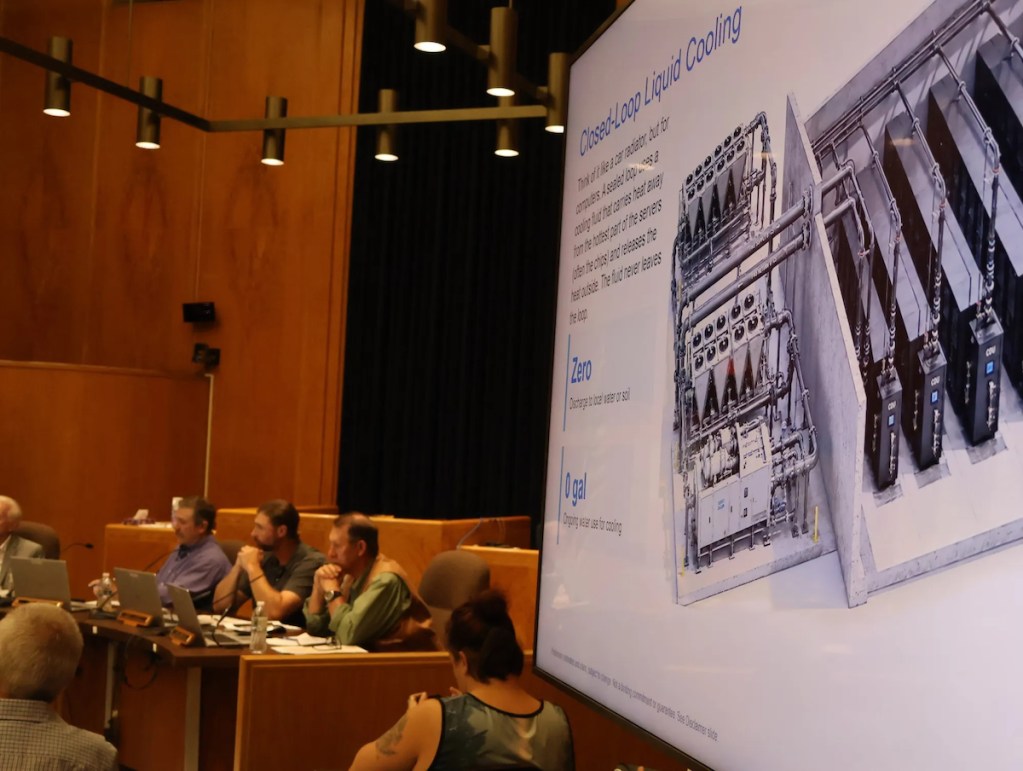
Thornock previously said the proposed data center relies on a closed-loop cooling design using a blend of water and food-grade propylene glycol. The blend is used for five to six years before being hauled off by a supplier for recycling, requiring no ongoing water draw or wastewater discharge for cooling.
On Friday, Prometheus announced a partnership with Evansville-based Mesa Power Solutions to supply natural gas generators. Previously, the company had said it would deploy Jenbacher generators to power the first phases of development. Either arrangement would allow the center to produce its own power on-site without drawing electricity from the public utility grid.
Friday’s announcement added to the announced partnerships with Spiritus, which says it develops carbon-negative power infrastructure, and Casper Carbon Capture, which agreed to provide land and access to permitted underground carbon storage wells.
Schlidt estimated the data center portion of the project would support roughly 3,000 temporary construction jobs at peak build-out and 150 permanent positions, and generate between $80 million and $115 million in recurring annual property taxes.
It seems that the county loses a part of its leverage in those negotiations if things have been fully permitted.
Commissioner Peter Nicolaysen
Thornock said the campus footprint requires 300 acres for on-site power generation and 640 acres for data center halls west of Big Muddy Creek. He told the board that prospective tenants need a clear path toward local permits, warning that delays could push the company to move resources to alternative project sites in Texas.
During the meeting, there were no other details provided regarding a site plan, project timeline or potential customers.
Uinta County advances project
Prometheus pointed to its work in southwest Wyoming as a model for how it plans to work with Natrona County.
In June, the Uinta County Board of County Commissioners approved a zone change from agricultural to industrial use for the Atlas Industrial Park Subdivision. That decision cleared the way for Prometheus to plan a 640-acre campus on Thornock’s family ranch outside Evanston.
Thornock told commissioners that Uinta County placed rules directly onto the company’s conditional use permits. The county handled the project through two separate permits, dividing rules between power generation and the data halls.
“These are the kind of good-neighbor things that have very specific conditions around how we have to operate our facility both during the construction phase and later on,” Thornock said.
Before making decisions on those permits, Uinta County planning staff traveled to the Nova data center in Jordan, Utah, Thornock said. The visit allowed staff to see closed-loop liquid cooling systems in person.
He offered to arrange a similar tour for Natrona County officials.
Thornock said the company also met with Evanston and Uinta County fire agencies to establish safety rules for on-site backup batteries.
Natrona County commissioners question developers
Commissioner Peter Nicolaysen questioned the timing of potential community agreements. Thornock said Prometheus prefers negotiating community benefit agreements after county permits are finalized. The company faced accusations of bribery in Uinta County when talks ran during the permitting process, he said.
“It seems that the county loses a part of its leverage in those negotiations if things have been fully permitted,” Nicolaysen said, “and so I would prefer that those things work in tandem, go through the permitting process, but also be moving forward and making progress on the community benefit agreement.”
Nicolaysen also pressed the developers on road access, utility impacts and cooling fluids. Thornock said primary access for construction and operations would come from a newly constructed Interstate 25 interchange, with Hat Six Road reserved as a secondary emergency route.
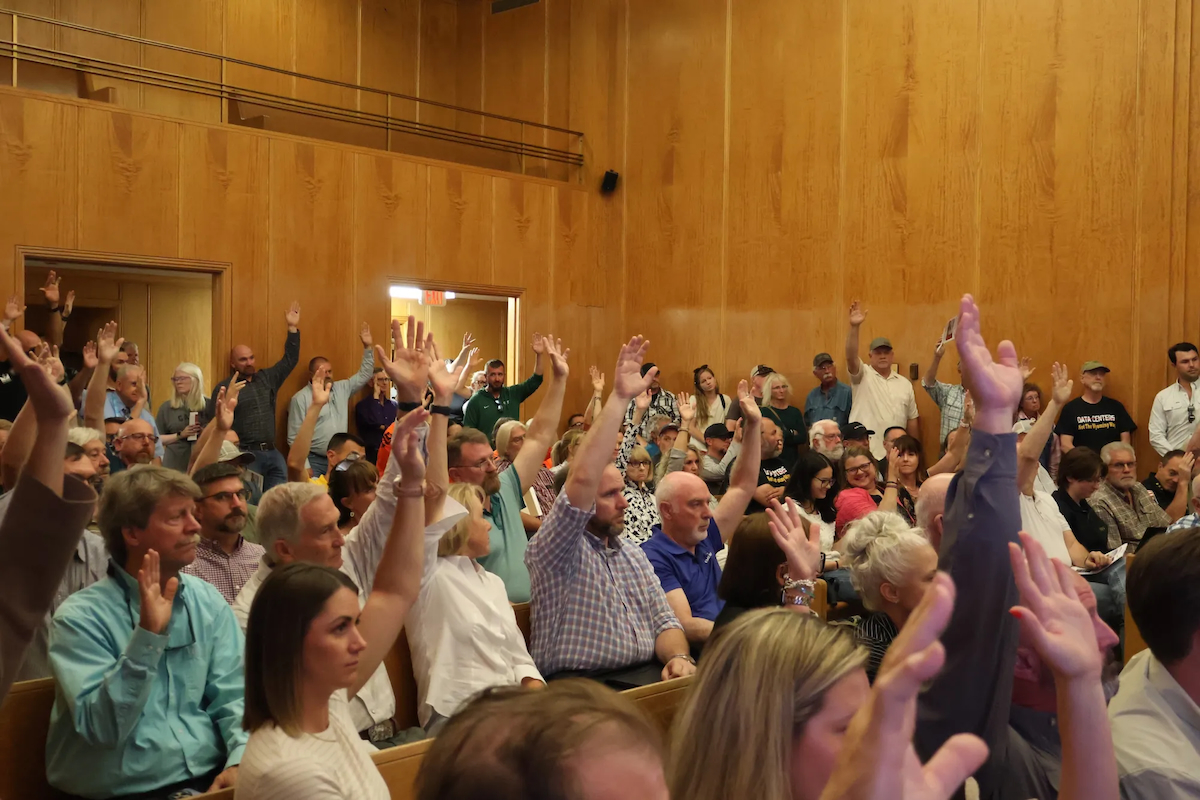
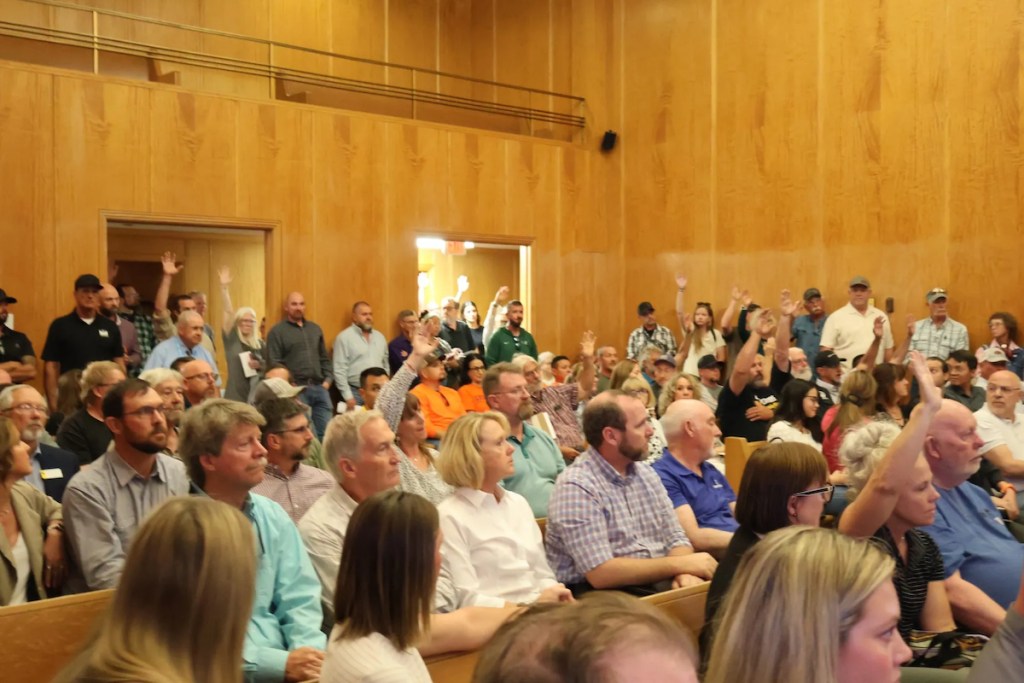
Commissioner Dallas Laird asked audience members to raise their hands to show whether they supported or opposed the development, then addressed the developers.
“Opinions are different than facts,” Laird said. “And agreements, in my opinion, if they aren’t in writing, they don’t mean anything. So, we’re going to take a really hard look at this.”
Public comment split over landscape, local control
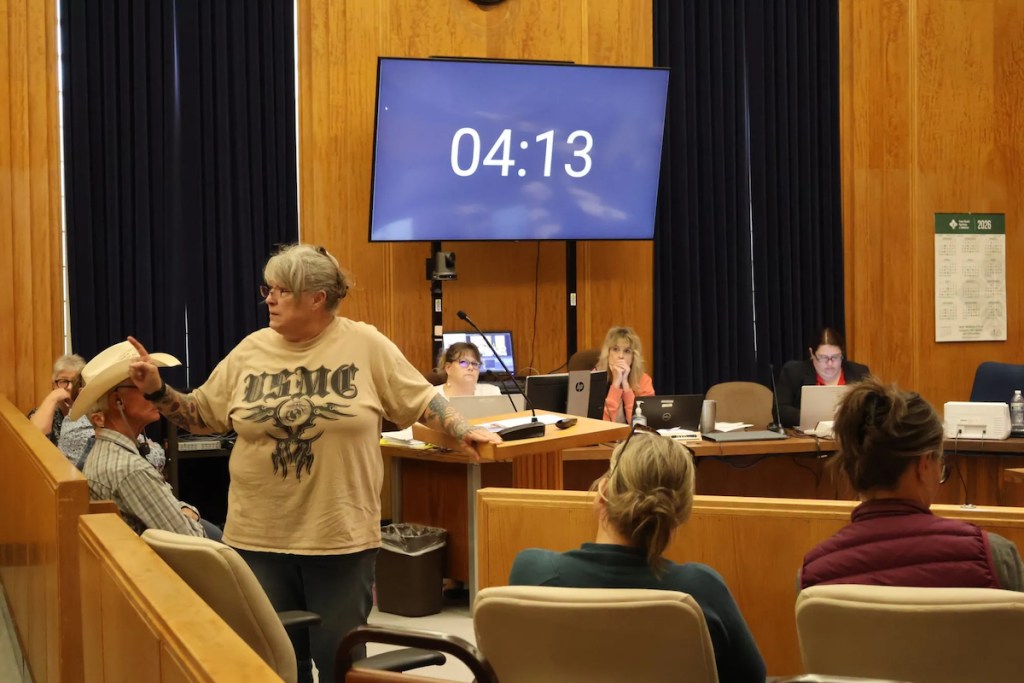
The commissioners took more than an hour of public comment from the dozens of residents packing the courtroom.
Katherine Dvorak of Casper questioned how initial water use would affect area wells and raised concerns about heat output from generators during hot summers. Sherry Johnson, a lifelong Casper resident, urged commissioners and audience members to drive out to Hat Six Road before supporting rezoning efforts.
”Please go take a look at that land because you people need to understand once you allow that behemoth, our landscape will never look the same,” she said. “We’re talking what, 150 jobs? It’s not worth our landscape. We can’t get it back. Once it’s gone, it’s gone.”
Erika Cook said she lives downstream and downwind from the site. The natural gas power plant was her primary concern.
“Gas generators on this scale would turn our rural prairie into a polluted industrial nightmare,” she said. “We would hear and feel the noise from this power facility 24–7, 365 days a year in our home. This is not what we bargained for when we invested our life savings in our peaceful family home.”
Brad Isner, a neighbor of the project’s initial site, said company officials have not provided answers to questions about construction camps, traffic and emergency services.
Meanwhile, supporters urged the board to keep project reviews under local control rather than handing oversight to state boards in Cheyenne.
“What we need to ask is if we have the potential as a community to welcome business development, handle it locally, or do we want to let Cheyenne determine our fate and the impacts and be in charge of the money that comes back to this community?” Casper resident Tassma Powers said. “Because that’s what industrial siting does.”
Keegan Fox of Casper told commissioners that public officials should base decisions on verified facts rather than fear or unverified promises.
“A responsible ‘yes’ doesn’t ignore legitimate concerns and it doesn’t allow speculation to become a substitute for evidence,” he said.
Colton Dillion, who lives off Hat Six Road, said the development would sit near his home, but he welcomed the opportunity to attract advanced technology jobs to Wyoming.
“Data centers are very efficient businesses in terms of space, in terms of noise, in terms of negative externalities of pollution,” he said. “I would really invite you to think about what is the alternative and what are these other opportunities that we could give to our children.”
The first thing that has to happen is if we pass an industrial zoning matter so that it can be handled by us.
Commissioner Dallas Laird
Fred Fichtner, chief operations officer for Mesa Power Solutions, said large infrastructure projects help local suppliers and trade workers compete for work, while geologist JoAnn True said that Natrona County has experience with big projects as it manages oil fields, pipelines and refineries. She urged commissioners to vet the project while creating jobs that give younger residents reasons to stay in the state.
Commissioners balance property rights, community impacts
In their closing comments, Nicolaysen and Chair Jim Milne said the board must balance community concerns with the rights of private landowners. Laird framed the current technology infrastructure race as an issue of national defense. He said that domestic computing facilities keep American technology out of foreign hands.
“[President Donald] Trump has said it too,” the commissioner said. “He says we have a war going on with China and Russia over who’s going to take over with this AI business. And that’s what this data center is all about. … Do you want China running your AI or Russia running your AI or do you want Natrona County commissioners and the state of Wyoming and America running AI?”
Commissioner Casey Coates, who in June said he had no interest in industrial parks, cautioned against reacting with panic instead of focusing on tangible facts.
“When we ask for the protection of the government, we really ought to be careful because government at times can be overreaching and those protections that we ask for can be overly applied to ourselves,” Coates said. “Do we not like something because of what it is, or do we have real impacts? If we have real impacts, let’s address those.”
Commissioner Dave North said that state environmental regulators handle water rights and industrial pollution under state statutes.
“The state engineer is the one that takes care of the water,” he said. “That is not our responsibility. That’s not our job. That is up to the state. The DEQ takes care of a lot of stuff. That’s their job. That is not our job.”
Potential county timeline
Commissioners told residents that any formal vote on the Prometheus project remains months away.
Laird said the county can’t set a firm schedule because the developer hasn’t submitted an application. Once filed, any proposal must go through multiple public steps before the commission can act.
“The first thing that has to happen is if we pass an industrial zoning matter so that it can be handled by us,” he said. “This has to go through our zoning board first and they have to decide whether it’s something we should be doing, and then we have to have another meeting where you all come down and we hear from people again, and then we make a vote.”
Laird added that even if the board approves a zone change, Prometheus would still have to apply for separate conditional use permits and meet state rules.
“This isn’t something you’re even going to see a building for for a couple years, I wouldn’t think,” Laird said.
North said the county will demand answers before taking any action.
“That’s a totally different process that takes a lot of time, and there’s a lot of hard questions that we’ve been asking and we will continue asking,” North said. “And before it comes before the commission, those questions are going to have to be answered. That’s the way that works.”

“Eric Schlidt with Prometheus Hyperscale’s Build Wyoming, left, and Prometheus founder Trenton Thornock sit among the Natrona County Board of Commissioners audience …”
The word “smug” comes to mind with this photo.
Nobody deserves mega data centers, polluted water, nuclear waste, wild fires, reduced/canceled services, a religion-driven home-school based education system, sold-off public lands and brand new roads in those that are left than we, the good people of Wyoming. 71 percent of us voted FOR this. Actually said, we WANT this. And we also voted for the White House Ballroom, the war in Iran, concentration camps, trade wars and so many other things. And when we send The Hag to Washington we will double down and say we want more. Enjoy it Wyoming!
i do not consent. Let the Texas billionaire build this where he lives. It looks like the benefits are for tax revenue but the negative impact for the people are long term. We are the people. Why does any where in Wyoming need an AI data center? Are these being put in place to increase tracking via all the cameras, smart devices, etc.?
https://search.brave.com/search?q=how+do+ai+data+centers+benefit+and+negatively+impact+the+community+they+are+in&source=web&conversation=09860e118e141565777edd6e39617d0a85e6&shared=1
Is this huge complex really worth 150 jobs? That’s not very many to entice young people to stay in the state. I say NO! Go ahead, move it to Texas.
Why can’t we get a Costco instead? It would probably employ more people. And notice how they never put industrial sites like this in Jackson or anywhere near Governor Gordon’s ranch near Kaycee. The owner of the land for this datacenter is a billionaire from Texas, and doesn’t live in Casper.
you got that right cynthia lummis just sold her ranch and other peoples water rights and hers to microsft for an undisclosed figure. they are all in politics for the latest grift.
Maybe it is time to start recalling elected officials who back these monsters.
People don’t want these data centers built in their communities! WHEN will politicians start listening to the people in their communities?
When we fire them.
Gordon, mark my words. When the Dems get both houses in DC in November and even the WH in 2028, NOTHING will change stopping the AI/datacenter juggernaut.
Big Tech worked hand in hand with Dems during Covid. Just like with the Big Banks, both parties are owned by Big Tech.
You’re inviting a vampire into your community if give these things the green light.
This is how it starts.