

The photo of an Iraqi inmate strapped by U.S. military police to a restraint chair in the Abu Ghraib prison sparked “a collective cry of ‘torture,'” Sue Burrell, an attorney and author of a 2009 paper on restraints used at U.S. youth detention centers, recalled of a 2005 Newsweek magazine cover.
For Burrell, however, it stirred a more personal response. “All I could think of was that the restraint chair in the photo was almost exactly like the one we had recently seen in a juvenile detention facility in the United States,” she stated in the paper’s preface, which showed the Newsweek photo next to another of a restraint chair at a U.S. youth detention center.
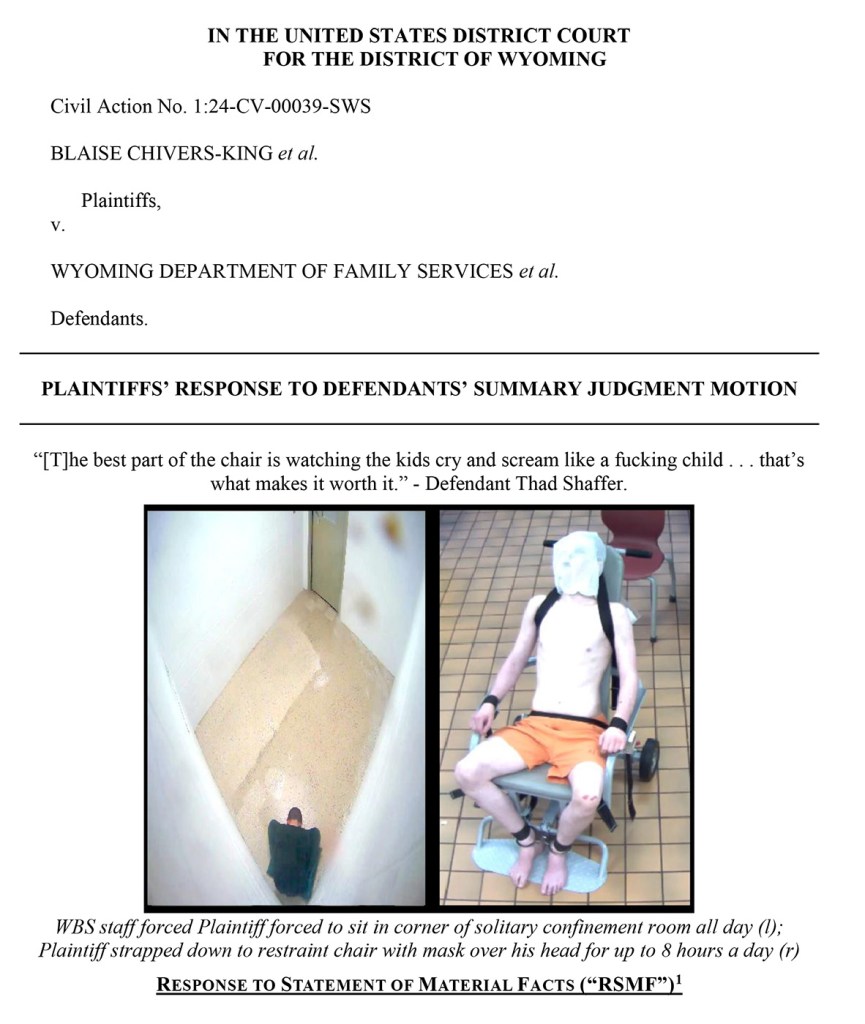
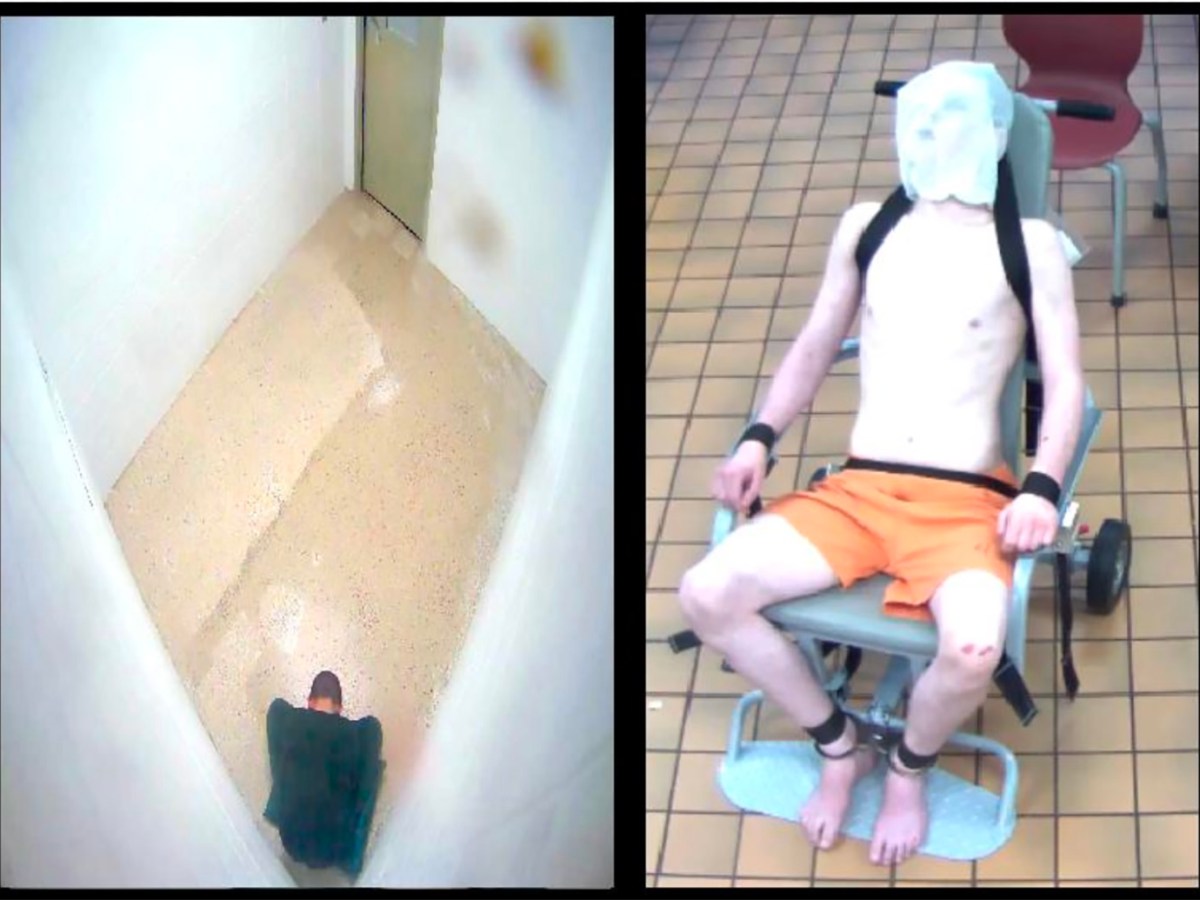
A June court filing in an ongoing lawsuit alleging abuse at the Wyoming Boys’ School, a state facility for delinquent juveniles, almost mirrors the 2009 paper’s preface, showing two side-by-side images, one of a boy in a restraint chair with a white bag over his head and another of him huddled alone in the corner of a cinderblock room. Above the images is a quote attributed to one of the defendants: “[The] best part of the chair is watching the kids cry and scream like a fucking child . . . that’s what makes it worth it.”
“I had never thought I would see a photo of a child with a bag over their head, like they’re being water boarded,” said Rep. Karlee Provenza, a Laramie Democrat who has advocated for juvenile justice reform in Wyoming.
It’s unlikely the images — which sparked outrage on social media — would have come to light if it weren’t for the lawsuit. For years, lawmakers and advocates have grappled with the lack of transparency around the Wyoming Boys’ School specifically and the state’s juvenile justice system more broadly.
Citing confidentiality laws, the Wyoming Department of Family Services, which oversees the boys’ school, has declined to release information about abuse allegations at the facility. DFS treats allegations of abuse or mistreatment at the detention center as Child Protective Service cases. Child Protective Services and the boys’ school are both under the auspices of DFS, meaning the agency investigates itself without oversight or transparency.
“We can’t trust the government to investigate itself,” Provenza said. “We’ve seen how that falls short, so it might be that it needs to be a broader conversation and not just targeted at DFS.”
A legislative catch-22
Lawmakers — those responsible for crafting laws that regulate the state’s juvenile justice system — also struggle to access data that could help them see more broadly how Wyoming’s juvenile justice system works. That’s because Wyoming doesn’t have a statewide system. Instead, each county takes a different approach, making it difficult to collect uniform data showing how kids move through the system and what outcomes they experience.
For years, legislators have sought new laws to standardize data collection on Wyoming’s juvenile justice system and allow DFS to share it. They hoped the data would show how children move through the system and what their outcomes are, which could help lawmakers pinpoint what’s working and what needs to improve.
But fears of government overreach have stymied efforts to pass legislation that would increase transparency. Some lawmakers who opposed these measures have suggested studying the juvenile justice system more before passing any laws.

“My recommendation would be that the Legislature take some time to really put together a good dive into the juvenile justice system and all of its programs together to be able to make one clear, concise bill that fixes a plethora of problems,” Casper Republican Rep. Jayme Lien told her colleagues before voting against a measure to change Wyoming’s confidentiality statutes.
That idea puts the Legislature in a catch-22: to study the state’s juvenile justice system, lawmakers need data. But when the Joint Judiciary Committee tried to do a deep dive into juvenile justice in 2021, it quickly realized that access to that data would require a statute change.
Lien didn’t respond to a message from WyoFile sent Monday inquiring about whether she had looked into the topic and had interest in supporting any related legislation this upcoming session if reelected.
Political will?
Juvenile justice reform isn’t an interim priority for the Joint Judiciary Committee this year. “It doesn’t need any study,” Rep. Art Washut, the Casper Republican who chairs the House Judiciary Committee, said. “We know what it is, we know what the needs are. It’s just a political will to pass legislation.”
“It’s always been very frustrating, sort of circular arguments that we haven’t done this, so we can’t do that,” Donna Sheen, the former executive director of the Wyoming Children’s Law Center, said. “But the bottom line is that we continue to leave children in really harmful places.”
When it comes to how children are treated at juvenile facilities, Wyoming’s current regulations are “pretty minimal,” Sheen said, and don’t differentiate between facility types. “So in that respect, there are very minimal expectations or rules around how children can be treated.”
Through materials provided in discovery, including depositions — testimony given under oath — images and records, the lawsuit against the boys’ school provides a window into what a child might experience at the facility. Besides providing images, the latest response in the case also includes new allegations that boys’ school employees were encouraged to downplay the use of force against residents in incident reports.
Excerpts from the plaintiffs' response to defendants' motion for summary judgement, filed June 12, 2026. (Illustration by Ryan Dorgan/WyoFile)“In light of what’s coming out from this lawsuit, it is clear that we need to make changes,” Provenza, the Laramie Democrat, said in a phone call.
What those changes might look like is unclear right now. “I think everyone is digesting what’s coming out from the lawsuit, and then trying to figure out: What are the policies that need to change within the agency? What are the guardrails that the state needs to put in place to protect kids?”
Provenza said over text that she’s “hopeful” other lawmakers “will see the need for statute changes” and will also be willing to work on juvenile justice reforms come the next legislative session.
More broadly, Provenza said she would also prioritize putting a version of past confidentiality amendment bills into statute. “Without that change in statute, we are going to have a difficult time evaluating any program effectiveness,” she said in a follow-up text message.
Governor, candidates react
Gov. Mark Gordon, who appointed DFS director Korin Schmidt, declined to comment on the specifics of the case when asked by WyoFile if he thinks Wyoming should have stronger guardrails on the use of solitary confinement and force against children in state custody and if the lawsuit’s allegations call for an independent review of the boys’ school and DFS’ oversight of the facility.
“Building upon the commitment I witnessed firsthand during my mental health town hall and visit to the Wyoming Boys School in 2023, the safety and security of the students and staff at the facility are paramount to me,” he said.
The governor said that he had been “in direct contact” with Schmidt, who “verified and assured” him that “the youth currently residing at the school are safe and receiving proper care.” He also mentioned that most of these allegations “were made roughly four years ago.” In 2022, WyoFile and the Casper Star-Tribune reported that the use of force, restraints and confined isolation had increased at the boys’ school.
Gordon will finish his final term as governor in November. There are four Republicans and a Democrat vying to replace him. WyoFile posed the same questions to these candidates.
“Wyoming needs a juvenile justice system that protects communities, holds offenders accountable, and ensures children in state custody are treated humanely, safely, and with appropriate guardrails that focus on rehabilitation,” State Superintendent of Public Instruction Megan Degenfelder, a Republican running for governor, said in a statement to WyoFile.
“I take these allegations seriously, children in state custody are the responsibility of the State of Wyoming.”
If elected, Degenfelder said she would “support an independent review” of the boys’ school, including its use-of-force policies, isolation practices, staff training, reporting and transparency for lawmakers and the public.
Republican gubernatorial candidate Brent Bien also said in a statement to WyoFile that he would support an independent review of the allegations. “These are minor children in state custody. As such, the state does have a duty to not only maintain order, but to also ensure accountability while still protecting that child.”
“Though I can not prejudge a lawsuit, as Governor, I would not ignore any allegations that involve excessive force, isolation, ‘restraint chairs,’ or any other actions that may harm children in state custody.”
Wyoming, he said, should have “clear guardrails” for juveniles in state custody. If elected, he would support legislation requiring reporting, “body/video records,” limits on isolation and restraints, trauma-informed training and regular oversight of “all juvenile facilities.” Bien said those measures should include “strong consequences” for violations.
“The recent allegations about the Wyoming Boys’ School are deeply concerning,” Sen. Eric Barlow, a Gillette Republican who served as Speaker of the House, said in a statement to WyoFile. “Every young person in the state’s care deserves to be safe and treated with dignity. Wyoming families want their kids close to home, getting help and support.”
In 2025, Barlow voted in favor of Senate File 157, “Department of family services-confidentiality amendments-2,” one of many attempts over the last couple of years to improve juvenile justice data sharing, before it died in the House Judiciary Committee.
Republican candidate Curt Blake did not respond to WyoFile by publishing time.
The state defendants in the boys’ school lawsuit have until Friday to file their reply supporting their request for summary judgement — when a court decides a matter before a case goes to trial.


Please note The United Nations Standard Minimum Rules for the Treatment of Prisoners, which include the following statements: “All prisoners shall be treated with the respect due to their inherent dignity and value as human beings.” … “The purposes of a sentence of imprisonment…are primarily to protect society against crime and to reduce recidivism. Those puposes can be achieved only if the period of imprisonment is used to ensure… the reintegration of such persons into society upon release so that they can lead a law-abiding and self-supporting life.”
Is the Wyoming Boys School a prison or a school? In either case, what is it’s purpose? How is it carry out that purpose?
Don’t believe everything you read. Remember, the residents of the Boys’ School would never lie, right? The mask is a spit/bite mask, not a “torture” mask. Some things do need changed for sure, particularly the removal of the current DFS director. Statistics have been collected and disseminated to the legislature for the last 35 years; however the legislature has failed repeatedly to review and act. It’s on you Cheyenne. New leadership is of paramount importance.
Gretchen, many times those masks/hoods are used following someone being pepper sprayed. People already in respiratory distress then having further restraints put on their ability to breath.
Yes, they are a torture device. There are numerous deaths of people in custody due to these methods.