


Republican candidates for Wyoming secretary of state shared their visions for the job and views on topics ranging from crossover voting to ballot drop boxes Thursday at a forum in Laramie.
Wyoming’s secretary of state post has risen in prominence in recent years as worries about election integrity and shady corporations have intensified. The secretary of state’s main responsibilities include overseeing elections and registering and authorizing businesses in the state. The secretary also serves on the State Board of Land Commissioners, State Building Commission, State Loan and Investment Board and as the chair of the State Canvassing Board.
Current Secretary of State Chuck Gray announced in December that he will seek Wyoming’s lone seat in the U.S. House.
This year, four Republican candidates are vying for the post, the state’s second-highest executive office behind the governor. Whoever wins the Republican primary race on Aug. 18 will face the lone Democratic candidate, Bryan McCarty, in November’s general election.
This will be Qwenton Eagle Oviatt’s first run for a political office. Democrat McCarty ran for U.S. House in 2022, but is also fairly new to politics.
The rest of the field has held public office or campaigned previously. CJ Young, a Cheyenne Republican and former field representative for U.S. Rep. Harriet Hageman, ran for the Wyoming House in 2014. Converse County Commissioner Robert Short, a Douglas Republican, ran for U.S. Senate in 2020, placing second in the Republican primary behind now-U.S. Sen. Cynthia Lummis. And Rep. Rachel Williams, a Cody Republican, has served in the Wyoming House since 2021 and chairs the Wyoming Freedom Caucus.
Oviatt, Short and Young participated in Wednesday’s forum.

“I’m running because Wyoming’s government is sick and it needs practical, collaborative leadership,” said Oviatt, a Fremont County resident and academic advisor at Central Wyoming College. “I believe we can secure our elections, protect our businesses from scammers, and bring people together instead of creating more divisions.”
Short, an entrepreneur who grew up in Glenrock, said he’s running because he believes that the office “requires leadership” that he would bring to the post. “I understand what collaboration means, and I understand what getting the job done actually means.”
Young was formerly the elections director for the Wyoming secretary of state’s office. “I bring a fairly wide background of experience with me, and I want to bring that to work in the secretary of state’s office. It’s something that I worked in before,” Young said. “It’s something I want to do, and I’m ready to get started on day one.”
The primary election is on Aug. 18.
Balancing business regulation and elections
The secretary of state is tasked both with business regulation and overseeing elections in Wyoming. The candidates had different priorities within these two mandates.
Short said he would prioritize business regulation over scrutinizing how Wyoming’s elections are run. “I think it’s important that we really take a hard look at how these folks are operating,” Short said of LLCs operating in Wyoming. On the other hand, Short said he believes that “devoting a great amount of time to elections is not necessary,” because county clerks and volunteers “do a spectacular job.”
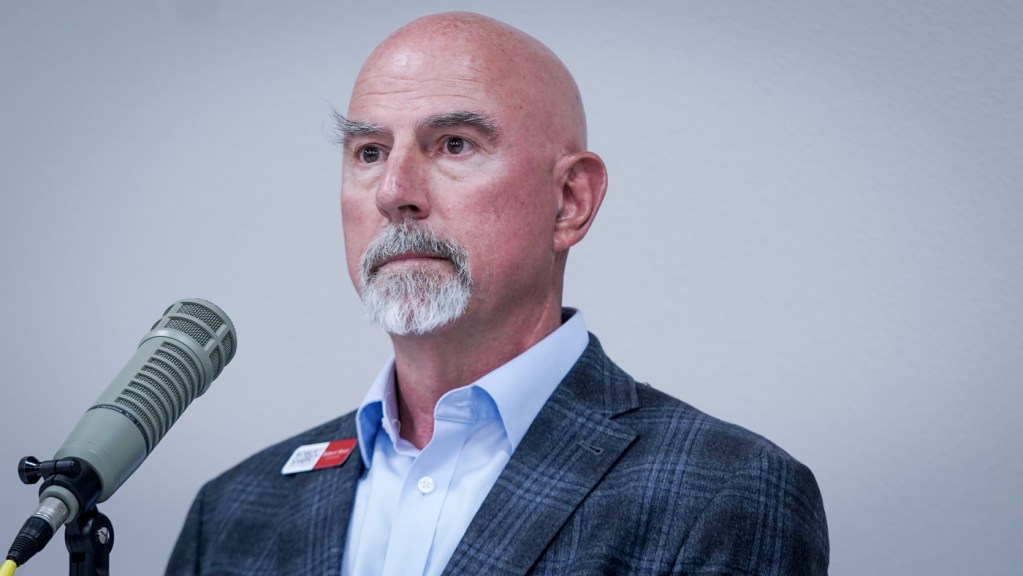
Oviatt and Young emphasized that this balance often depends on the time of year, with election years being necessarily more focused on the elections administration side of the secretary’s responsibilities. “The business regulation side of it is very important too,” Oviatt said. “There’s a lot of fraud in there, and that is going to be something that the next secretary of state is going to have to start tackling day one.”
Young, who helped set up Wyoming’s election security task force, said he believes “there are real threats to our elections,” such as cybersecurity threats. “We need to restore people’s trust in those elections through showing them that they can trust it,” Young said. “We also need to partner with the clerks. They are great resources. We can trust them.”
On the business side, Young said the office needs to “get some new software in there” to “free up some staff time.” He wants to create a new position in the office to investigate bad business actors in the state.
Ballot drop boxes
Since allegations of widespread voter fraud came about after the 2020 elections, politicians across the country have advocated banning ballot drop boxes.
That includes Gray, Wyoming’s current secretary of state, who centered his 2022 election campaign on election integrity and has pushed repeatedly for Wyoming to ditch its ballot drop boxes, alleging that they are vulnerable to voter fraud. County clerks, meanwhile, maintained that drop boxes are safe and secure.
The three candidates said they support secure ballot drop boxes.
Changing political parties
Wyoming used to have a partially open primary election system. While voters were restricted to casting ballots in races that aligned with their political party affiliation, they were allowed to change their affiliation on Election Day and during most of the early voting period.
But that changed in 2023, when Wyoming lawmakers passed a law that requires voters to affiliate with a party before the slate of candidates has been finalized in order to ban what’s known as crossover voting. The Wyoming Supreme Court is currently mulling the constitutionality of this ban.

Short and Oviatt support allowing voters to change their party affiliation at any time, while Young does not.
Absentee voting
Wyomingites can request an absentee ballot, which allows them to mail in or drop off their completed ballot to their county clerk’s office. Absentee voting is popular in Wyoming. At least 45% of the state’s registered voters cast their ballots absentee in the most recent election. However, President Donald Trump has aggressively advocated for drastically limiting mail-in voting, which he claims leads to cheating.
All of the candidates said they support absentee and mail-in ballots. “We should make voting as easy as possible in Wyoming,” Short said.
Hand-counting ballots
Politicians in Wyoming and across the country have called in recent years for hand counting election ballots and banning electronic election equipment used for tabulating votes. Those calls have intensified after Weston County Clerk Becky Hadlock used a combination of correct ballots and misprinted ones in the 2024 general election, which resulted in an initial miscount in the House District 1 race.
The candidates said they aren’t fans of hand counting ballots, but support it in some circumstances, such as counting a small portion to audit results.
Ballot collecting
Wyoming lawmakers have attempted to ban what some call “ballot harvesting,” the practice of dropping off someone else’s completed ballot, echoing calls to ditch the practice over concerns about election integrity. All the candidates said they would support allowing people to drop off other people’s ballots as long as all rules are followed.
“Some people, especially in retirement homes, they definitely need that,” Oviatt said.
Who should manage elections?
In recent years, state and federal officials have clashed over who should steer how elections are conducted.
The U.S. Constitution vests the power to determine the “times, places, and manner” of elections with the states. But President Trump has pushed to take some of that power, issuing an executive order that would have required documentary proof of U.S. citizenship to register to vote and restricted mail-in ballots. A federal court declared parts of the order unconstitutional.
The candidates all believe that the federal government has no business mandating how elections are run in states. They emphasized supporting election administration at the local level by helping county clerks.
“It turns out that each individual county has their own personality and their ability to run elections that suit the constituency of that county,” Short said.
“I think our clerks do a great job,” Young said. “I work with many of them personally. I trust them. They’re great people. They do good work, and they care about their communities.” Young and Oviatt said they want to create a new training position in the secretary of state’s office to help local staff learn the ropes of running elections.
“I think it would be the job of the secretary of state to help them in whatever they need,” Oviatt said of county clerks. “They are asking for more training. I’ve heard that from several of them.”
Managing school land trusts and investments
Five statewide elected officials, including the secretary of state, sit on the State Board of Land Commissioners, which administers more than 3 million acres of school trust lands scattered throughout every county in the state. The board is responsible for managing these lands and investments to maximize income for the state through leasing.
That means the secretary of state and the other board officials must at times weigh opposition to projects from residents and other politicians. Some industrial projects that the board has recently approved have drawn significant public opposition.
The candidates emphasized that the board is mandated to manage these lands to maximize revenue. Young said he believes it’s important that the board members “measure each decision based on the facts, not just on politics.” Young and Oviatt said those decisions should be made collaboratively and measured on “a case-by-case basis.”

Short agreed, adding that he envisions helping the Legislature devise ways to encourage project owners to involve locals before bringing their proposals before the board so that “locals have an opportunity to be heard.”
Business regulations
Wyoming’s current business registration system leaves gaps that can allow bad actors to anonymously set up shop in the state. Reporting by the Washington Post linked several registered agents in Wyoming to companies facing accusations of wrongdoing in international court cases. Gray, the current secretary of state, has urged lawmakers to tighten business registration regulations, particularly after his office dissolved three Wyoming entities flagged as instruments of North Korea by the Federal Bureau of Investigation.
While the candidates emphasized that they want Wyoming to be business friendly, they agreed that existing laws leave Wyoming vulnerable to sketchy actors.
Oviatt said he envisions implementing “top-tier screening software” to “catch some of these fraudulent factors on the front end of things.” Young also suggested using software to flag suspicious businesses.
Short emphasized working with the Legislature to introduce new laws that strengthen business regulations. Both Oviatt and Young said they would create a new position in the secretary of state’s office to investigate bad business actors in the state.

Folks, relax! Rodriquez was busy investigating the Rebecca Bextel checkgate situation. You know, the passing of money on the legislative floor which Rodriquez deemed an illegal bribe. That’s why should couldn’t attend this silly, meaningless debate. We’re waiting on your results of the investigation Rodriquez!
Unfortunately, unlike other League of Women Voters forums, this one did not include questions from the audience. That was a disappointment. Would like to see a format which included questions from the public, especially in the upcoming school superintendent candidates’ forum.
Not …one…word… about the conspicuous absence of candidate Rachel Rodriguez-Williams. The ex-California virulent Park County representative who became the chairman of the virulent Wyoming Freedom Caucus is also running for the state’s 2nd highest elected office, the Vice Governor. Where was she ?
Please, WyoFile, try to get Rachel R-W on the record on these and other issues. Or at the least, explain why she won’t participate in public forums. Being a gadfly towards her , I can personally attest that Rachel does not want to hear from any of her constituents who don’t pass that ridiculous Republican 80% Purity Test. She won’t listen to you on the front end , nor will she respond on the back end to any phone messaging , e-mails , texts, or snail mail.
I’m sure that privately the WyoFile reporters would tell you the same when it comes to getting RRW to engage. She really does not like WyoFile or Wyoming Public Media ( whom she supported fully defunding in the UW package last session). I also suspect RRW has no love for the League of Women voters either.
It is incumbent on the state news media to get Rachel to speak up and share discourse, starting here. I’m sure the conservative MAGA-tinted Cowboy State Daily semi-private heavily biased news channel can likely get Rachel to expound. But she’s running for Lieutenant Governor-Secretary of State, a high and powerful elected office. She has an obligation to speak up , reach out, and be responsive. So—-????
Dewey, I’m sure you’ve already seen this but, the extremely negative comments regarding Rodriguez on her own HD facebook page are quite entertaining. It makes for fun reading with your coffee each morning. I’ve tabulated that about 98% of the commentators are 100% against RRW and MAGAstein/freeDUMB. She’s been asked some hard questions on FB with not a peep, so not surprised that the Californian would bow out of an open debate
… and she blocked me from her Farcebook page . Guess she doesn’t appreciate the constant buzzing of a Gadfly flitting in earshot.
As others have stated, Rachel RODRIGUEZ Williams is really bad about communicating with her constituents. She only discourses with her ilk.
It appears that candidate Rachel Rod-Williams, Rachel Rodriguez and/or Rachel Williams (yep, bonus package of 3 in 1) wisely declined participation in this debate. you know, be considered a fool or open your mouth and leave no doubt. So no ready for prime time but regardless of who you support for Sec of State, kudos to the ones that showed up
I thought that it was interesting the neither of the freedom caucus affiliated candidates showed up. I guess that they didn’t want to answer the hard questions.
What, wait, where was the Trump/Epstein candidate, the artist formerly known as Rodriquez? Rachel RODRIGUEZ Williams has gone to great lengths to hide her hispanic heritage in this race yet can’t make the effort to attend this debate? RODRIGUEZ, you’re tenure as House Rep 50 was pretty dismal and believe me (plus the voters on August 18th), the position of Secretary of State is WAY OVER YOUR HEAD. Go back to California and take the MAGAts and NonFreeDUMB dips back with you
I’m amazed that ‘election integrity’ is still an issue. Actually it was never a real issue, but instead a way to obscure the fact that the orange menace lost an election. He (trump) sure did pull the wool over the eyes of MAGA.