


About a week before President Donald Trump’s Fourth of July signing of the One Big Beautiful Bill, the co-chairmen of the Wyoming Legislature’s Joint Appropriations Committee made a request of the state’s congressional delegation.
Rep. John Bear, R-Gillette, and Sen. Tim Salazar, R-Riverton, asked the delegation to consider either amending the bill or bringing future legislation to avoid a $50 million annual revenue loss for the state.
In return for the bill’s rate reduction to federal mineral royalties for coal, the two lawmakers asked that Wyoming get a larger slice of the pie that’s usually split down the middle with the feds.
“Thank you in advance for any efforts to consider the financial impacts on the distribution of these revenues and align a revision to the federal-state share in harmony with the proposed royalty rate reduction,” Bear and Salazar wrote in a June 25 letter obtained by WyoFile.
Companies pay royalties to the federal government for minerals extracted from federal lands. Generally, those dollars are split 50-50 between the feds and the government of the state in which the mineral production took place.
In Wyoming, those royalties have long built schools and paved roads, and they continue to help fund K-12 education, city and town services and the University of Wyoming.
The Big Beautiful Bill, however, reduced the federal royalty rate for coal from 12.5% to 7%. Supporters of the legislation, including Wyoming’s delegation, hailed the reduction as a way to boost coal production. But state forecasters estimate the rate reduction will cost Wyoming roughly $50 million in annual revenue, and it’s not expected to be offset in state coffers.
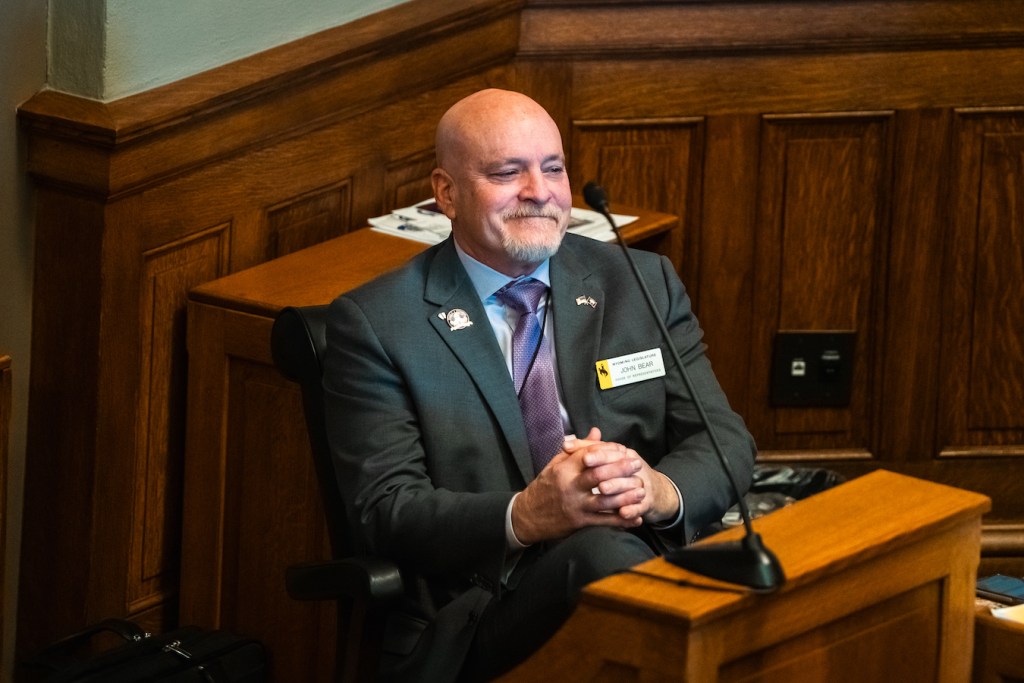
The coming revenue hit concerned Rep. Bear, former chairman of the Wyoming Freedom Caucus.
“Enough so that I sent a letter to our Federal delegation asking them to change the percentage split between the feds and the state,” Bear said.
More specifically, Bear and Salazar asked the delegation to consider either amending the Big Beautiful Bill or crafting separate legislation to temporarily modify the mineral royalty sharing from its traditional 50-50 distribution to a share that would give 12.5% to the feds and 87.5% to Wyoming.
No amendment was made, but Sen. John Barrasso’s staff responded with a letter, telling state lawmakers they would look into it. Plus, Bear said there are plans to follow up with the delegation to see if they are interested in running a bill.
To be clear, Bear said, he supports the rate reductions.
“That move is similar to our cutting their severance tax,” he said. “Unfortunately, it puts us in a bigger bind on school finance.”
Education funding
Extractive industries pay severance taxes to Wyoming for removing, extracting, severing or producing minerals. Like royalty dollars, severance taxes are in part used to pay for education.
In 2022, the Legislature reduced the state’s severance tax rate from 7% to 6.5% before reducing it once more to 6% earlier this year. Together, the two bills cost the state $20 million in annual revenue loss, while their stated purpose was to boost coal production, which has dwindled from its boomtime days.
Efforts like the rate reduction and the severance tax cuts “improve the competitive environment for coal production from Wyoming’s world-class mines and offer the promise of extending the financial viability of robust Wyoming coal production well into the future,” Wyoming lawmakers’ letter states.
Still, Bear and Salazar wrote, modifying the rate share “is consistent with long-standing concerns to avoid reductions to Wyoming’s revenue generated from coal, oil and gas from administrative fees, congressional sequestration, and similar efforts to reduce Wyoming’s revenue from our treasured extractive resources.”
U.S. Sens. Barrasso and Cynthia Lummis and U.S. Rep. Harriet Hageman did not respond to WyoFile’s request for comment.

This looks like a never ending spiral. In addition to a reduction in air quality regulation, the coal lobby also has secured a reduction in the royalty on extraction to coincide with a reduction in the rate of state severance taxes. Whatever happened to the late Stan Hathaway’s proposition that it was to be “. . . development on our terms”? The state’s Congressional delegation needs to be more forthcoming as to how this has happened on their watch.
In the “good old days” we used to have people in Congress who actually thought it was important to serve the people of the state. They knew if they failed to deliver they stood a good chance of not being reelected.
Now we have an electorate that only cares about “owning the libs” even if the resulting actions are harmful to the state and themselves. So no one should be surprised that the 3 Trump stooges didn’t stand up for the state.
Excuse me. Who voted for President Trump? Who voted for the members of our sycophantic Congressional delegation? Wyoming legislators themselves have voted to reduce revenues from our state’s “treasured extractive industries” when years of data and experience demonstrate that reducing taxes and royalties result in nothing except – duh – reduced revenues.
Elections have consequences.
Again, your three federal goofballs stabbed you in the back.
So, the Federal government cuts the gross Coal royalty rate by 44 percent, yet Wyoming’s Republican ruling faction wants a sharp increase in the State’s net yield from it. Yet they reduced the State-only royalty rate How does all this work ? Wyoming Freedom Caucus fiscal economics is oxymoronic on its best day.
Then they try to explain it. The words fail.
Has it ever mattered to any Wyoming Republican in this milennium that reducing taxes royalties and fees on minerals has never resulted in an increase in production of same , or revenue generated from..?
I have been assured by right wing media that the reduction in coal severance is akin to putting that energy source “on sale” which will lead to much higher revenues in our coffers.
The party of managing wombs and bathrooms does not seem to yield the best results when it comes to real world.
Back before the 17th Amendment, we put in Senators that had to care about the State, but now that Lummis and Barrasso are funded by outside interests they have to deliver for those that pay for their services. People have been convinced that democracy produces the best results, but at one time, every 6 years, the Governor and the State Legislators could weigh in on a Senator’s service to State of Wyoming but the rich figured out how to break that bond in 1913. It only takes the purchase of 51 Senators to wreck America as we are witnessing first hand.
The rightwing goofballs are getting exactly what they voted for-chaos and grift.
So….we get nothing? The Bear guy begs and…Wyoming will get little to nothing. 🙄
“Sen. John Barrasso’s staff responded with a letter, telling state lawmakers they would look into it.” Yes – I have many, many, many EMAIL responses from Barrasso that say the same thing. And Lummis and Hageman.
Well, the BBB was a tax cut, right?