

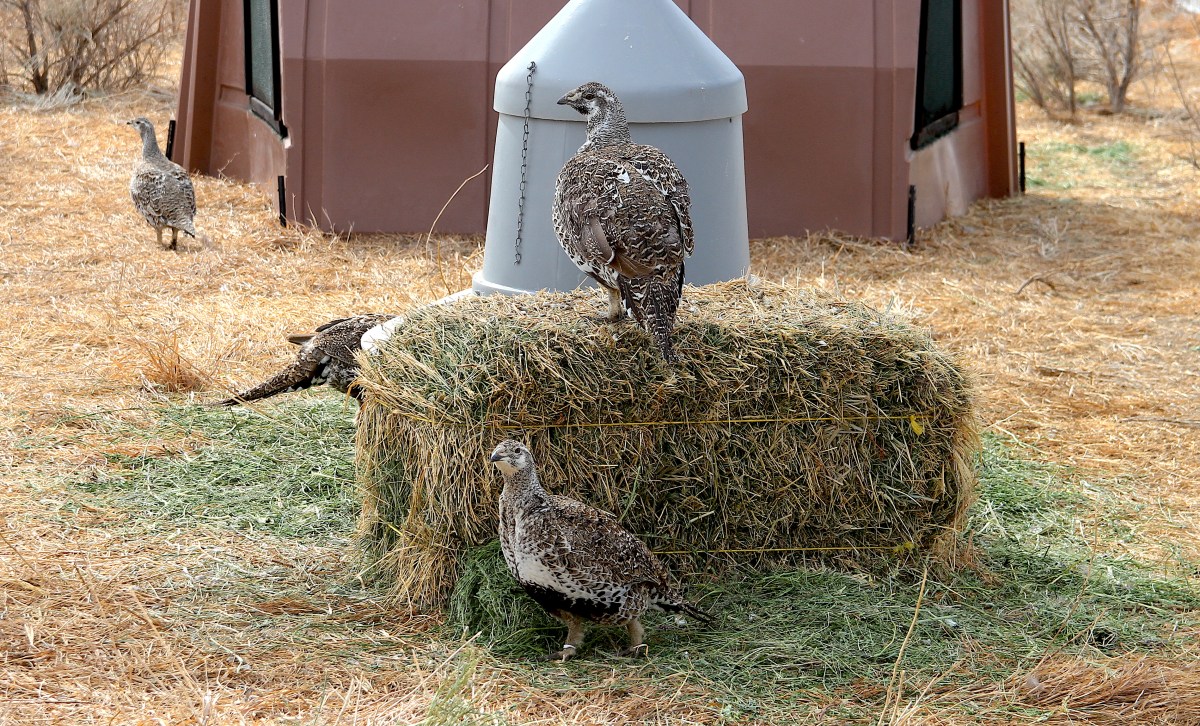
POWELL — Owls were to blame for the sage grouse carcasses that littered the grassy flight pen floors some mornings.
At night the birds of prey would perch atop the pens. With an innate fear of raptors, their netted-in quarry would flee. The captive grouse raised by the Diamond Wings Upland Game Birds are forceful fliers, and the ensuing collisions with their fenced boundaries often proved fatal.
Diamond Wings Manager Karl Bear, who’s dedicated the last year to collecting eggs, hatching and raising the iconic grouse of the high desert, hasn’t kept a precise collision-killed bird headcount. But until troubleshooting solved the problem, strikes were the largest factor that trimmed his flock from 114 healthy, hatched chicks down to the 51 yearling adults that remained alive in mid-March, he said.
“They have powerful wings, and they would get a lot of momentum,” Bear said. “They maintain their wild [instincts] and they’d fly up and hit their heads. That was pretty difficult.”
But at least, he added, the grouse weren’t getting decapitated. That happens. An owl or hawk learns to land on the pens and the panicked farmed game birds fly up into the netting, which is only large enough to admit their heads. Deadly talons await.
“They flush them, and pull their heads off,” Bear said. “So there’s 10 chukars laying there headless, because they snip them off.”
Bear didn’t want to chance raptors decapitating his prized sage grouse, so he went with inch-wide netting instead of two. That worked to keep sage grouse intact. He solved the collision deaths, too, using a two-part strategy: fitting solar-powered, blinking Nite Guard lights to the pens that deterred owls and installing cloth windscreens that discouraged the grouse from hard flushing.
“Little things you learn, you know,” Bear said. “Just trial and error.”
While small adjustments have helped Bear bring successful sage-grouse farming arguably within sight, plenty of controversy and attention still circle his endeavor, which is partly bankrolled by the oil and gas industry.
During the Wyoming Legislature’s recent budget session, several conservation and hunter advocacy groups made contesting Senate File 61 – Sage grouse game bird farms-extending certification expiration-2 — a bill that would keep grouse farming legal — a top priority. State wildlife officials have stayed neutral, but numerous unaffiliated biologists contend that farming sage grouse to augment wild populations — the ultimate goal — is a bad idea that’s been tried before, does not work and does not address the actual habitat-related root cause of the species’ decline. Still, the proposal to allow Bear to keep grouse farming for another five years sailed through the statehouse and was signed into law by Gov. Mark Gordon on March 15.

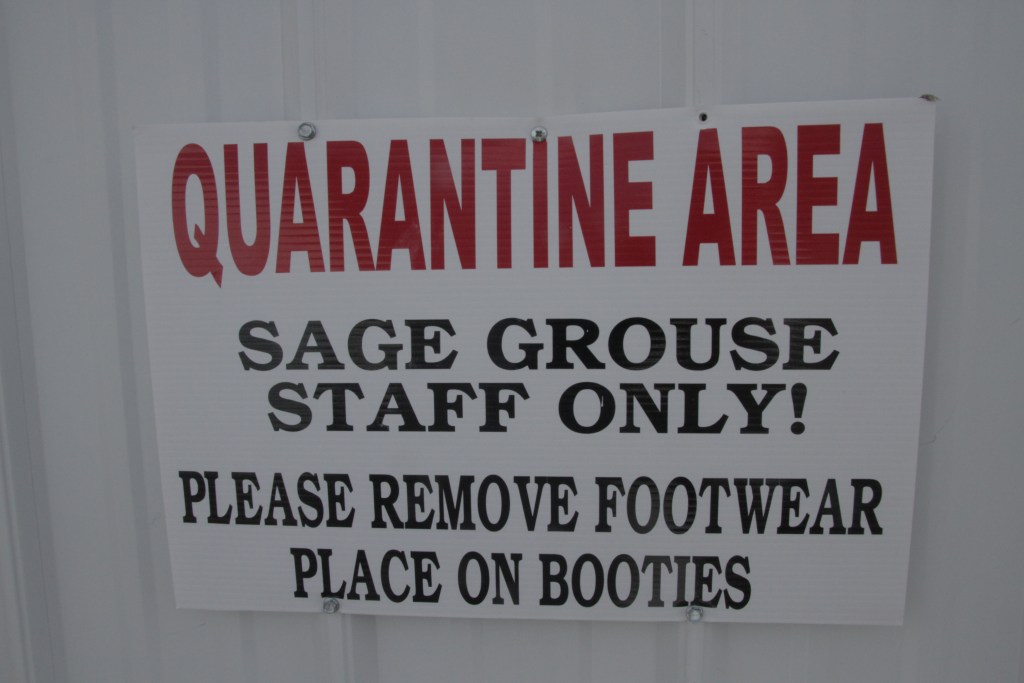
So more than 50 domestic, yet still majestic, sage grouse remain in the 300-foot-long flight pens rising off the prairie between Ralston and Powell — as does the one optimistic aviculturist who’s doing everything he can to help them stay alive and mate.
“Our hurdle is just breeding right now,” Bear said. “And the next step is to raise them [with wild instincts].”
Done this before
The greater sage grouse is a trickier species than most to raise in captivity. While some breeding operations pump out popular game birds like pheasants by the millions, there have only been a few efforts to compel the sagebrush-dependent, chicken-sized birds to live and breed in captivity.
Thirty-seven years ago, one of those efforts unfolded in the high plains south of Laramie at the University of Wyoming’s Red Buttes Environmental Biology Laboratory. Cheyenne biologist Greg Johnson headed that effort in 1985 and ‘86 for his graduate studies. After gathering 142 eggs and 73 chicks from the wild, he was able to establish a functional population. Johnson achieved solid survival: 84% of the hatched and captured chicks survived until they could move to outdoor pens, then 91% of those birds survived the flight pens. But it wasn’t easy.
“They’re very difficult to raise in captivity,” Johnson said. “You never see sage grouse in a zoo, and there’s a reason for that.”
Keeping the captive birds healthy and alive was a labor-intensive puzzle, he said. Johnson cut truckloads of sagebrush in the winter to feed them. He’d collect insects to emulate chicks’ natural diets. Cleaning their pens took a ton of time, he said.
The effort was rooted in scientific inquiry: Johnson was investigating how a pesticide, widely applied aerially at the time to kill grasshoppers, was affecting sage grouse chicks, which depend on bugs. But in the process he pioneered domestic sage-grouse rearing techniques.
“I think I was the first one that successfully produced chicks,” Johnson said. “Other people were trying, and they just had very little success at all.”
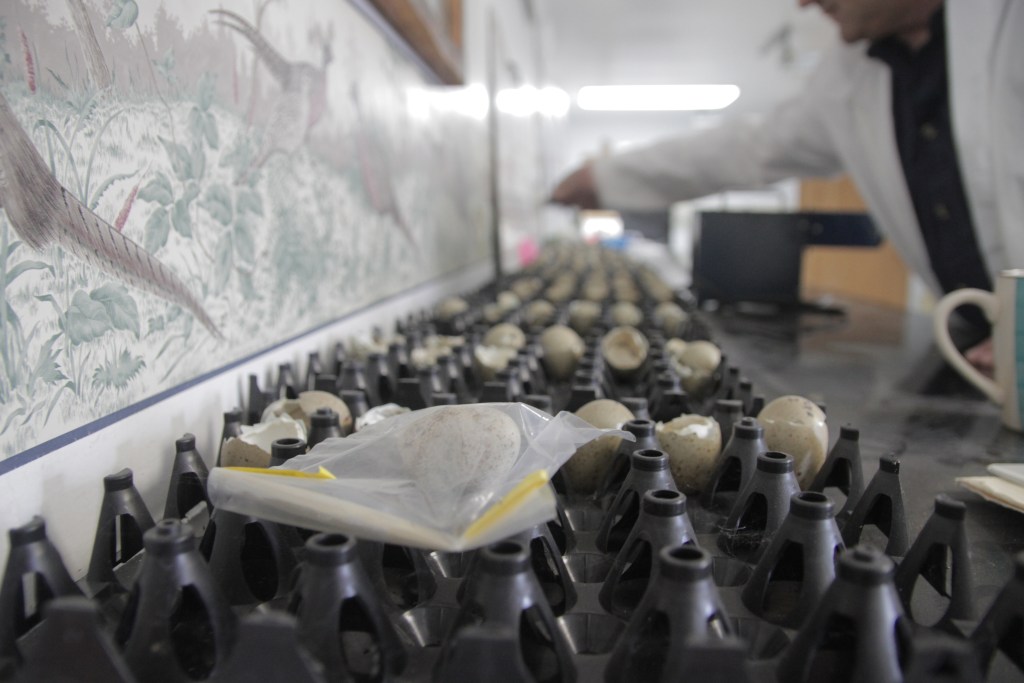
Johnson and his advisor, former University of Wyoming professor Mark Boyce, even got them to breed, a task complicated by sage grouses’ elaborate displays and need for open lekking grounds. In all, eight of the sage hens laid clutches. But of 41 eggs, only 13 hatched and 11 of those chicks died within a few days, he said — most succumbed to a bacterial disease. Just two survived.
‘Doesn’t work’
Producing captive-raised sage grouse that can survive in the wild is another challenge. The track record isn’t good. Boyce, who’s since moved on to become an ecology professor at the University of Alberta, relayed the results of the Calgary Zoo’s captive breeding program, which has released 187 sage grouse so far.
“They release the birds in the wild, and they just die,” Boyce said. “They have had very, very low success: One bird that made it to breeding season and laid a clutch.
“It just doesn’t work,” he added.
“They release the birds in the wild,
and they just die.”
former University of Wyoming biologist Mark Boyce
Even facing that dismal track record, Bear, a 25-year game-bird-industry veteran, has hope that he can instill sage grouse chicks with the predator-avoidance savvy and other life skills they’ll need to stay alive.
“Our goal is to raise a good, healthy, wild bird,” he said. “We’re probably not there yet, but I think we’ve improved with every year.”
But Boyce, Johnson and other biologists who testified in Cheyenne this legislative session all made the point that releasing birds doesn’t address the underlying cause of the species’ decline.
“The bottom line is you’ve got to have good habitat,” Boyce said. “People just don’t seem to appreciate sagebrush habitat. It’s been under assault forever. Sage grouse, they depend on it, they have to have it, so it’s not surprising that we’re losing sage grouse in many areas.”
University of Wyoming postdoctoral researcher Chris Kirol, who studies sage grouse, testified that grouse farming was a “distraction” from habitat issues and a waste of resources.
“The odds of these females surviving in the wild are extremely low,” he said, “and then the odds of them actually being able to raise chicks, even lower, because they have nobody to learn from.”
What’s left?
Experts estimate between 200,000 and 500,000 birds remain in sage grouse’s 11-state range. Wyoming holds the largest chunk of those. There’s been an 81% decline over the past 53 years, according to the U.S. Geological Survey and past petitions to federally classify the bird as threatened under the Endangered Species Act.
Wyoming Game and Fish Department Director Brian Nesvik, who maintained a neutral stance on the grouse farming bill, told a legislative committee mid-session that the state has maintained a “healthy sage grouse population” that is at “the bottom of a trough” — the low point of a naturally occurring cycle.
But former Game and Fish sage grouse biologist Leslie Schreiber has expressed more concern. She told WyoFile in January that ratios of hens to chicks sage grouse hunters shot last fall suggest the population has not necessarily bottomed out, and that numbers have charted into concerning territory.
“Based on the data in hand, Wyoming sage grouse populations are heading back to mid-1990s levels, which is alarming,” Schreiber said. “This is particularly concerning because it does not follow the historic patterns of population cycles in the state.”
Schreiber, who resigned in the weeks after making that statement, declined an interview for this story. But her predecessor, Tom Christiansen, testified in opposition to the grouse farming extension, detailing numerous concerns.
Habitat protection has been the centerpiece of Wyoming’s sage grouse conservation policy.
An Endangered Species Act listing, which could further restrict extractive industries’ use of core grouse habitat, could have “devastating” implications for Wyoming’s economy and the state’s revenue streams, Diamond Wings Upland Game Birds’ former owner, Diemer True, said.
True, a former oil industry executive, created a nonprofit, the Western States Sage Grouse Recovery Foundation, that is underwriting the grouse farming effort. The endeavor had cost $550,000 as of mid-March, money that’s been sunk into GPS-equipped tracking backpacks to aid in finding eggs, pen improvements, food and other expenses. Diamond Wings and the Foundation, True said, don’t expect to recoup the cash via the commercialization of sage grouse.
“It’s never going to pencil out,” he said. “This is a philanthropic effort and a research effort, but there’s no way the foundation gets reimbursed.”
True said his interest in supporting grouse farming is not related to his industry ties, but out of concern for Wyoming’s general wellbeing. “I’m no longer a part of the oil industry,” he said, “and I’ve moved on from that.”
Industry support
The Sage Grouse Recovery Foundation is guided by a board of four who all have energy-industry ties. The Petroleum Association of Wyoming and other land-use industry groups, like the Wyoming Stock Growers Association, supported the grouse-farming permit extension. Such range-reliant sectors stand to be the most directly impacted by an Endangered Species Act listing or a habitat-focused conservation regime. Donations to the foundation are not listed on its IRS 990 form. True described donors as people he knows: “They’re not all oil and gas,” he said.
Gov. Gordon’s office was “generally supportive” of continuing grouse farming, Chief Energy Advisor Randall Luthi testified in Cheyenne. That’s a departure from the stance of former Gov. Matt Mead, who let the initial 2017 sage grouse farming bill become law without his signature due to “considerable reservations,” according to a letter he released at the time.
“This is a job half done,” Luthi told members of the House Travel, Recreation, Wildlife and Cultural Resources Committee. “There’s a chance to get more science, more of what we learn, more of what might be possible.”
True and Diamond Wings’ current owner, petroleum engineer Dennis Brabec, have sought out scientists who could conduct bona fide research at the facility.

“We’ve reached out to a number of other foundations, the University [of Wyoming] and Northwest Community College, and none of them have wanted to take it on,” True said.
NWC President Lisa Watson recently told the Powell Tribune the grouse farming effort was “irrelevant” to her school’s coursework.
University of Wyoming professor Jeff Beck, who has been studying sage grouse in Wyoming since 2007, said his research focuses on wild sage grouse and sage grouse habitat in wildland settings.
“The work they’re doing, who does that kind of work?” Beck said. “Well, it’s really more in the realm of zoo biology.”
Silver lining
Advocacy organizations like the Wyoming Wildlife Federation, Theodore Roosevelt Conservation Partnership, Wyoming Outdoor Council and others pushed hard against SF 61 in Cheyenne during the Legislature’s budget session. Their pleas captured national media attention.
“The frustration was that it was perceived that there was an anti-industry push behind this bill,” Wyoming Wildlife Federation Advocacy Coordinator Jessi Johnson said. “Our problem with this bill was that it was incredibly broad, and had very little to do with the one farm that actually got up and running.”
One silver lining, she said, was that the Legislature agreed to only extend grouse farming’s legality for five years — initially there was no sunset.
Ultimately, the phalanx of conservationists, standing shoulder to shoulder with wildlife scientists, could not sway legislators voting on an issue being pushed by True, a former Wyoming Senate president with well-established connections.
In its final vote in the Senate, only four senators opposed it: Cale Case (R-Lander), Mike Gierau (D-Jackson), Chris Rothfuss (D-Laramie) and Tim Salazar (R-Riverton). Three-quarters of the House voted to let Diamond Wings continue its work following pleas from the floor for reconsideration.
“We’ve got a new [presidential] administration in there now,” Rep. Chuck Gray (R-Casper) said from the House floor. “I do think this policy makes it more likely for listing than not, because it allows them to say that we’re doing something out of line or experimental. I could see the current atmosphere in our nation’s capital leading to that.”
Gray’s sentiment matches anti-grouse-farming rhetoric that’s come from the Bureau of Land Management’s headquarters in Washington, D.C.
“If we would have to farm a species in order to keep it alive, that tells me we’re failing,” BLM Director Tracy Stone-Manning recently told High Country News.
Mimicking nature
Outside of Powell, Bear now has until 2027 to get his 51 remaining sage grouse to breed in captivity. In recent weeks some of his birds half-heartedly displayed, but it has fallen short of full-fledged mating dances, he said, which could be because of the birds’ suboptimal yearling age.
“More and more the males are strutting,” he said, “but they don’t have the prominent white chest [plumage] of the ones out in the field.”
Bear has gone to watch wild sage grouse court hens on a Bighorn Basin lek more than once this spring. His last time out there were 25 or so males puffing their yellow chest air sacs and strutting flamboyantly. At one point a raven flew over the top of the lek and started “crowing like crazy.” Unlike in the flight pens, the flock of grouse had an easy escape route: the open air.
“The whole bunch of them took off, other than three birds,” Bear recalled. “They just disappeared.”

I wonder if raising them to the fledgling stage and releasing them with a mom at that point wouldn’t be worth a try? Possible integration into existing group? I don’t know at what age they are dying off though but think it is survivability of clutch but at what stage do they pass most critical? I also think in the wild that predation by skunks, coons, coyotes and raptors are a greater issue than some of the other causes people mention but that those ‘other’ do have some degree of influence on numbers.
The ferret program was a success I hope this will be too .But sage grouse need habitat more then anything . And no body wants to protect that . We over graze it develop it put power lines across it . And allow birds of prey to eliminate them . A raven has more protections then a sage grouse.
I don’t believe the blackfooted ferret reintroduction program has been successful, but time will tell. Ferrets need intact prairie dog colonies. Bubonic plague takes out the dog towns. Cowboys and cows don’t get along very well with prairie dogs.
A few years ago in SD, on state land, I saw prairie dog poison pellets broadcast on a dog town. This was a illegal application and a violation of the pesticide label. No action was taken against the person responsible.
My education is in natural resources. The sage grouse is a specialist species which is dependent on a specific habitat. As such, they are very difficult to bring back from the brink. As one contributor stated, “putting lipstick on a pig”, although the pig is Mr. True. As a person that has is interest in profiting in many ventures, including politics and bird farming, it it only goes to reason that he should show a sympathetic hand. What better way than to play his political hand.
It Ain’t Gonna’ Work!
Oh, to the reader that commented on getting rid of cattle. Cattle filled the niche of the bison, sage grouse depended on bison then just as the do by cattle under proper grazing.
Good article. Again raises question as to why states like Wyoming think they should be more in charge of implementing laws such as the Endangered Species Act–states would make them more endangered.
Sage Grouse are not like Pheasants. They cannot be raised domestically and turned out expecting to survive. The chicks learn from their mothers, absent a mother they do not learn how to survive. It’s pretty simple, in order to thrive Sage Grouse need large patches of uninterrupted sage habitat. Power lines attract raptors, water impoundments attract skunks, cut throughs for roads destroy sage brush, compressor stations interrupt calling on a lek. Sage brush needs 50 to 100 years to reestablish from disturbance. The try to raise Sage Grouse domestically just reduces numbers since the eggs come from native nests. The chicks are doomed to failure. It all pretty simple.
Mr.True, thank you for your help efforts.
If you remove cattle from the range, you could have more here tomorrow to replace them. Remove a native wild species and its gone forever.
Thank you for the background on this critical issue.
Putting lipstick on a pig…. absolutely a crazy waste of money and time. I swear to God, these legislatures are full of half-wits.
What a great plan! Now we can raise Sage Grouse like chickens and not have to worry about saving all that prime habitat. Our children and grandchildren will really thank us for this.