
A bill to require school districts to adopt policies restricting cellphone use in classrooms advanced out of legislative committee Monday.
The Senate Education Committee voted 4-1 to send Senate File 21, “Ban on cell phone use in schools,” to the floor for consideration by the whole body, but not before softening the language to read “restrict” instead of the original “prohibit.”
The measure comes amid a bipartisan trend of new limits on smartphone and social media use in schools. Nearly 20 states, including California, Oklahoma, Minnesota and Florida, have passed laws or enacted policies that either ban or restrict students’ use of cellphones or recommend local districts enact such policies.
Sponsor Sen. Wendy Schuler, R-Evanston, a retired teacher, said she was inspired to bring the bill by a common teacher complaint that policing phone use has become a classroom nightmare. She cited data on the harmful mental health effects of social media and the hours of screentime many teenagers experience.
“When we talk about trying to do good things for our kids in education, I think this might be one of the most important things we can do for our students,” Schuler said.
The bill zeroes in on restricting use just during “instructional time.”
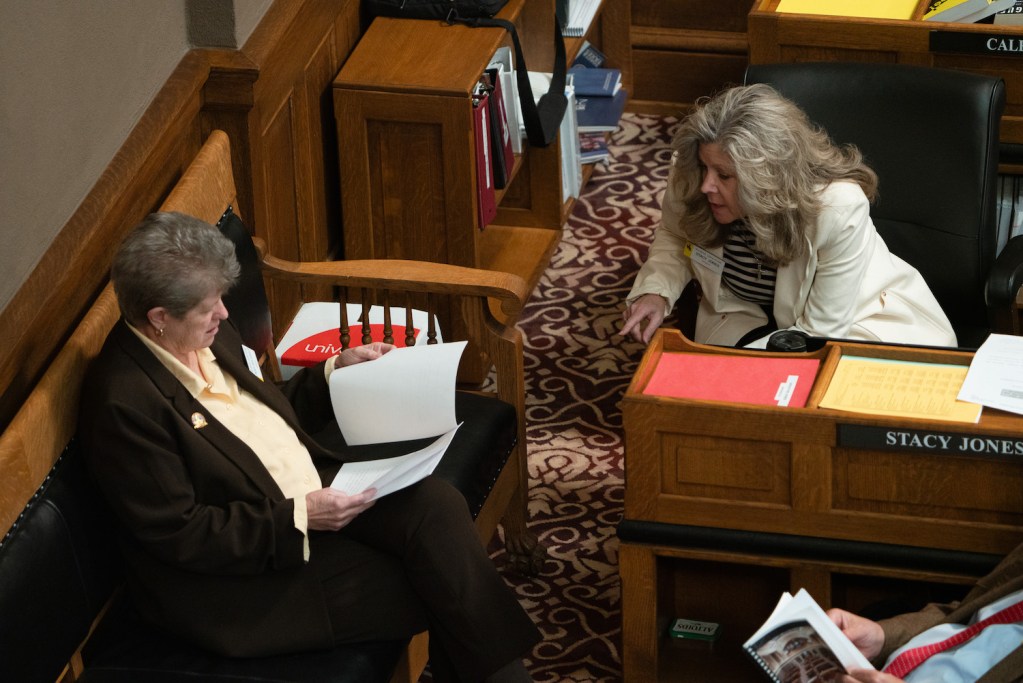
Not everyone agreed, however, that it’s as simple as banning devices, and due to potential complexities around safety, health conditions and communication needs, lawmakers replaced the more stringent “prohibit” in the original version with “restrict.”
What they said
At least 18 of Wyoming’s 48 school districts — and likely more — do not have cellphone policies, according to data collected this fall by the Wyoming School Boards Association. The lack of district-wide policies hasn’t stopped some schools in those districts from adopting specific rules. Senate File 21 would force all districts to adopt policies restricting smartphone use
In states that already have such regulations, Schuler said, the results are promising. “They’re seeing better social interactions with kids with their peers, better focus in class, higher achievement.”
Kirk Schmidt of Lander, a retired school administrator, warned lawmakers about passing a bill that would not be nimble enough to react to the ever-changing realities of technology.
Schmidt also noted that some teachers use these devices for instructional purposes. “This takes all that away,” he said.
Others wondered about enforcement, privacy concerns and timelines.


Supporters, meanwhile, echoed that smartphones are correlated with declining academic performance and behavioral problems like bullying.
“I can tell you that the phones in the schools are very difficult for the teachers and administrators,” said Cheyenne resident Deb Mutter Shamley, who has experienced it firsthand as a substitute teacher.
Wyoming Superintendent of Public Instruction Megan Degenfelder supports the bill, a spokesperson told lawmakers. Degenfelder and Gov. Mark Gordon penned a joint letter in September urging Wyoming schools to limit cellphones.
Tweaks
In order to allow districts more flexibility, committee members voted to amend the language. They also pushed out the timeline two months to give school districts until Sept. 1 to enact policies.
Sen. Charlie Scott, R-Casper, said he thinks the measure can “make significant progress in improving the quality of instruction in public schools.”
Sen. Chris Rothfuss, D-Laramie, who cited concern about state government overreach, was the lone dissenting vote.
The bill now heads to the Senate floor where it must pass three readings before it can advance to the House.