


DENVER—Standing on the steps of the Byron White U.S. Courthouse on Tuesday, attorney May Mailman accused the 10th Circuit Court of Appeals of “looking to try and find a small reasons to not hear this case.”
Mailman’s comments to reporters came less than an hour after she addressed a three-judge panel examining a federal lawsuit with national ramifications for transgender rights and questions over who should be allowed to join a sorority.
The case began over a year ago, when six members of Kappa Kappa Gamma at the University of Wyoming filed a lawsuit in the U.S. District Court in Wyoming against the sorority for admitting its first transgender woman in the organization’s history.
After a federal judge dismissed the case last August, the sorority sisters hired Mailman and announced they would appeal. But attorneys for the sorority quickly argued that the lower court’s ruling could not be appealed.
The question was at the heart of Tuesday’s oral arguments in Denver.
Mailman, however, took the judges’ interest in such a question to indicate the appeals court was not interested in weighing in on the case.
“They’re trying to avoid that because somehow there have been pressures in society that have minimized the importance of women and women’s spaces and made it OK for people to act like they’ve forgotten what a woman is,” Mailman said.
As expected, the panel did not come to a decision Tuesday morning, but took the case under advisement. The hearing, meanwhile, took place only after the sorority sisters requested oral arguments.
The 45-minute proceeding allowed both sides to impress on the court and to reiterate much of what was already laid out in their filings.
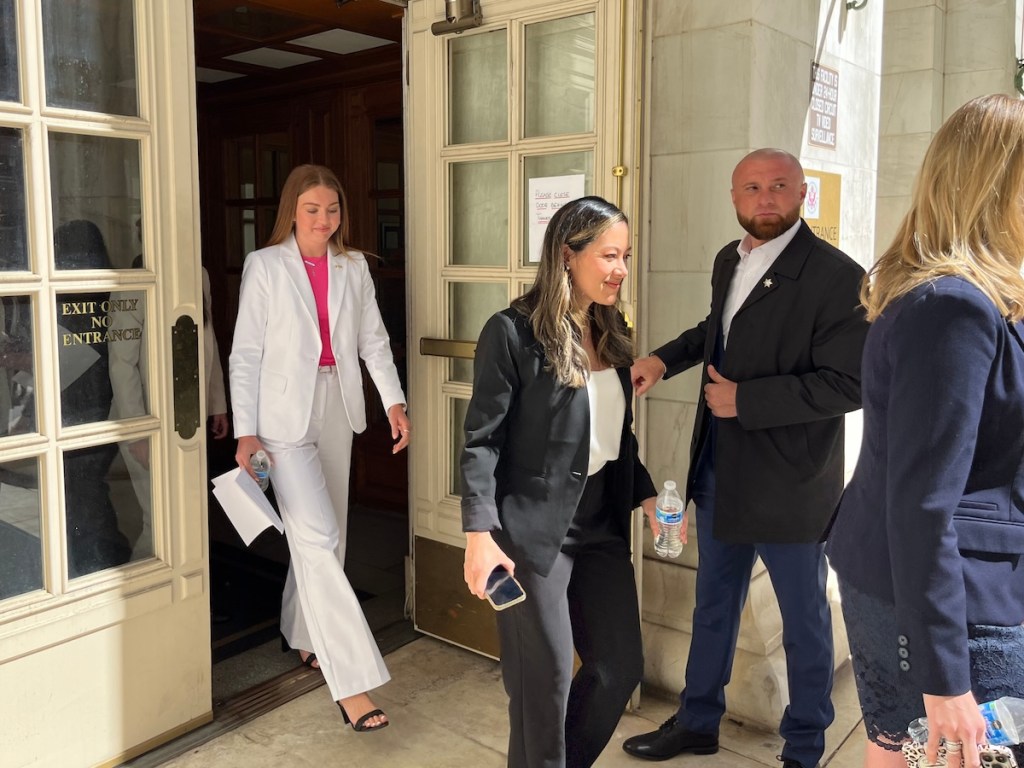
It was also an opportunity for spectacle. The plaintiffs took full advantage.
Their supporters — numbering roughly 60 — gathered in front of the courthouse for a demonstration. They held up signs that read, “sororities are for women,” and “women have the right to women’s spaces.”
When the time came, the plaintiffs appeared from behind the far corner of the courthouse in a choreographed entrance, flanked by Mailman and Riley Gaines, a former college swimmer who has risen to prominence by advocating against the inclusion of transgender athletes in women’s sports.
Several cameramen, set up at just the right spot, caught the group as they turned toward the courthouse and ascended its marble steps.
How we got here
In March 2023, two Cheyenne attorneys filed the lawsuit in the U.S. District Court for the District of Wyoming on behalf of seven unnamed members of Kappa Kappa Gamma at UW.
The suit accused the sorority of breaking its bylaws, breaching housing contracts and misleading sisters when it admitted by a vote of its members the first transgender woman in its history.
Attorneys for the plaintiffs also asked that the court grant anonymity to their clients, but were ultimately denied.
Six of the seven original plaintiffs refiled an amended 72-page suit in April 2023 with their names attached — Jaylyn Westenbroek, Hannah Holtmeier, Allison Coghan, Grace Choate, Madeline Ramar and Megan Kosar. They also named Artemis Langford, the transgender woman at the center of the case, after originally using the pseudonym “John Doe.”

The sisters asked the court for “all remedies available” including voiding Langford’s membership, defining “woman” to prohibit transgender members in the future from joining, plus monetary and punitive damages from the organization.
The lawsuit caught headlines on national TV and in international tabloids and drew the attention of some of the biggest names in conservative media — from which the plaintiffs did not shy away.
In May 2023, they and their lead attorney at the time, Cassie Craven, appeared on Fox News’ The Ingraham Angle as well as The Megyn Kelly Show, where they discussed Langford’s height, weight and genitals.
In the lawsuit, plaintiffs accused Langford of “inappropriate” behavior and said her attraction to women made her “more threatening.”
Attorneys for Langford, however, provided evidence last July of text messages that revealed one of the most serious allegations resulted from “a game of telephone after one sorority sister told a drunken story to another.”
Regardless, U.S. District Court Judge Alan B. Johnson ruled the allegations were not only irrelevant to the plaintiffs’ claims but “unbefitting in federal court” when he dismissed the case in August.
In a 41-page decision, Johnson concluded that the plaintiffs failed to adequately state a claim against Langford and her sorority, and that the government cannot interfere with how the sorority determines its membership since it is a private, voluntary organization.
“Defining ‘woman’ is Kappa Kappa Gamma’s bedrock right as a private, voluntary organization — and one this Court may not invade,” Johnson wrote before applying the landmark 2000 decision by the U.S. Supreme Court in Boy Scouts of America v. Dale, wherein the high court ruled the organization had the constitutional right to exclude a scoutmaster.
Johnson ruled “without prejudice,” a designation that left the plaintiffs the option to refile.
Instead, the plaintiffs hired two high-powered attorneys to appeal the dismissal to the 10th Circuit Court of Appeals.

Appealable?
The question now, in part, is whether the case is appealable.
Soon after the plaintiffs filed their notice to appeal, attorneys for Kappa Kappa Gamma asked the federal appeals court to toss the case out, arguing that Johnson’s ruling could not be appealed.
Both parties focus on footnote 67 of Johnson’s ruling, but make different arguments about what it means.
“If plaintiffs wish to amend their complaint, the Court advises Plaintiffs that they devote more than 6% of their complaint to their legal claims against defendants,” the footnote states.
“It also counsels Plaintiffs to provide more factual detail, where feasible, as well as highlight the Defendant(s) it sues under each count and relevant state statutes and authority. Finally, if provided another opportunity to clarify unclear language within an amended complaint, Plaintiffs should not copy and paste their complaint in lieu of elaboration or legal research that assists the Court in disentangling their claims.”
This excerpt, in particular, is where the lower court “plainly did not exclude plaintiffs from refiling” rather than appealing the case, according to sorority attorneys.
Meanwhile, attorneys for the sorority sisters argue that Johnson’s conditional language does not guarantee they would be permitted to file an amended complaint, necessitating an appeal of his dismissal decision. Since there are no more facts they could present or develop to the lower court, they also argue doing so would be a “futile endeavor.”
“The district court merely discussed what might happen ‘if’ plaintiffs were allowed to amend,” the attorneys argue. “As the rest of the order makes clear, however, no amendment could cure the legal grounds for dismissal on which the district court relied.”
The lower court ordered both parties to file briefs on the merits. The sorority sisters did so in December, while the sorority filed in January.
Inside the courtroom
It was standing room only in the courtroom, where the mood was hushed giddiness ahead of the proceedings. Twice, the bailiff reminded the room that photos were prohibited in a federal courthouse, and he asked that any photos that had already been taken be deleted.
In the front row on the right side, seated just behind their attorneys, waited four of the six plaintiffs, flanked by Riley Gaines.
Behind them sat their supporters, many wearing “save our sisterhood” buttons, others sporting purple, gold and magenta silk scarves from Independent Women’s Forum — a DC-based, right-wing policy group that has attached itself to the case.
Langford did not attend the hearing, and most of the rest of the courtroom was taken up by a few reporters and those involved or interested in the five other hearings on the panel’s docket.

The Kappa case was up first.
Both parties were told they would have 15 minutes each to address the court.
Mailman began her argument by telling the court the issue was “quite narrow,” since the question was not the “interpretation of woman,” but whether the sorority breached its fiduciary duty.
But Judge Carolyn B. McHugh quickly cut in, moving the discussion to the question of whether the lower court’s ruling could be appealed.
“Let me interrupt,” McHugh said. “I have a preliminary question that goes to whether we have jurisdiction to hear this case at all.”
McHugh said the lower court’s ruling, “seems, to me, it’s not final.”
Mailman pushed back, arguing that it was final because Johnson ruled on the merits of the case. McHugh also asked Natalie McLaughlin, counsel for Kappa Kappa Gamma, to weigh in on the question.
“We questioned the court’s jurisdiction, and that’s why we raised it in a motion and raised it again in our brief,” McLaughlin said.
Following the hearing, each of the plaintiffs who were present spoke alongside representatives from Women’s Declaration International and the Women’s Liberation Front.
In a statement to WyoFile, Kappa Kappa Gamma wrote it “will continue to vigorously defend against attempts by plaintiffs to use the judicial system to take away a private organization’s fundamental rights and cause lasting damage to individuals and to our membership.”
Langford remains a member of Kappa Kappa Gamma. She does not live at the house, nor did she previously.


WE are KKG not KKK. These wannabe attention seekers and the $ hungry ilk are following ‘Wily Gains’ for lucrative speaking engagements and bigot jobs. These people wouldn’t be admitted into a sorority elsewhere without losing 50 pounds & the mean girl attitude. Smug narcissists.
One country has transgender issue correct. Peru just declared transgenderism a MENTAL ILLNESS. That is exactly what it is.
Funny how this author ridicule’s the group for taking pictures on the steps of the Federal Court House and the another Wyofile article posted today also has lawyers posing on the same Federal Court House steps. No bias at all in the article. Highly disappointing journalist bias from Wyofile.
Pretty sure courts have ruled that private organizations are free to set their own rules. Hence why Boy Scouts could ban gay troupe leaders and members, and Augusta National could ban women. People just don’t like it when they are letting people in instead of banning them.
One solution would be. Fallow Norte Dame. Don’t allow sorority’s period. Every year they are trouble some where. Just ban the secret clubs.
The court is in Denver which is one of the most trans friendly cities in the US. Just sayin’ .Artemis, and the sisters that support her, are courageous women, modern Joan of Arcs, but Artemis would be more welcome here.
So the Readers Digest version of the Enquirer Magazine crash-blossom for this story would be: Mailman exposes Johnson as Kapa Kapa Gamma Sisters seek to lift the transgender veil…….