

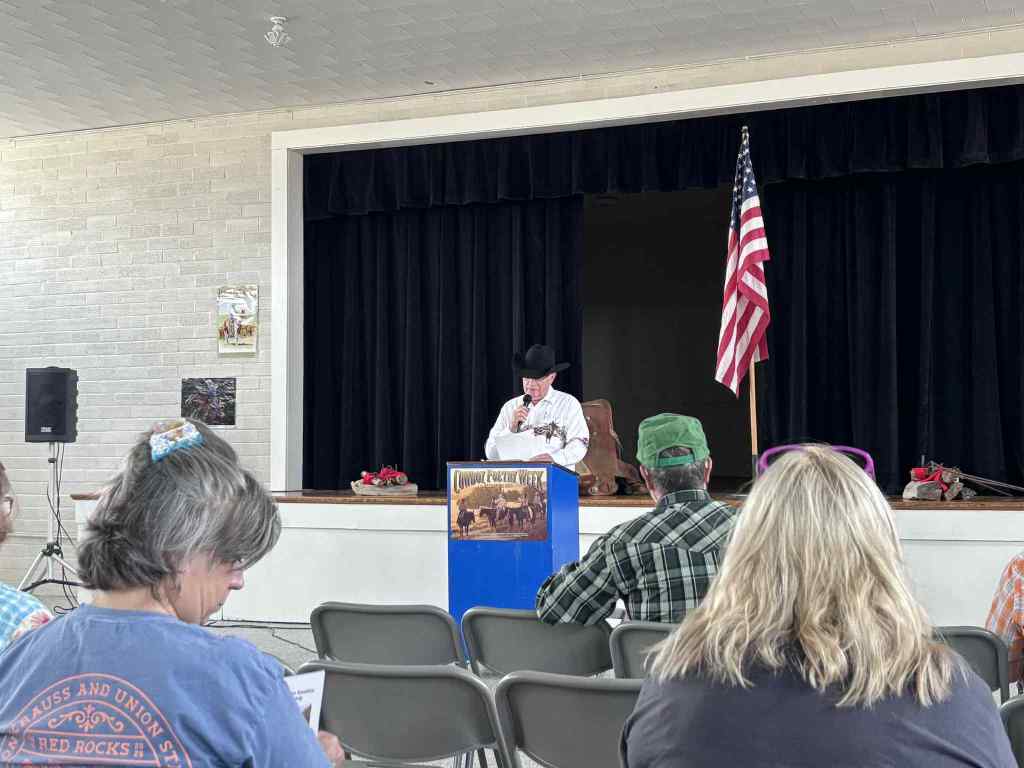
RIVERTON—Cowboy hats cast shadows under the fluorescent lights of an exhibition hall at the county fairgrounds. The crowd — an array of solid, paisley and plaid pearl-snap shirts — chatted till an announcement broke through the buzz. “There’s more programs back there, if you’re missing one and want to know who’s speaking,” said event organizer and emcee Wanda Weisz. She paused, then eyed the cowboy next to her. “You’re up!”
Jerry Bell stepped to the stage, clad head-to-toe in denim with a white, curlicued horseshoe moustache. A guitar hung over his shoulder, held by a saddle cinch in place of a traditional strap. “We’re going to try to mix it up a little bit. I found that if you do a song and then a poem, and a song and then a poem, you can hold the people’s interest a whole lot longer.” Not his first rodeo, Bell strummed his guitar and broke into song.
Weisz, Bell, and several dozen people were gathered to celebrate cowboy poetry in honor of the National Day of the Cowboy — observed annually on the fourth Saturday in July. Weisz first began organizing cowboy poetry events around six years ago when she worked as a librarian. Only three poets gathered for her first event, but her program eventually became so successful that she was asked to bring it with her when she became an assistant at the Shoshoni Recreation District.
“At [these events], you never really know what’s going to happen,” she said excitedly on the phone ahead of the National Day of the Cowboy gathering.
Originating from cattle-driving cowboys in the 1800s, the genre crystallized in the latter half of the 20th century when the Western Folklife Center held the first Cowboy Poetry Gathering in Elko, Nevada. Typically, cowboy poetry is narrative, reflecting life on the range with a humorous and personal bent. These stories come alive at cowboy poetry gatherings, where speakers pair their observations with eyebrow-waggling declamation and the occasional musical instrument.
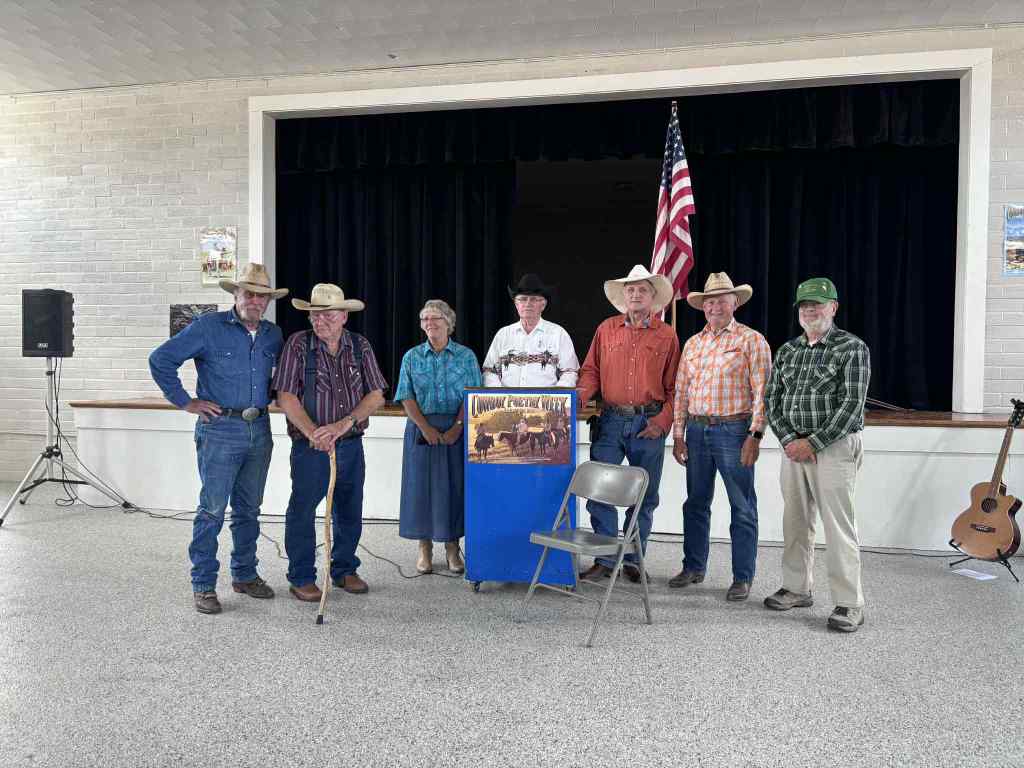
The event in Riverton was no different. Six poets — Bell, Lance Johnson, Rodger Weitzel, John Wickstrom, Lee Wickstrom and Garland Kennington — offered their stories to the crowd, who ate homebaked cookies and brownies off a folding table. Each went for about 20 minutes, their poems and songs ranging from playful to patriotic.
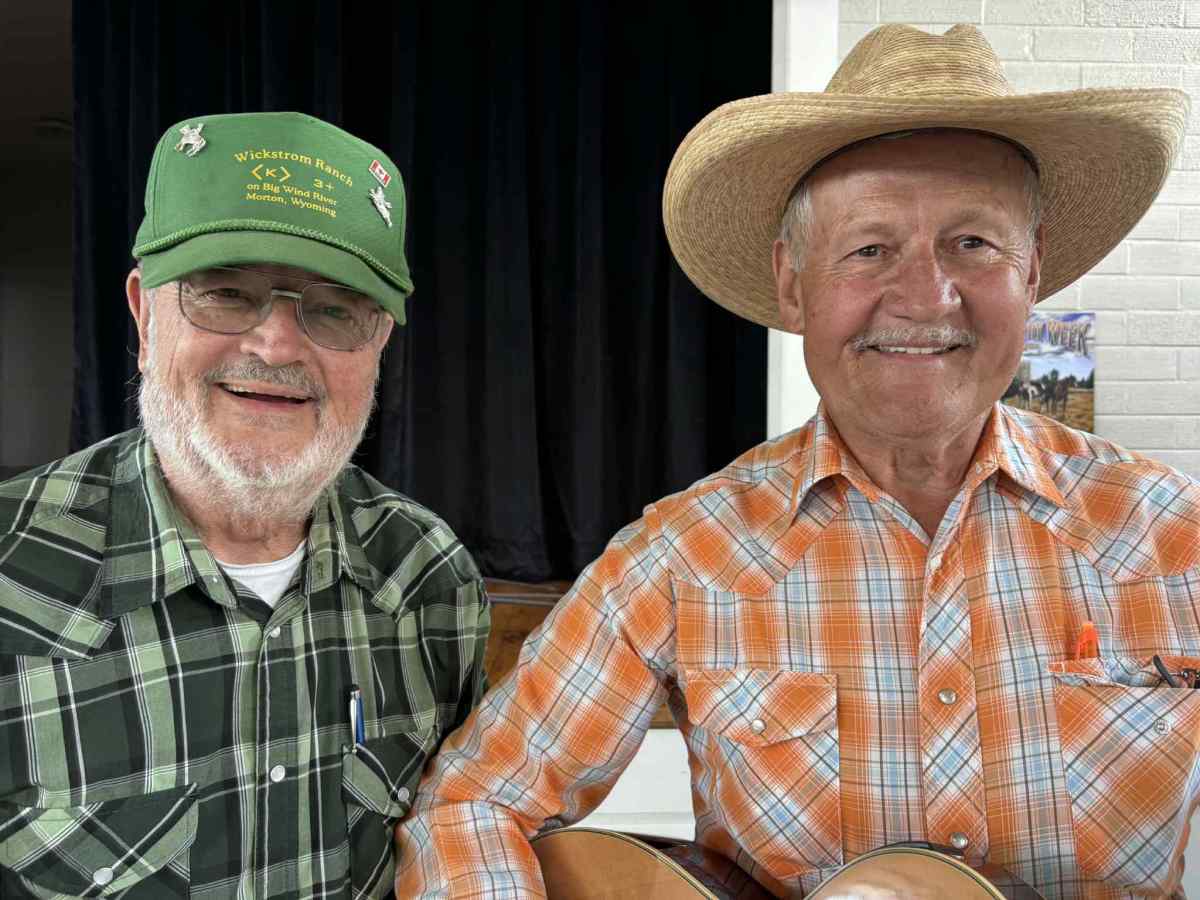
Brothers Lee and John Wickstrom sat together before the show began. Lee looked easy with a checkered shirt and guitar in hand. John, though, had a hint of nerves. Sitting next to his professional poet older brother, it was to be his first time sharing his work. “I began [my career while] driving a tractor pulling a hay rake,” Lee remembers, “I just started making up a song.”
The Wickstroms grew up on a ranch with their mother, father, and two other brothers between Lander and Kinnear. Lee left the ranch after high school to go to college and work as an engineer. “When I returned, I felt like Rip Van Winkle,” he jokes.
That sardonic longing is key to understanding cowboy poetry. Lee sang “Wind River Waltz,” a song he wrote about his parents’ love, while John read “The Boneyard,” a eulogy for rusted-out farm equipment only good for parts. The afternoon did not lack humor — Johnson shared a poem about using a maddened bull to pull out a tooth, and Bell one about measuring his wife’s bust with his hat.
In cowboy poetry, the poet may ride a bronc or chase a lover, grin with kids or rope and brand the devil, but the poems are always personal.
“Cowboy poetry, cowboy pride, cowboy integrity,” affirms Weisz, “it can be a little of anything: lonely, sad, humorous, straightforward. It’s a good way to reflect life.”
Thank you for a story with good Wyoming people.
The Wickstrom boys are some of the best of Wyoming, I ought to know been their sister-in-law for going on 54 years. Nice article.