


Grassy Wyoming roadsides can be enticing to grizzly bears, especially mothers with cubs, and many people can’t resist stopping to marvel at the charismatic critters.
“Everybody wants to see a bear. That’s the picture you want to take home from your vacation,” said Wyoming Highway Patrol Sgt. Andy Jackson.
Stopping to view wildlife can be done safely, but in the heat of the moment, the trooper has written tickets to motorists for stopping in the middle of the road, leaving their car doors flung open and standing a hundred yards down the highway to take pictures.
“I ask them, ‘Would you do this where you live?’ And they go, ‘Well, no,’” Jackson said. “And I go, ‘Well why would you do it here?’”
As bears come out of hibernation, the snow melts and grass greens up along roadsides, Jackson and his colleagues with other local, state and federal agencies are gearing up to attempt to steer humans toward safer habits when it comes to viewing wildlife.
Togwotee Pass tees up a particularly vexing mix of grizzlies, wildlife watchers, steep grades, blind corners, high speeds and troubling behavior. Local, state and federal agencies put out a joint call last week for people to follow “ethical wildlife viewing and photography practices” on Togwotee Pass. The U.S. Fish and Wildlife Service, Wyoming Game and Fish Department and U.S. Forest Service have jointly stepped up patrols and are asking the public to heed their directions to minimize traffic jams and ensure safety for humans and bears.
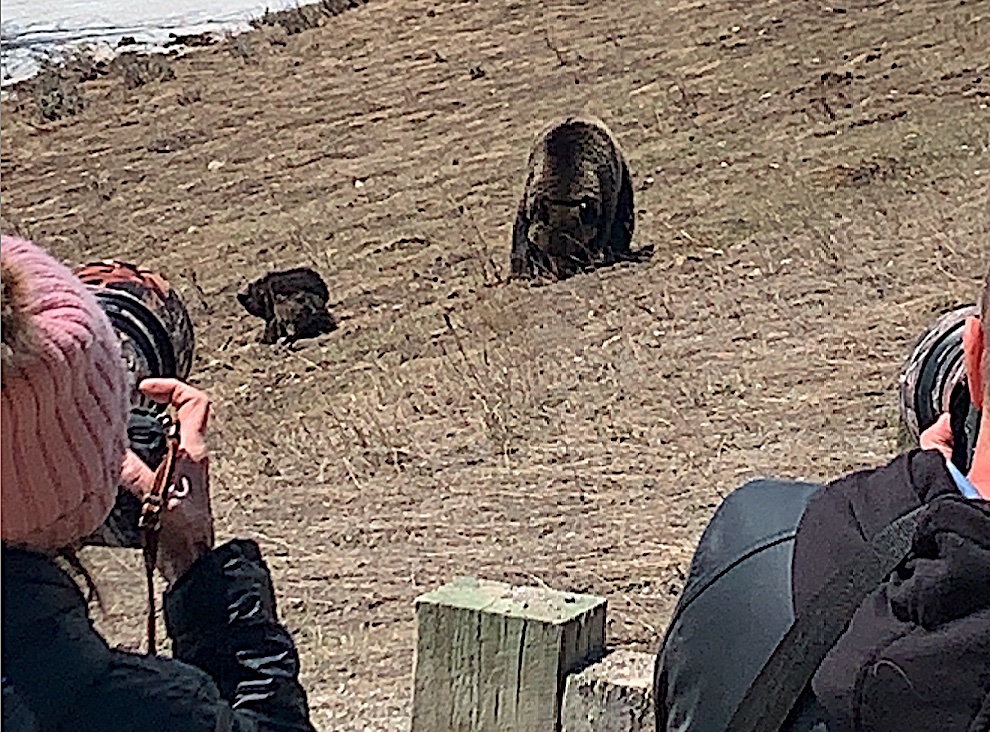
Retired U.S. Fish and Wildlife Service special agent Steve Stoinski knows what a hazardous — and sometimes volatile — mix can be found on Togwotee Pass after spending the summer of 2021 trying to solve the problem. Stoinski came out of retirement to work, under contract, for the Fish and Wildlife Service to intensively haze Grizzly 863, also known as Felicia, away from the roadside. Stoinski was already familiar with the grizzlies of Togwotee Pass, having previously investigated reports of drones harassing the federally protected threatened species. Although hazing briefly deterred the mother grizzly, Stoinski saw that it didn’t have a lasting effect.
“The takeaways I had for managing grizzlies near the road,” he told WyoFile, “the bears are just going to hang out on the road.”
Roadside bears
Grizzlies have reasons to be next to the road, whether to forage for food or for their own safety, he said. Male grizzlies tend to stay away from the highway, and female grizzlies tend to avoid male grizzlies to protect their cubs, he said.
“I only saw one boar griz that whole summer,” Stoinski recalled. “At that time, Felicia, Bear 863, she headed out of that area as soon as she got wind of that bear and bolted across the highway. We had to stop traffic to get her across the highway.”
Wildlife managers no longer have Bear 863 marked, according to Game and Fish Large Carnivore Supervisor Dan Thompson. Out of an abundance of caution, Thompson didn’t want to say for certain whether the sow and two cubs frequenting the Togwotee Pass area this spring are Felicia and her offspring.
“Over the years, we’ve started to wonder if 863 has turned into a different bear that just likes the road,” Thompson told WyoFile.
Regardless, there’s a sow with two cubs that frequents the area. Game and Fish caught and marked one of the cubs last summer.
“We definitely have a bear that is very observable, and it’s unfortunate we have to go back every year and remind everybody [of] etiquette and ethics when it comes to viewing them,” Thompson said.

Ethical, and legal, viewing practices include not approaching bears, maintaining 100 yards between yourself and a bear, stopping in paved pullouts — not on the shoulder — and not feeding wildlife. Though Wyoming Highway Patrol typically responds to traffic complaints, they also get called to Togwotee Pass for confrontations over bear viewing.
“At times, some of the Game and Fish, some of the biologists, get harassed by the people that are bear watching,” Trooper Jackson said.
Already this spring, Thompson said, “we’ve had some pretty nasty confrontations from some members of the public, basically telling us we can’t tell them what to do.”
Human nature
Those tensions motivated multiple agencies to come together to ask the public to follow directions from law enforcement and wildlife managers.
Stoinski also got an earful from bear watchers and photographers in 2021 when he hazed bears away from the road.
“They were pretty belligerent,” Stoinski said at the time. “They got in our faces, were poking me in the chest.”
But eventually, they overcame those initial conflicts and worked together to promote bear and human safety, he said.
The Bridger-Teton National Forest is leaning heavily into education and cooperation to improve safety for bears and people on the highway, which is a designated scenic byway.
Along with the Bear Wise Jackson Hole program and other agency partners, the national forest is asking “the public, photographers, and wildlife tour groups to lead by example.”
“We get that there’s a lot of opportunities to see wildlife all over the forest,” Bridger-Teton spokeswoman Mary Cernicek said. As new vegetation sprouts along roadsides, attracting bears, “we’re so excited to see them and probably having unintended consequences.”
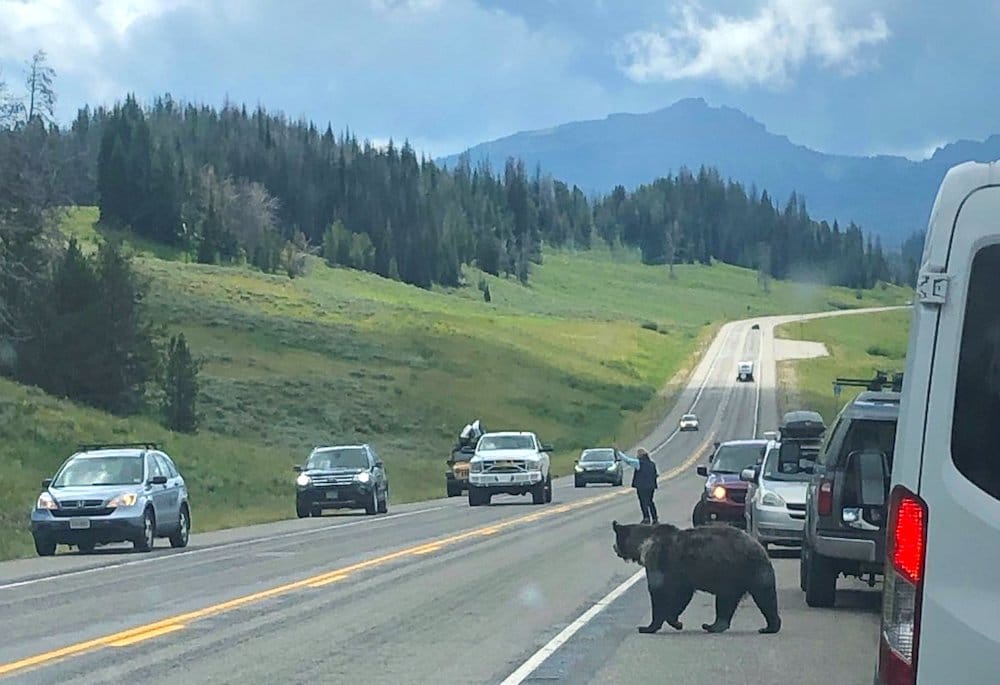
Originally, Togwotee didn’t see a heavy management presence along the highway, but as bear jams escalated, wildlife managers responded with attempts to change both bear and human behavior. Game and Fish still hazes grizzlies, when possible, away from the Togwotee highway.
“It’s been an ongoing effort to try to keep something worse from happening,” Thompson said.
If it is Felicia along the road, she has been hit by a car before, he said.
Last fall, world-famous Grizzly 399 was fatally struck by a vehicle on the highway through the Snake River Canyon south of Jackson. The matriarch bruin had raised her cubs roadside in Grand Teton National Park for nearly two decades.
Visitors save up and come from around the world to see Wyoming wildlife — a phenomenon not limited to national parks.
Striking a balance
In Wyoming, it’s illegal to park on the shoulder of a highway unless it’s an emergency, Trooper Jackson said, and people are supposed to use designated pullouts. But enforcing that law isn’t so easy.
He points to the hamlet of Wilson at the base of Teton Pass, where a moose can be seen most summer days from the shoulder of Highway 22.
“All summer long, we get people stopping, taking a picture of the moose in Fish Creek,” Jackson said. Wyoming Highway Patrol fields frequent complaints from people who want the cars out of there.
“And I’m going, ‘These people came 2,000 miles to see this,’” Jackson said. “We try to have a good balance of what’s common sense.”
The Teton County Sheriff’s Office also enforces traffic laws and gets called to help out on Togwotee Pass. Sheriff Matt Carr said the county used to offer overtime pay to a deputy who lived in nearby Buffalo Valley to patrol the area more frequently.
“The key problem is people stopping,” Carr said. “It’s really not the tourists as much as it is the professional photographers.”
Carr said he no longer has that deputy or the budget to help as much as the county has in the past.
“We’re trying to watch budgets very seriously this year with the revenue losses we’re seeing from property tax reductions,” Carr said.
Grizzly speed limit?
Looking back on his summer managing the mayhem in 2021, Stoinski sees human nature as a major driver of behavior that can’t be overlooked.
“People coming from across the country to visit the parks, or to visit Wyoming, and they see a grizzly bear for the first time in their lives, they just can’t help but stop,” Stoinski said. “There’s got to be a balance between letting people enjoy the bears while they’re near the road without getting too close.”
One thing that authorities can control is the speed limit. For his part, Stoinski would like to see variable speed limits deployed when grizzlies are in the area and bear jams become unavoidable.
“Maybe we ought to consider having a grizzly bear speed limit.”
Steve Stoinski, retired USFWS Special agent
Wyoming has variable speed limits for blizzards along the interstate, he noted. Why not take the concept for a test drive along Togwotee?
“Maybe we ought to consider having a grizzly bear speed limit, you know when the bears are around the highway,” he said. “Slow traffic down just for people’s safety.”
Already, electronic signs posted along the highway tell people not to stop on the road to view bears.


Jackson Hole Wildlife Foundation Executive Director Renee Seidler encourages wildlife enthusiasts to find safer spots to view bears.
“The biggest issue is the road, the traffic, the speed and very little capacity to manage the crowds,” Seidler said, compared to nearby wildlife viewing hot spots in Teton Park.
Seidler also said the agencies might not have yet found the right mix of “carrot and stick.”
“It’s a recurring problem that I would love to see fixed,” she said.
— Mike Koshmrl contributed to this story.

When I see the corruption DOGE is uncovering and the waste in USAID abuse and NGO’s it’s shameful .
Not as shameful as you believing lies.
The positive to this is when the bear gets delisted and we can start hunting them they probably won’t hang around the road near as much, they have got accustomed to seeing people, not good!
Why did the grizzly cross the road? Because some dumb ass humans put it there. Grizzlies were here first and with their habitats extremely fragmented from roads, development, ranching, mining, etc., they have no choice to make the crossing. While I’d love to see the roads taken out, I am pragmatic enough to know that won’t happen. Seems to me that Togwotee Pass is a perfect spot for 4-5 wildlife crossing, both over and under passes.
Maybe some funding could be found for building more pullouts.
Note to those who want to weaken Endangered Species Act: People are coming from all over the world to Wyoming to see grizzlies, not cattle.
It’s problem people!