

RIVERTON—It was hard at first to adjust to the new school policy banning cellphone use in the classroom, 17-year-old Riverton High School junior Alexis Taylor said. When there was a down moment or a pause in a lesson, the impulse to check her phone arose.
Little by little, however, she realized it’s easier to focus on lessons, lectures and discussions when her phone isn’t within reach and buzzing with notifications. “The need to always want to see what’s on there” has diminished, she said. She spends more of her downtime talking to friends.
“Now that we’re further into the year, [the ban] makes so much more sense,” she said.
Not everyone likes the policy, but most students at least understand the benefits, the school’s staff report. Teachers, meanwhile, say it’s made their jobs exponentially easier.
“I love it,” art teacher Maci Evans said. Evans has always made students put their phones away in her class, but the administration’s new stance helps to fortify her rule.
“I don’t even have to ask anymore,” she said. “In class, they kind of just do it.”
RHS adopted its policy amid a rise of districts and entire states imposing new limits on smartphone and social media use in school. In September, Gov. Mark Gordon and Wyoming’s Superintendent of Public Instruction Megan Degenfelder penned a joint letter urging Wyoming schools to draft and enforce policies regulating cellphone use. Though many have already done so, the letter spurred others to initiate the process.

Nearly a semester in, Riverton High School officials report that its policy has on balance been favorable.
“I know that a lot of our students are starting to recognize, ‘wow, I kind of get stuff done when I don’t have my cellphone with me all the time,’” Principal Thomas Jassman said. “So it’s been positive.”
‘Pretty effective’
Evidence is mounting to support what to many is self-evident — cellphone use in classrooms can be severely detrimental to education.
Some 72% of high-school teachers report that students being distracted by their cellphones in the classroom is a major problem, according to a 2024 Pew Research Center analysis of classroom challenges. Distraction and compulsive use aren’t the entire problem, either, as students use their phones to bully, share inappropriate videos and record physical violence in the hallways.
A bipartisan movement to address the issue is building. Nearly 20 states, including California, Oklahoma, Minnesota and Florida, have passed laws or enacted policies that either ban or restrict students’ use of cellphones in schools or recommend local districts enact such policies.
Jassman was already a supporter of classroom cellphone bans when he took the helm of RHS in 2023. Not wanting to rock the boat too much his first year, he initially implemented an out-of-sight, out-of-mind policy that required students to stow their phones away during class.
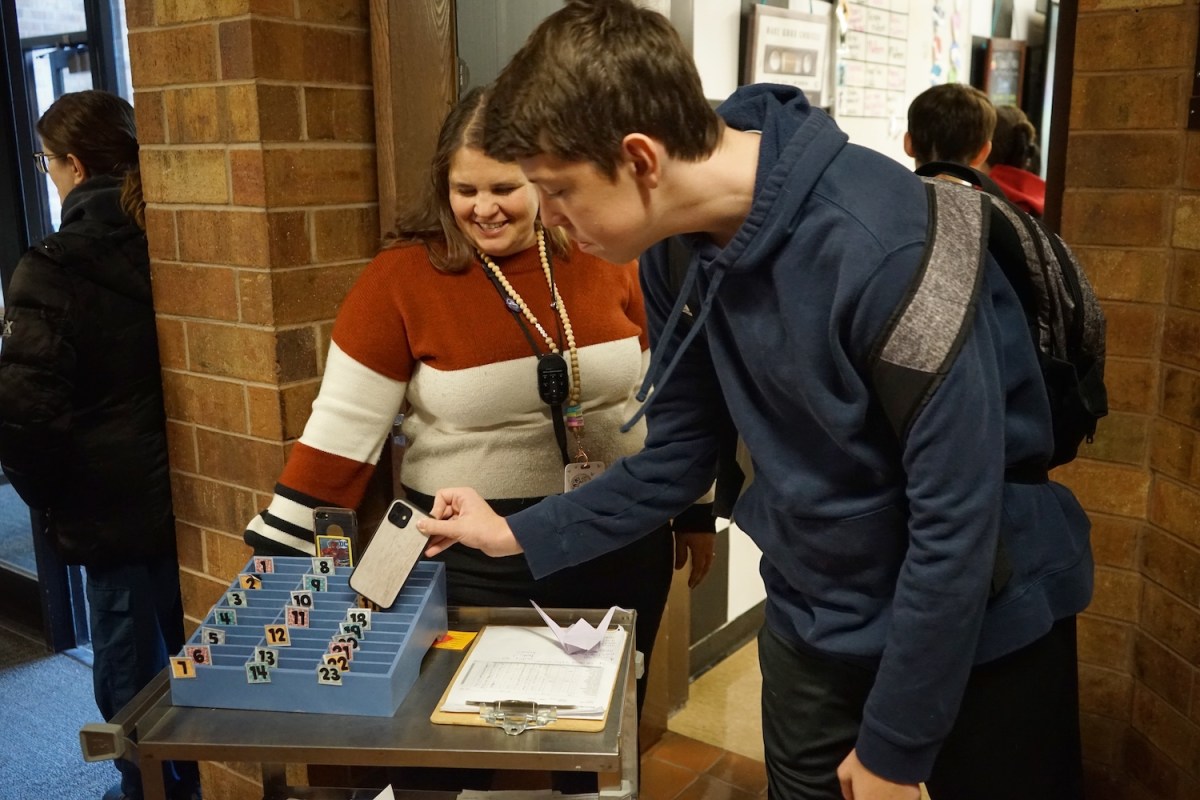
For 2024, however, the policy was made more stringent. The school purchased cellphone caddies that teachers could use to collect students’ devices before each class.
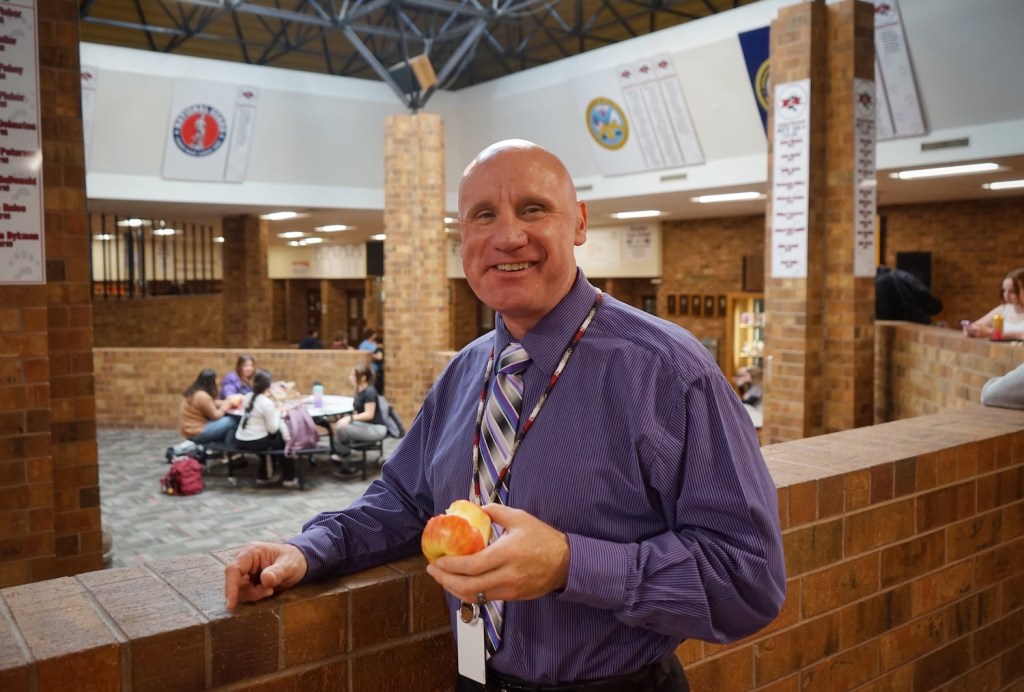
“And we told them that as they entered the class, they could either put it in [the caddy] or they had to put it in their backpack and it couldn’t be visible,” Jassman said.
If the student breaks that rule, the teacher gives them a warning and records the incident. If a second violation occurs, the teacher confiscates the phone and records the incident. A third violation results in a cellphone being confiscated and taken to the Student Support Center office as well as a notification to the parent or guardian, who then has to pick it up at the end of the day. After that, repeat offenders have to turn in their phone to the SSC office at the beginning of each day. They can pick it up after the final bell.
Students can use their phones during lunch and outside of the classroom.
It took a little while for everyone to get used to the new normal, Jassman said, but “I think it’s been pretty effective.”
Implementing the change
Before Jassman became principal, cellphone rules were up to teacher discretion, Riverton High School social studies teacher Sam Howerton said. She used to allow students to put their phones away in their backpacks, but that’s changed.
“I definitely am a collector now,” she said, “and have learned that it’s just better because it’s too much temptation” for the students to have their phones within reach. Howerton asks them to turn their phones into her as they file into class.
Some still struggle with the rule and say they don’t have their phones when they actually do, she said, and she has observed those deceptions grow more sophisticated. Despite that, she’s a fan of the school-wide policy.
“There’s more positives to collecting phones or not allowing kids to have them during class time than not,” she said. Managing a classroom without students picking up their phones during any scrap of downtime makes teaching more efficient, she said.
Jassman has also observed a decline in “student drama,” which he attributes to kids having fewer opportunities to post mean things or engage in cyberbullying.
Both Howerton and art teacher Evans have had to confiscate phones from time to time, but Howerton said she feels those instant consequences are effective.

Certain students who rely heavily on their phones grumbled, especially at first. Another source of pushback was parents who have become accustomed to having unfettered access to their children via texting and still want to check in or update them.
That parent piece required some communication, Jassman said. For example, if there is a family emergency, he said, it’s not ideal for a student to be surprised by the news via a text message in the middle of a lesson.
“And instead of letting them deal with that traumatic circumstance right there in the classroom, we’ve kind of made the request to [parents to] notify us,” Jassman said. “Let’s go ahead and pull your son or daughter out, and we can put them in the counseling office, and then they can be in an environment where they can really be supported.”
Picking up steam
When Gordon and Degenfelder’s letter came out regarding cellphone use in schools, the Wyoming School Boards Association decided to wait for communities to hold conversations with parents before weighing in, Executive Director Brian Farmer said.
“We said, ‘let districts be flexible. Let districts look at what works for their communities and for their parents,” he said. “The stakeholders really ought to have a voice. And then look at appropriate use, versus straight-up bans.”
A big part of what’s at issue, Farmer said, is the mental health and well-being of kids. Social media platforms are designed to be addictive and have widely acknowledged associations with anxiety, depression and other harmful disorders.

Riverton High School is by no means Wyoming’s first or only education facility with a cellphone policy.
Bighorn School District 2 in Lovell has a longstanding school rule prohibiting cellphones in class, Superintendent Doug Hazen said. Students are to keep their phones in their lockers outside of the classroom.
“We have always placed a major focus on protecting classroom instruction, which is why we have never allowed cellphones in class,” Hazen said. Though he doesn’t have hard data, Hazen said “anecdotally, I believe we see better classroom engagement without the distractions that come with cellphones.”
Phone access is managed at the building level in Teton County School District, according to Executive Director of Communications and District Services Charlotte Reynolds.
Jackson Hole High School uses a “pocket to pocket” approach, meaning students place their phone in a hanging pocket sleeve as they enter the classroom, Reynolds said. Teachers use the pockets to take attendance. So if students don’t turn in their phones, they are counted absent for the class.
Fremont County District 1 in Lander is another that doesn’t have a district-wide policy. However, the school board voted in October to explore a policy with surveys to teachers and staff, students and parents.


Sadly, smartphones have become a lifestyle instead of a tool, and I call the blasted things pacifiers. Yes, I own a smartphone; but only as a necessary evil of modern life. It’s turned off 95% of the time, and it’s a tool for me, nothing more.
Why this was allowed in the first place is probably a result of the education system becoming more concerned with being the students’ friends instead of being educators.
Teach the 3-R’s, quit being the kids’ friends, and get the social engineering out of the schools.
I’m surprised that it seems to be “news” that banning phones from the classroom improves classroom engagement and learning.
When I was CIO over a large call center, we banned all cell phones while working–we provided cell phone lockers at the employee entrance. We even went as far as using cell phone detectors on the call center floor to enforce the policy. Funny how average handling times went down and customer satisfaction went up.
Personally, I’d do the same with the schools. Mobile phones are not necessary for education–as evidenced by the countless students that were extremely well educated before cell phones existed.
Education outcomes are lower than in the past. Let’s take the easy step of actually requiring students to pay attention to those actually educating them.
And like the article says, if there is a family emergency, call the school’s office!
Good morning,
I am happy but not tremendously excited for this decision because along with the child’s education serious consideration and attention needs to be to the following: Self Control, self respect, respect for others, unselfishness, consideration, honestly, integrity, accountability, logistics, coordination, cooperation, and honor.
Neighbors like it or not “cellphones/smartphones”are here to stay and are an integral and integrated part of everyone’s life at what seems in every age group according to their needs, desires and or requirements… Soooo let them KEEP THEM and they will learn ALL .the aforementioned because of its importance in their own respective lives BUT! They should have them turned off/muted/etc. while in the classroom.
REASONING: Is because of a common statement “In this day and age”… Most importantly “IF” any kind of incident like what happened in Texas with the children at that school or Colorado, and other S
states especially what happened in Texas with the parents desperate to see, seek or talk to their children and we all remember the report that the Law Enforcement Officers did not go into the school until certain support arrived.
Are we/you/I going to be satisfied with the outcome when each child DOES NOT have a way to communicate with their parents to give them their condition, status, well being and just as important location of the KILLER(S)/TRESPASSER(S)?
The cellphone has become a valuable tool in their lives, let’s aid them in the aforementioned of good proper use of in in the proper environment because it will translate very well into adulthood, seriously, how many employers authorize cellphone use while “on the job”, driving a vehicle, etc. We as adults are the real examples to our children individually and collectively but they are at school while we adults are “on the job” and when our children transition into the workforce it will not be a hugh surprise that cellphone usage have RESTRICTIONS on/in and under certain circumstances, conditions and environments, it’s a “WIN/WIN for everyone! Thank you for reading this far.
Semper Fi!
Kids don’t need phones period. Not even in school. Kids are supposed to use the phones to give away the location of the school shooters? How about putting armed guards in school? How about arming teachers? Then kids won’t need phones for your reason. Also, the phones are right there in the classroom. So if a shooting starts, they can just grab their phone from the front of the classroom. Your logic of them holding them during class kind of falls apart.
Deployed soldiers in the army don’t get to take cell phones with them because it’s a distraction and the military knows it. Not sure if you remember, but there was a time before cell phones. Article brought up good points where kids don’t need to be bombarded with text messages of dying family members in classrooms or helicopter parents in general.
4G 5G radiation is bad for yet millions of people keep one in their pocket and pressed against their head. Not all waves pass through the body. Some waves are stopped then absorbed by your skin and brain and turn into heat and damage your DNA. This is science you’ll learn in Junior high, quick Google search, or turning on your microwave.
Keeping kids distracted in school also keeps them less educated, which is exactly what the federal government wants so they can keep people poor and oppressed. Uneducated people freely give up more rights to the steadily encroaching federal government.
There’s a reason why other branches say Marines eat crayons. Stop proving our point.