

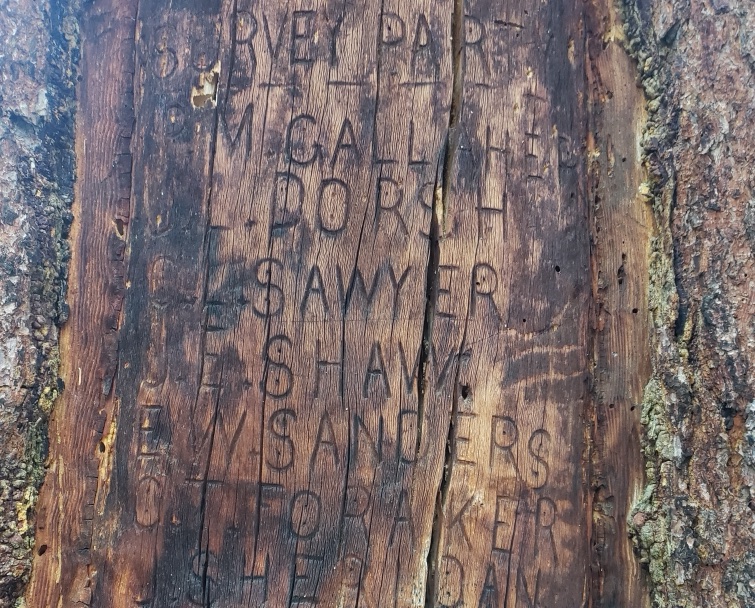
Public opposition will slow plans to remove and display a section of a dead Shoshone National Forest tree that surveyors mapping Yellowstone Forest Reserve boundaries inscribed 133 years ago.
The dead Engelmann spruce still stands about 28 miles from the nearest trailhead in the Washakie Wilderness. Plans to recover the artifact via helicopter have been underway for years, and there’s even a place in the Wyoming State Museum to display it.
But as plans advanced, federal land managers did not loop in the general public nor advocacy groups whose mission it is to uphold the Wilderness Act. When they ultimately learned about the project, advocates publicly objected — and let Shoshone National Forest Supervisor Ken Coffin know it.
“I got probably somewhere around 200 emails from people from across the country who had legitimate concerns about the project because it’s in the wilderness,” Coffin told WyoFile. “Admittedly, we worked with the folks who believe that the removal is an appropriate thing to do — I happen to be in that camp — but we didn’t really work with the other side. I thought they had a point.”
Concerns about the tree removal emanated from Wilderness Watch, a Missoula, Montana-based advocacy group that seeks to preserve and steward lands and rivers in the National Wilderness Preservation System. In mid-August, Katie Bilodeau, the group’s legislative director and policy analyst, wrote a blog post encouraging folks to send the Shoshone National Forest their thoughts about the tree removal plan.
Readers wrote in droves contesting the plan, which required a “minimum requirements analysis” because the tree removal would require use of a helicopter and other mechanical equipment in designated wilderness, where it’s not normally allowed.
“It would have also included at least four helicopter landings in the wilderness,” Bilodeau told WyoFile. “Wilderness is a place where nature should govern. We shouldn’t be so eager to jump in with our tools, because we can radically alter things pretty quickly.”
After hearing from Bilodeau and others, Coffin paused the project. As a result, the beetle-killed tree will not leave the remote reaches of the southern Absaroka Mountains in 2026.
And it might stay in the 9,100-foot-high basin permanently. The Shoshone National Forest is in talks with Wyoming State Parks about using a 3D scan to create a replica of the inscribed tree instead of displaying the real thing in Cheyenne.
“If we walk away from that meeting feeling like that [3D scan] serves our purpose,” Coffin said, “then it’s possible that we would not remove the tree.”
If project proponents, led by Wyoming State Parks, aren’t appeased by that plan, then the Shoshone National Forest would resume its approval process for removing the tree.

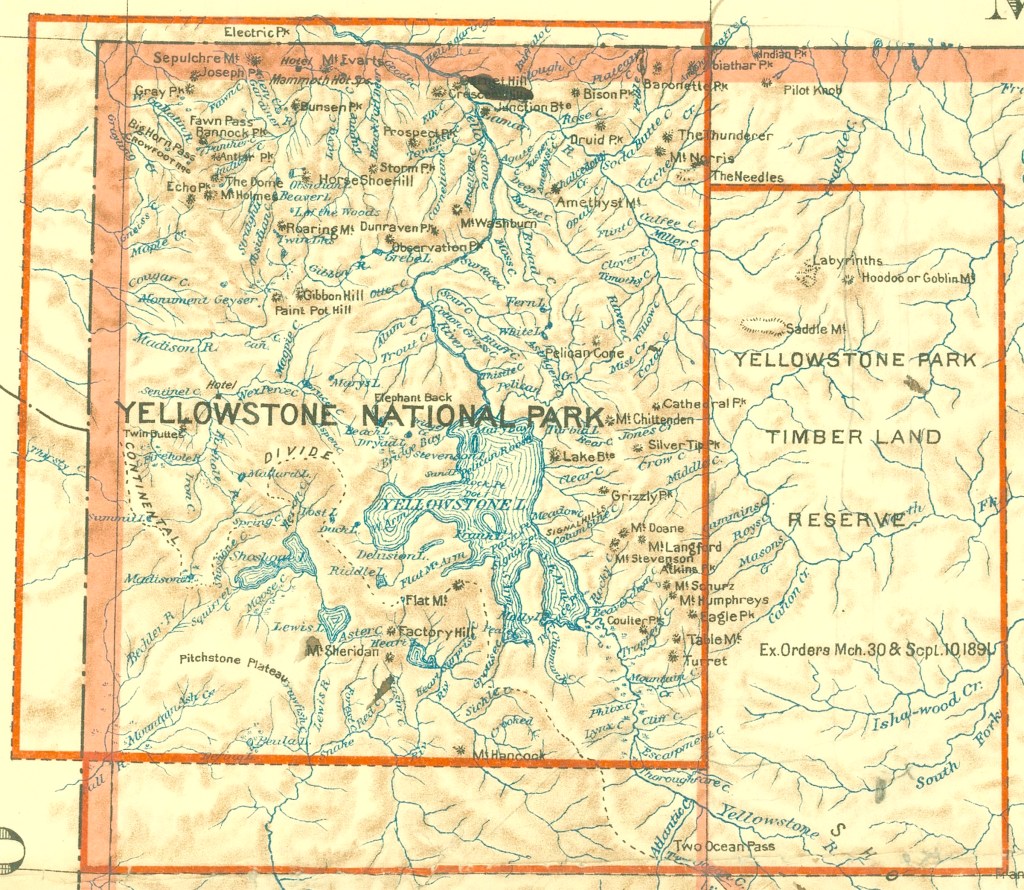
The tree in question has been researched by historian Lawrence Todd, a Colorado State University emeritus professor who lives in Meeteetsee. Surveyors inscribed the spruce on Oct. 3, 1893 while mapping the Yellowstone Forest Reserve, which is the forebear to the Shoshone National Forest. The mapping party, led by Phillip M. Gallaher, took shelter near the tree during a snowstorm that slowed their surveying and carved their names into its trunk “probably out of boredom, more than anything else,” Todd told WyoFile in early 2024.
Its historic value is clear. The tree was inscribed just 21 years after Yellowstone National Park’s establishment and three years after Wyoming gained statehood, and it’s a reminder of Americans’ early efforts to “reserve” some forests rather than harvest them all. The 1.2 million-acre forest reserve designated in 1891, was the first piece of land set aside for inclusion in what would eventually become the National Forest System.
A century and three decades later, the tree was standing dead. In 2024, Wyoming lawmakers debated setting aside some funding to recover the inscribed section and temporarily put it on display at the Wyoming State Museum in Cheyenne. Long-term, the plan is to put the tree section at the Buffalo Bill Center of the West Museum in Cody.
The first attempt at funding died, but Wyoming State Parks secured a $25,000 allocation during the Legislature’s 2025 session, plus another chunk of money through a state grant program to celebrate the American sesquicentennial anniversary.
State Parks Director Dave Glenn told WyoFile on Tuesday he agrees with Coffin’s decision to “slow roll” the project to “make sure everybody’s supportive” of it. And Glenn’s open to 3D printing a hologram of the tree — he’s seen the scans and said they turned out really well.
Still, Glenn prefers that the tree be removed from the wilderness so it doesn’t topple over and rot.
“From our perspective, we’d still like to get the tree [out of] there, just because it’s so historic,” Glenn said. “That history is going to go away. It’s going to fall down and be gone.”
Bilodeau at Wilderness Watch, meanwhile, has shared gratitude for Coffin pausing the project. On Tuesday, she wrote another blog piece commending that decision and thanking her members for writing to the national forest.

“Y’all saved the survey tree,” she wrote. “While trees don’t have as many lives as cats do, they do have a meaningful second life when they die and become snags, spending years giving back to the ecosystem that had given them life… Removing this ‘deceased’ tree would have devalued this tree’s second life as a snag.”
While it remains to be seen if wilderness advocates will succeed at permanently preventing the survey tree’s removal, it would not be the first time their advocacy has shaped or slowed projects planned in designated wilderness in Wyoming. In 2017, the Bridger-Teton National Forest caught an earful about its plans to helicopter in a new Yellowstone River bridge at Hawks Rest, though the bridge was ultimately replaced four years later.
Plans to stock naturally fishless Mystery Lake in the Teton Wilderness also were scrapped in 2016 as a result of concerns shared by wilderness proponents.Five years later, however, the lake was restocked with Snake River cutthroat trout following pressure from anglers.
Correction: This story has been updated to include that Mystery Lake was eventually restocked with fish. -Eds.

With regards to the final sentence of this article:
Plans to stop fish stocking in naturally fishless Mystery Lake in the Teton Wilderness were only temporarily scrapped. According to Buckrail July 29, 2022:
“The Wyoming Game and Fish Department recently stocked 1,000 Snake River cutthroat trout back into Mystery Lake in the Teton Wilderness as part of a restoration project that began in 2016….This is the second consecutive year Snake River cutthroat trout have been stocked into Mystery Lake”
https://buckrail.com/game-and-fish-restock-mystery-lake-with-cutthroat-trout/
Can WyoFile determine why this happened — did WGFD and USFS agree to respect Wilderness at Mystery Lake just as a tactic to defray criticism at the time? How often does this kind of thing happen, and might it also occur for this tree removal?
I can understand both sides of the debate,but I wonder if they also consider safety of visitors and if this tree contains the beetle ms that killed it.🤷♂️
I question the push to remove this tree instead of allowing it to fall naturally and rot. If this were any other tree in the Washakie Wilderness, we wouldn’t be having a debate about letting natural processes run their course. Is there a genuine ecological disadvantage to allowing this cycle to complete itself?
Decay isn’t a failure or a loss of value—it’s ecological succession. By singling this tree out for extraction, we risk treating a living, self-willed ecosystem like an outdoor museum and imposing human sentiment on a wild place. Letting the tree fall, decompose, and return to the soil isn’t neglect; it’s respecting the very autonomy that designated wilderness was created to protect.
So they propose to vandalize a national forest to preserve evidence of vandals 132 years ago. The tree might still be living if those surveyors had not provided beetles an entry to the tree.
The tree needs to stay. Even though it’s dead, it contributes to the forest. Nesting, food etc. Yes eventually it will fall. But that’s part of the circle of life. If it’s possible, remove the inscriptions. Put it in a museum. The history of our country is vitally important also. I hope a conclusion can be reached that satisfies everyone.
I very seldom side with environmental groups but this is one of those times (oddly, this is the second time I’ve written that sentence in a Wyofile comment this week). I’m not opposed to a brief helicopter incursion into wilderness though, and I understand that keeping it in place would eventually cause it to be lost to the elements or a fire. I understand the desire to remove the tree so it can be preserved, and placed in a museum where more people can easily view it. But something about viewing it in the actual location where the etching took place matters too. That makes it way cooler than seeing it on display in a museum. And for me, seeing something like this in a remote location that requires effort to reach, where few people go, just adds to the coolness factor.