

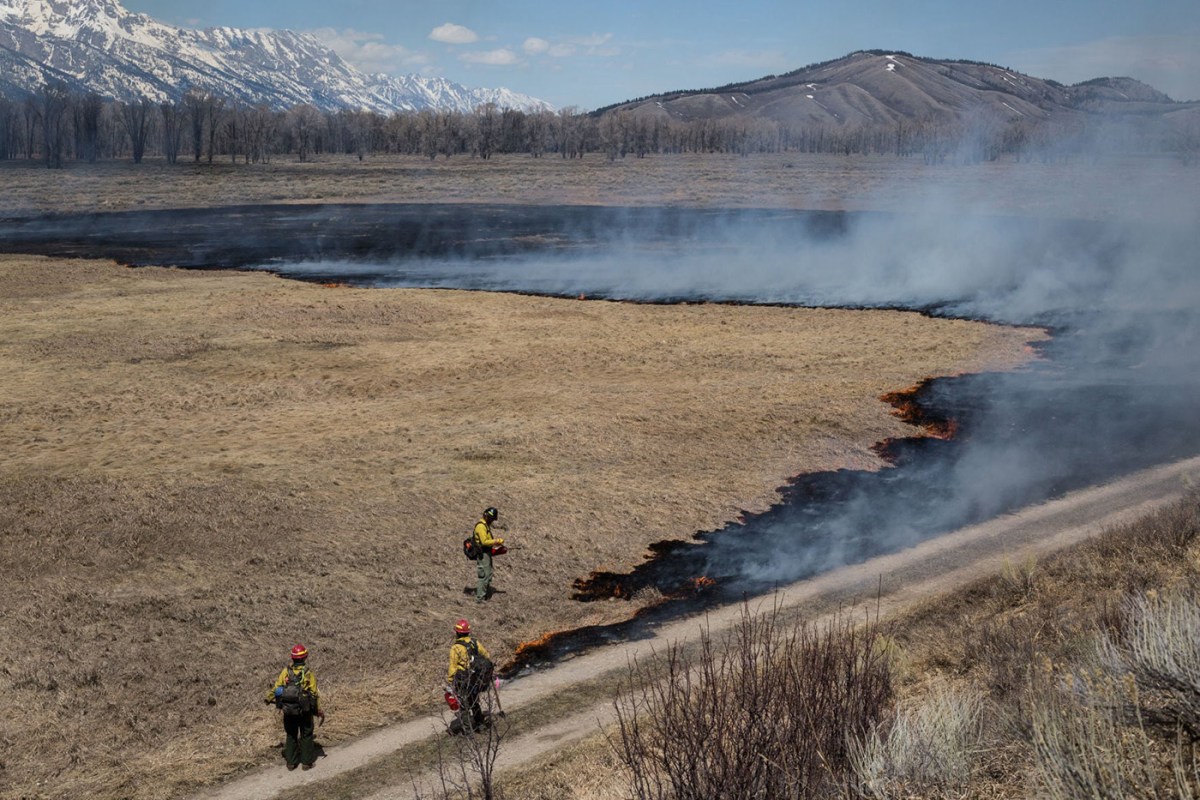
As major fires burn across Colorado and Utah this summer, the broader Western lesson is hard to miss. Colorado’s Aspen Acres fire forced evacuations and destroyed more than 160 structures. Utah’s Babylon Fire passed 100,000 acres recently, the state’s first fire to reach that mark in eight years. Colorado officials also issued air-quality advisories tied to wildfire smoke moving through the region. In the West, wildfire risk does not stop at a state line, and neither do the economic and environmental costs.
Opinion
Wyoming knows that reality well. Wildfire affects rangelands, watersheds, wildlife habitat, recreation, public health and the economies of rural communities. It also affects core questions of economic policy: how communities protect infrastructure, how land managers reduce long-term risk, how businesses operate during smoke events and how states navigate federal rules that do not always fit Western conditions.
That is why the U.S. House passage of the Fire Improvement and Reforming Exceptional Events (FIRE) Act deserves attention here in Wyoming.
Introduced by Rep. Gabe Evans, R-Colorado, and co-sponsored by Rep. Adam Gray, D-California, Rep. Paul Gosar, R-Arizona, and Rep. Jeff Crank, R-Colorado, the bill would revise how the Clean Air Act treats air-quality monitoring data affected by exceptional events and by actions taken to mitigate wildfire risk. The basic issue is straightforward: States and communities that use prescribed fire and other tools to reduce future wildfire danger can still face compliance problems tied to emissions from those very activities.
That creates a poor fit between federal air policy and Western land management reality. Prescribed fire requires careful timing, coordination, and public communication. State agencies already work through smoke management requirements, weather conditions and public health concerns before a burn ever begins. In Wyoming, the Department of Environmental Quality already regulates smoke management and open burning through its own framework. The burden grows when smoke from a burn contributes to a monitored exceedance and the state has to assemble a complex exceptional-events demonstration with EPA to keep that data from distorting compliance decisions.
The consequences do not stay on paper. Air quality designations can shape the regulatory environment for communities and industries. States also have to build public support for preventative action that may bring some short-term smoke while reducing the much larger harms that come with catastrophic wildfire later.
The case for prevention is especially strong in the West. Catastrophic fires destroy habitat, damage watersheds, threaten homes and infrastructure and leave behind higher long-term costs than the controlled burns and mitigation work designed to lower those risks. The Western Governors’ Association has made that point clearly, backing expanded use of prescribed fire and calling for a more workable system for handling the air quality burdens tied to wildfire smoke.
Wyoming has a strong interest in that debate. Republican Sen. John Curtis of Utah introduced the Wildfire Emissions Prevention Act last fall, with Republican Sen. Cynthia Lummis of Wyoming as a cosponsor, aiming at the same general problem. That is worth noting not only because Wyoming has a voice in the discussion, but because it shows this issue has become a regional governance question rather than a niche regulatory dispute.
A better framework would recognize something simple: Smoke from a prescribed burn carried out to reduce future wildfire danger does not fit neatly in the same category as ordinary industrial emissions. Federal policy should account for that difference while still protecting public health and requiring responsible burn practices.
The FIRE Act will not solve every problem tied to wildfire, smoke or land management. Congress still needs to think seriously about forest health, fuel reduction, interagency coordination and the capacity of states and land managers to carry out this work at scale. But this bill addresses a real mismatch between the rules on the books and the conditions Western states actually face.
Wildfire prevention is land policy, water policy, public safety policy and economic policy all at once. A federal framework that supports earlier action would give states more room to reduce risk before smoke and flame force the issue on worse terms.
If Washington wants fewer megafires and healthier Western landscapes, it should give states a framework that supports prevention.

The author is wrong about just about everything. In fact, in the US more people die from prescribed fire smoke than from wildfire smoke. Another study found that the health costs from prescribed burn smoke is five times greater than that caused by wildfire smoke. So the idea that prescribed burns save people from wildfire smoke is simply mythology.
https://utahnewsdispatch.com/2026/07/16/the-forest-services-fuel-reduction-strategy-is-adding-fuel-to-the-fire/
The article you linked is full of invective and uses a lot of hyperbole and cherry-picking of facts. To the author’s credit, he doesn’t direct his insults to one side or the other of the political spectrum. I don’t pretend to be an expert, but the concept of burning when the chances of catastrophic wildfire are minimal, ie prescribed burning, makes a lot more sense than crossing our fingers and hoping that catastrophic fires won’t happen on their own. Also, anyone who has visited many of our national forests can plainly see that the dense (overgrown) pine forests support very little wildlife and are prone to disease and insect infestations. Thinner forests have fewer, healthier trees and more understory that supports wildlife. Prescribed burning is not the only solution, but I think it is part of the solution, ie a tool that should be used more often and more commonly.