


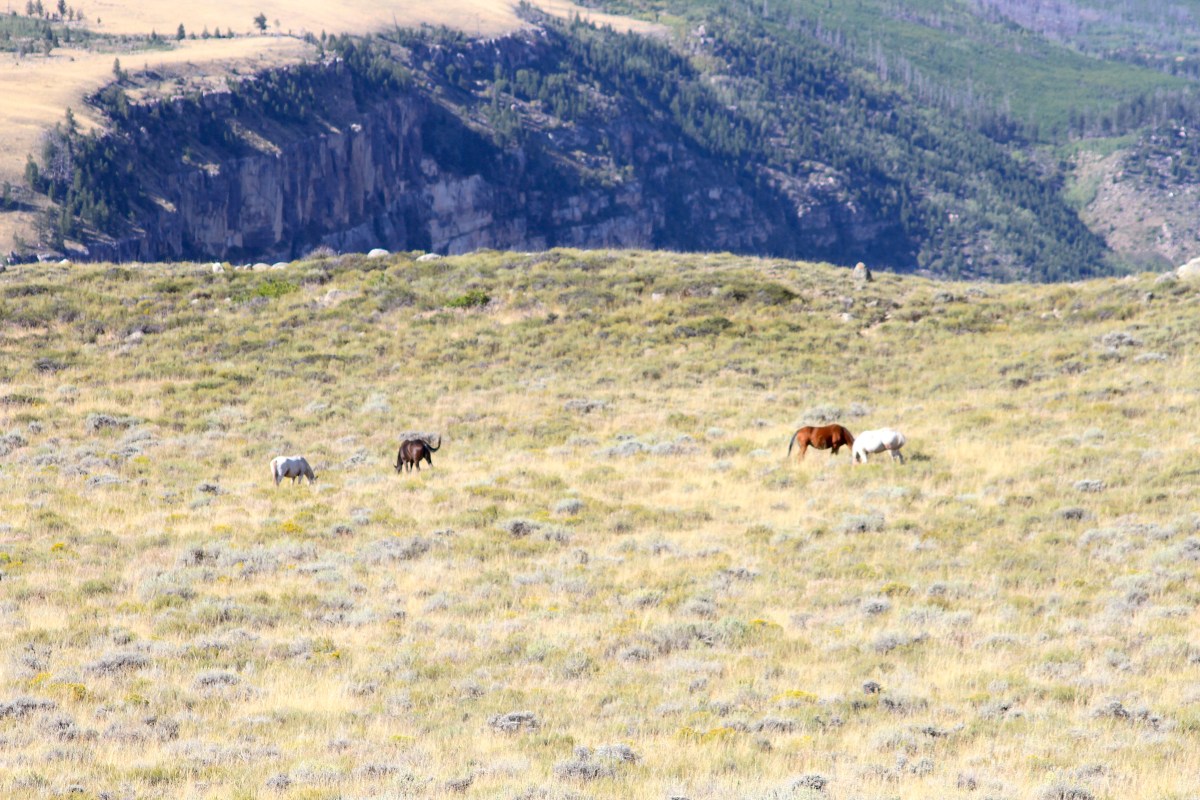
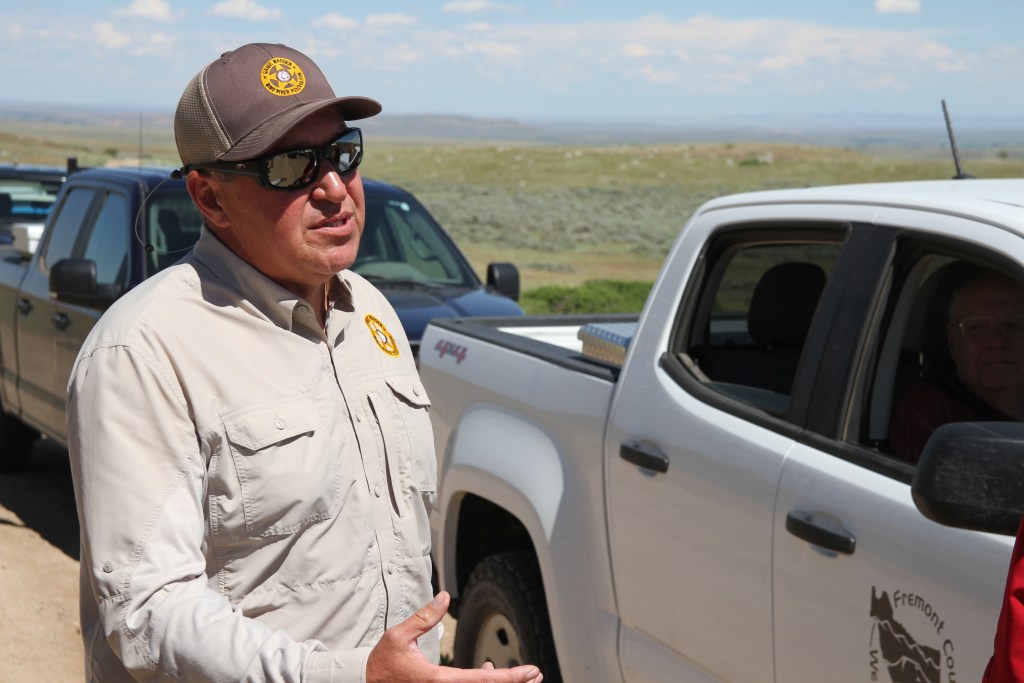
LITTLE WIND RIVER DRAINAGE—Driving into the foothills west of Fort Washakie to tour experimental cheatgrass treatments, Art Lawson’s attention landed instead on the verdant vegetation he saw in every direction and something that he didn’t see at all — free-roaming horses.
The landscape he was driving though had immediately, dramatically rebounded following a massive roundup of the non-native equines in late 2023.
“Almost overnight results, really,” said Lawson, who directs Shoshone and Arapaho Fish and Game, which manages wildlife on the Wind River Indian Reservation.
“The mule deer that I’ve seen since we removed horses is unreal,” he added. “Really, deer [numbers] I haven’t seen in 10 years.”
There was no doubt in Lawson’s mind that the Wind River Indian Reservations’ many thousands of feral, free-roaming horses are what displaced mule deer and an array of other native species.
“We used to drive around and see horses,” Lawson said during the June outing. “Now we can drive around and see wildlife.”
Adaptable, hardy and unencumbered by predation, horses can double their population every four years. On the reservation, they were “growing in unreal numbers,” Lawson said, and obviously damaging the landscape’s ecological integrity.
“The cheatgrass that’s leftover after horses have been there for a while, it’s horrible,” Lawson said. “There’s no nutrition in cheatgrass.”
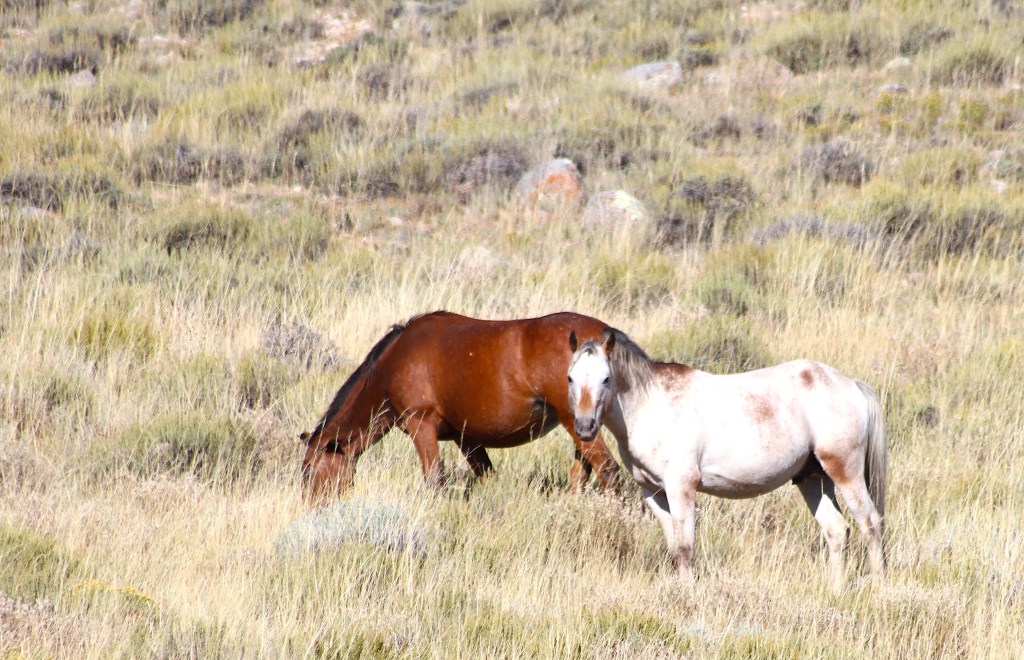
Free-roaming horses’ dominance over the Wind River Range’s eastern foothills peaked just before last year’s roundup. In late fall 2022, a first go at an aerial survey found 5,500 horses on 1 million acres of the reservation — roughly half the land area within the boundaries. That didn’t account for animals the survey missed or foals born into the herd the following spring.
“We felt pretty confident there were at least 9,000 horses out there at that time,” said Pat Hnilicka, the supervisory biologist for the U.S. Fish and Wildlife Service’s Lander office.
The estimate was “very shocking,” he said.
Nationally, there were an estimated 73,520 free-roaming horses and burros as of March. At that time, the Bureau of Land Management estimated that there were 10,264 animals in its Wyoming herd management areas — which means the reservation housed almost as many feral horses as the rest of the state combined.
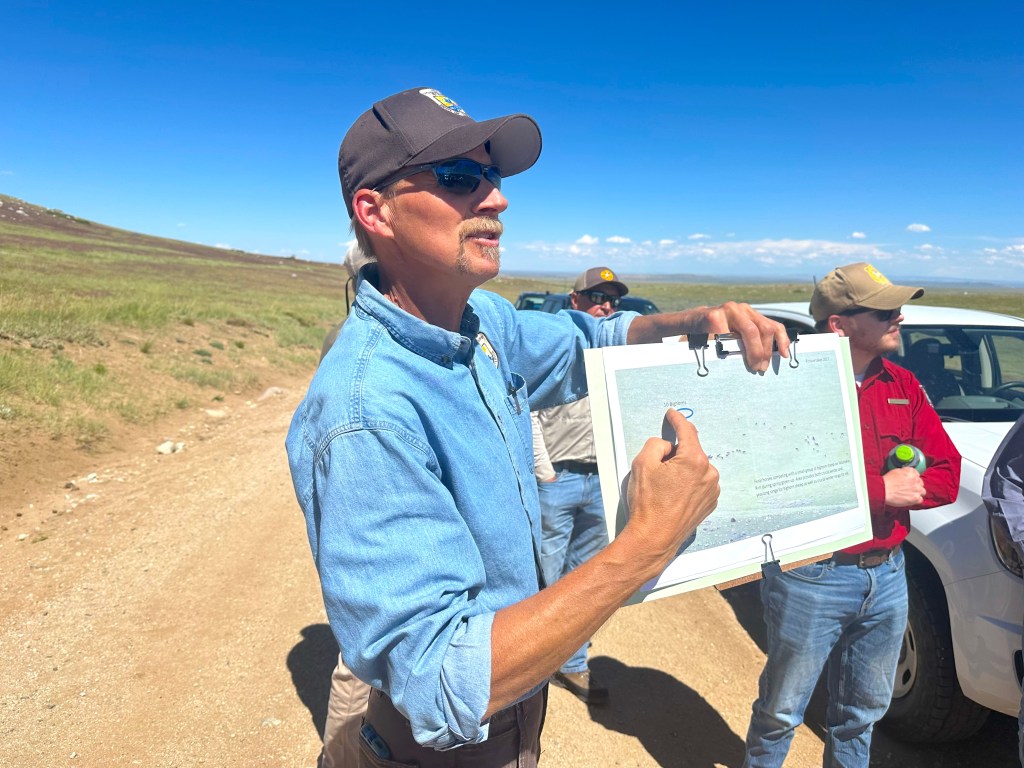
Hnilicka shares Lawson’s views on the immediate ecological impacts of the 2023 and 2024 roundups. The increase in forage that’s now available for wildlife was “very dramatic,” he said.
“It was at an ecological crisis point,” Hnilicka said. “If something wasn’t done, there was no turning back.”
Roughly 7,600 horses were gathered and trucked away over the last two years, he said. Another aerial survey is forthcoming, but in the meantime Hnilicka’s confident there are fewer than “several thousand” horses remaining on the reservation.
Back-of-the-envelope calculations suggested that the 7,600 horses removed from the landscape frees up well over 100 million pounds of forage.
“Now that forage is available for wildlife,” Hnilicka said, “or for natural recycling — protecting the soil.”
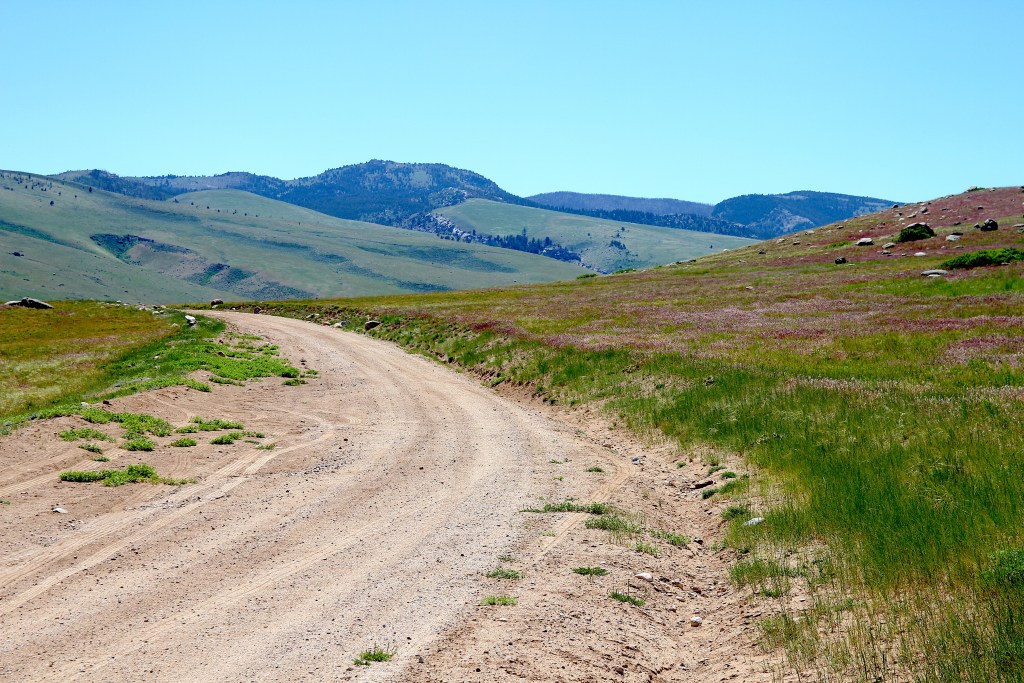
Ahead of the horse removals, wildlife managers on the Wind River Indian Reservation set up around 30 range monitoring sites to scientifically quantify how the range is recovering. One of those sites showed a “six-to-seven-fold increase” in the amount of residual forage remaining after the growing season, according to Hnilicka.
Even the overall look of the land is different. When horses were abundant, Hnilicka would look around and “for miles in every direction” see no residual grasses. Now, the “Wyoming brown and gold” colors of fall have returned to the hillsides sloping off the Wind River Range.
“That’s the residual grass and forbs that are on the landscape that are still there [because they] haven’t been consumed,” Hnilicka said.

The return of those grasses and forbs and less-intensively browsed shrubs has caused ample and welcomed ecological ripple effects, Lawson said. There was a resurgence of mule deer in an area where they need all the help they can get. Pronghorn seemed to thrive, too, and were raising twins in noticeably higher numbers. A herd of 1,000-plus elk returned to calving grounds on high open ridges they’d abandoned because it had been “completely covered in horses.”
A whitetail deer fawn bound across a field in view of Lawson’s truck window as he was mid-conversation discussing the ecological effects of the horse removal.
“We’ll see more and more wildlife now,” he said. “It’s almost like they thanked us.”

I wouldn’t be too quick, wild horses have been here since the Spainish came and left them. The government tends to act first and then discover that their great plan came with unintended consequences. I suggest that you remove only a few each year and auction them off to buyers to support land management. Too many deer can also destructive or whatever other wild creature they want to return. Deer will also attract vicious predators as well as hunters. Just maintain balance. We all maybe riding those horses, when the Green Program goes into effect. Please, don’t kill them.
All horses currently in the Americas descended from selectively bred domestic stock brought here from Europe by boat. The horses at issue are by definition feral domestics. I don’t want them eliminated from public land. I do want their numbers maintained at Appropriate Management Levels. All livestock both managed and feral need to be greatly reduced on our fragile arid public land in favor of native species and ecosystem health and recovery.
How did the horses get their in the 1st place and where were they taken? I’ve been reading a lot lately about horses being rounded up. Some of them have been because humans are encroaching on the land the horses are on and have been for quite some time. Maybe it’s time to start the talk about human overpopulation. It’s long over due in my opinion. Everything I read about trying to save wild animal species involves some kind of human encroachment onto the little bit of land left for animal species. Humans have driven many animal and plant species to extinction. Maybe its way past time to due something about human overpopulation. Humans are the biggest cause of environmental issues in the world. We neuter and spay our animal species to control their populations or we kill them. Maybe humans should control their numbers. It’s way past due.
Where were the horses taken and what was done with them? Is anyone following up on the care and treat t of the horses that were removed?
Nothing was said in this article about what they did with all of the wild horses that they controlled and took i Inhumane control over.. Wyoming has so much land that they can support the horses and all the other wildlife none should take control over the other and hopefully you’re not euthanizing the wild horses that you took control over
Right I like too now what they did with them a no need to remove the horses
They were terrorized and rounded up in the cruelest way possible and then they trucked them to slaughter houses. Many of the horses were loaded on to trucks after they were already wounded, some with broken legs. After the terror of the round up and holding pens they then had to face the horror of the inhumane slaughter houses. It is a totally despicable way to treat any animal especially the feral/wild horses who had done nothing to deserve such a horrible end. https://www.animalsangels.org/investigations/horses/wyomings-wind-river-horses-are-under-attack-11-7-23
I noticed in one of the comments someone said round up the horses and feed them to the wolves because wolves are a problem. And he stated he was a rancher. Need I say more? Like I said ranchers have the BLM in their back pocket so that the cattle can go on these lands instead of the horses. I don’t believe this BS about them caring about wildlife sorry.
This responder articulately expresses my exact reaction to this one sided “a good horse is a dead horse” article. Thank you.
First and foremost, whenever you see an article in which the wild horses are referred to as “feral”, this is a huge red flag because the only people who insist on labeling the wild horses as “feral” are those who want the wild horses removed from the range and are willing to completely ignore scientific evidence which proves that wild horses are native to America. Another red flag is the fact that there are no “before” photos to support the author’s claim that the land improved “overnight” due to wild horses being removed. Any improvement of that nature was more likely a natural occurrence caused by a rainstorm and would have happened even if the wild horses were still there. Another red flag is that the author only mentions the rebounding of animals considered by hunters as “game animals”. What about other wild animals that aren’t normally targeted by hunters? The bottom line is that this article is full of mistruths and bias against wild horses and should not be trusted as a reliable source. Our very own government has been ignoring the true science for years that proves that cattle destroy the land, not wild horses, and has been on a mission to dupe the public into believing that wild horses should be removed from the land instead of protected as the iconic wildlife that they are, and as required by the wild horse and burro act that requires them to be protected on the range, not removed and warehoused in small pens and ending up in slaughterhouses, as many of them have, including the wild horses that were mentioned in this article.
Interesting how they don’t go into detail where they are trucked off to. Most of these horses are sent to slaughter to Mexico or Canada. It is an inhumane process. And let’s not forget that after a while the ranchers will move in with their cattle anyways. Because we know that’s who the BLM is working for 🤷
This is not accurate and another attempt at justifying these inhumane roundups as other articles of late. That’s because of the growing support of Americans wanting to stop these roundups. It’s about money. And special interests. Here are the facts and our iconic wild horses are the scapegoats.
It comes down to money the BLM makes off of the horses, whether it’s selling them at auction or to the slaughterhouse. The big money is the special interest groups, mainly Ranchers, which are giving big money to D. C. and paying pennies for their livestock to graze on our public lands which TAXPAYERS ARE FOOTING 90% OF THE BILL!
According to the CONGRESSIONAL RESEARCH SURVEY:
Cost to graze on privately owned land out west was $23.40 per AUMS which is the amount of monthly forage eaten by a cow and her calf. Meanwhile, the Public Land Grazing Program allows them a bargain price of $1.35 per cow/calf pair. So, points of the study are:
1) Taxpayers fund more than 90% of the cost for commercial ranchers to graze their private livestock on public lands.
2) Direct government expenditures to administer public lands grazing constitute an annual net loss to TAXPAYERS of at least $123 million and more than $500 million when indirect costs are accounted for.
3) Less than 2% of the nations beef supply come from public land grazing livestock.
4)The BLM manages 245 million acres of land. Livestock are allowed to graze on 155 million of those acres while wild horses have been restricted to 27 million acres designated as their habitat and then, still being shared with livestock.
There is growing outrage about this level of capitalism and corruption happening here. There’s growing support , outcries and anger for these round ups to stop immediately. Animals rights groups have shown the Dept of the Interior, the Bureau of Land Management and the Dept of Wildlife and Fisheries proven methods of birth control ingested in feed drops that are much more humane and cost effective but these round ups continue. Sooner or later, their numbers will come down one way or other and eventually prove the damage to fauna and habitat for animals such as grouses are because of the livestock. The real problem will become evident. But they will have to cut the number of livestock at that point and they will have made money off the wild horses and cut their numbers way down, dividing family groups that have been together for generations, terrorize them in the round ups they do, mostly by helicopter, many being maimed or killed in the process, put in pens under SUBSTANDARD CONDITIONS up to a year or more and if they live through that, go to auction, many still being sick from stress or wounds that haven’t healed and if they don’t sell, get sent to slaughterhouses in Mexico or Canada.
Instead they need to put the blame where it lies and take away the livestock that outnumber the wild horses by far. Less money will be changing hands in D. C. and they don’t want it to stop. Meanwhile our iconic wild horses are being slaughtered for money. Nothing else. Those are the facts.
I would appreciate equal reporting WITH THE FACTS on this issue as it’s misleading. I would also appreciate it if this be posted.
As a society, community, as human beings, we must stop this barbaric process. Write or call your representatives in D. C. as well as the representatives in these states allowing it.
MANY SEATS ARE UP FOR GRABS NOVEMBER 5TH IN THE HOUSE AND SENATE. ITS THE PERFECT TIME TO DEMAND THE IMMEDIATE HALT OF THESE ROUND UPS. THEY TARGETED 24,000 WILD HORSES BE TAKEN IN 2024. They are going to accomplish that number by years end. No telling what number they’d set for 2025. We can stop this. Remind them they work for your interests, not theirs. Be their voice. We are their last hope. If we don’t stop this, our majestic icon of the West will be a memory our grandchildren will only know in stories.
Ranchers should pay for their own grazing land or feed. If they don’t have that land then they should have fewer cows. Public lands should be for people to observe the iconic wildlife like wild horses, elk, big horn sheep and wild burros and their livelihood. Wolves and other natural predators are meant to control these animals in a natural way and pace that was intended and not forced or replaced by humans hunting them down. Put to a vote the people of Colorado voted to bring wolves back but they have ranchers trying to fight them as though they own the whole state and their votes are worth more than the rest of ours.
The oldest horse fossil ever found on earth was here in Wyoming, and they spread to the rest of the world from N. America!! Recent research by the Smithsonian, a most reputable research/museum, has shown that horses in N America DID NOT die out like many other species at the end of last Ice Age, in 10,000 BC. New scientific techniques showed they were STIlL alive 8,000 years longer than originally thought!! That means that they were only gone for about 3000 sone odd years before the Spanish re-introduced them in the 1500’s!! Many Indian tribes claim they have always had horses and they may very well be right!!! Just need more scientific analysis advancement. Horses belong here, end of story!!! The winter of 2022-23 here in WY was unusually cold and brutal- killing off almost all deer fawns and antelope, and then the following summer of 2023 was unusually rainy! So of course there was more forage on the Wind River Reservation and most of Wyoming!!! But writer is attributing this to drastic removal of 90% of the reservations wild horses- very flawed and biased conclusion folks!
What and where did all the horses go ? What did the Indian authorities do with them ? Hopefully most went to slaughter not to taxpayers funded pastures for the rest of their lives !
Just wondering if beef cattle graze these Wyoming lands?
The way that this article is written is nothing short of propaganda.
This author states that these horses are “Adaptable, hardy and unencumbered by predation” … as if they are immune from disease, injury, or wolves and big cats.
This author chose the words “7600 horses were gathered and trucked away over the last two years”. Gathered implies that they simply came together and then they hopped on a truck and toodled on down the road. Wow Mike Koshmrl, you could write a children’s book out of this.
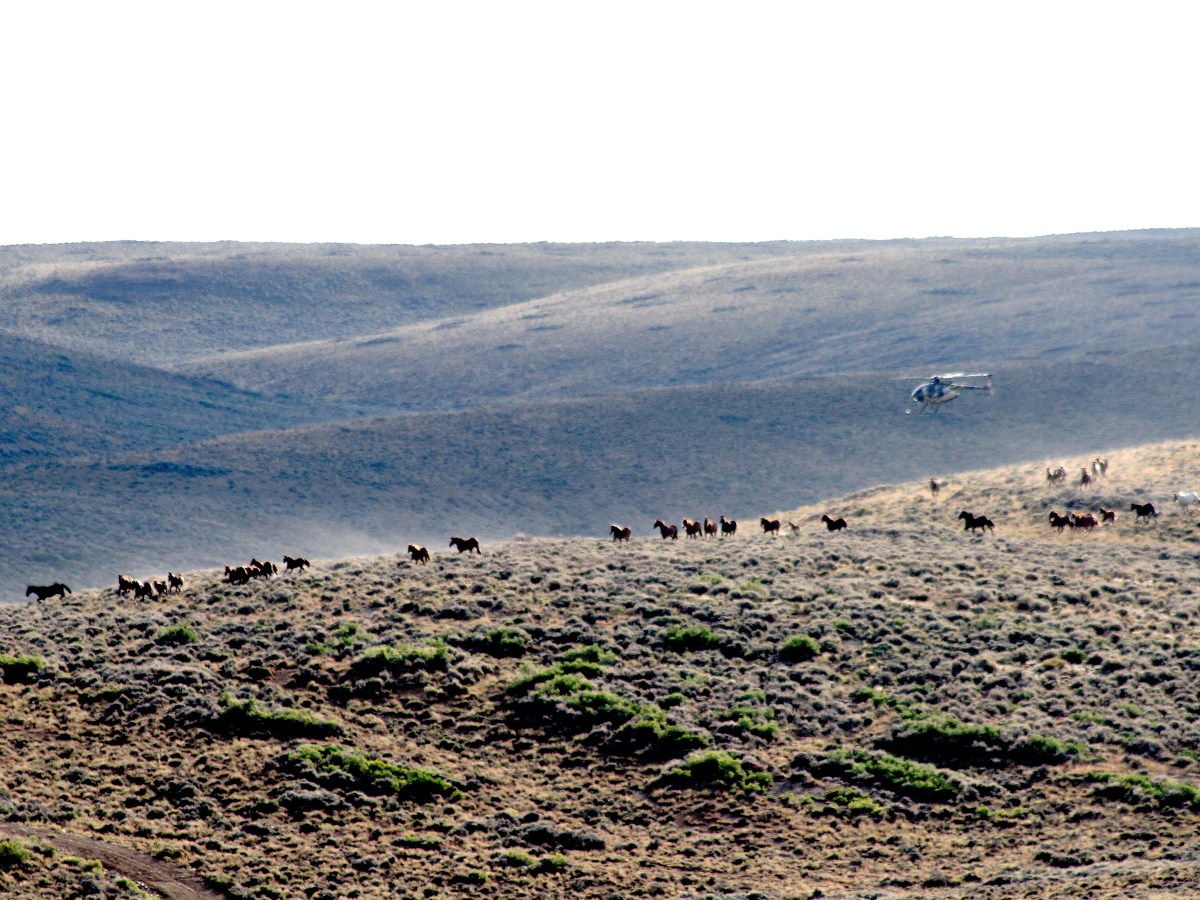
Instead, these horses were not “gathered”, but in fact are located with helicopters and then driven in terror across rough terrain. They may be sure-footed normally, but running for their lives they are often injured, young separated from their mothers. If they’re injured, the helicopter may circle around so that someone can shoot at them, maybe killing them, maybe just further injuring them.
The ones that do make it to the corrals are exhausted, possibly injured, terrified. Horses are prey animals and they are in fear for their lives. The people conducting these roundups are usually in it for a paycheck. Some may have compassion. Some may darker undertones. None of them will risk their life to help a wild animal that is fighting for it’s life.
Now what happens? They might get water. They might not. They might get hay or food, but even that is less likely (as that costs money). Hopefully they aren’t harassed or tortured. They will spend weeks or months in fear. The lucky ones will get adopted. The rest will be trucked to Canada or Mexico (still without food) to be put through a greater hell before being torturously put out of their misery.
Horses are not cattle. They are not bred for milk or meat (at least not in the US). But, they are victims of inconvenience. Could they be rounded up more humanely? Yes, but that takes time and money (and compassion). Could they get medicine to curb their birth rates? Yes, but that takes time and money (and compassion).
The BLM is bad enough, but I would expect more from the Wind River Indian Reservation leaders. More care should be taken with these horses. They are amazingly hardy, have great hooves and would make wonderful additions to stables around the country if we would just take the time and money and compassion to do this better.
But, then again, compassion has been running at an all time low these days.
I have been studying on what happens during these round ups or gatherings and you are so right the horses are terrorized, seriously wounded, some even break their legs. When they are held in holding pens the terror and torture only increases. After that they may well be trucked for long periods of time in horrendous conditions only to face their worst terror in the slaughterhouse. It is inhumane and inexcusable. Those who participate in these round ups are guilty of criminal animal cruelty. I hope they wake up one day and realize what a monstrous thing they have participated in and know in their hearts that they have no possible excuse. My dad used to say that people who were cruel to animals would stand before God one day and give an answer for what they have done.
Right on! Excellent info and commentary!
It makes me sad that I see all these people in the comments asking what happened to the horses. While I understand that population control is needed, an extermination will upset the balance of the ecological environment. For those asking about where the horses went, either Canada or Mexico where they will be made into dog food and glue.
Ya think? Need to bring back slaughter houses for horses. Horse meat is good. But our country won’t allow it. I’m a rancher, I own several horses. The nonsense has got to stop.
Wolves are a huge problem here. Maybe round up the weak and sick horses and feed the wolves
This shows what’s possible! If BLM would do this, we could once again be seeing native wildlife instead of non-native invasive feral livestock. The “Wild” Horse and Burro Act was a mistake that resulted in an ecological travesty. It should be repealed.
Why didnt this writer address the cattle barons who push for hirses to be rounded up and sent to slaughter?! If he is so educated in all this why leave such important aspect of grazing for wildlife, out?
So what happens to the horses? Is there a way to curb reproduction to coexist
I agree with the comment about the cattle. Cows are being raised in crates with NO life at all there are so many, the cruelty in that industry is beyond unimaginable, same with pigs and chickens, but the horses are the problem. Cattle contribution to pollution, land monopolies and global warming are common knowledge. I don’t buy it as THE problem or a viable solution either, Charles.
Cattle tear the hell out of the land! Far, far more than any horse!!! Sheep too! I can see where herd size should be managed, but maybe the BLM needs to quit trying to “be the boss” & quit being a hard ass. There’s been (safe) birth control darting being done in other states by BLM that actually care, I know, rare & volunteers who have been involved in it for years. All this is, is a way to get paid for the land use by selling grazing leases!!! And I can find as many pics online that show the land benefits from having horses on it!!! And that it don’t with cattle & sheep! We’re not all naive! We don’t all believe everything you people say!
What was done with the horses that were trucked away?
Round up the horses, ship them off to holding pens and slaughter, and bring in the sacred cows. Without comprehensive PZP contraception implementation the process will have to be repeated over and over again. There’s no mention of this common sense measure so I have to doubt the sincerity and commitment of these land managers.
“Back-of-the-envelope calculations suggested that the 7,600 horses removed from the landscape frees up well over 100 million pounds of forage.”
How much native forage do the millions of privately-owned cattle grazing on public lands consume? The damage inflicted by cattle grazing is orders of magnitude higher. Federal grazing subsidies cost American taxpayers hundreds of millions of dollars annually and we get cattle blighted public lands in return. What a deal.
Horses pull out the roots of the grass. Cattle do not
I am not buying this info, that removing 7000 (probably killed) horses solved all the wildlife problems. First , managing wildlife areas means sustaining many different wildlife species. When I hear REMOVING certain species of wildlife –mountain lions, or horses, or wolves or coyotes — it’s almost always an effort to increase the population of certain wildlife for human consumption. Balancing a variety of wildlife species is the key . If these “wildlife managers” were interested in managing wildlife they would know about the Pregnancy Zone Protein (PZP) for horses. PZP is a humane, cheap way to keep to give a birth control to the mares and keep the horse population in BALANCE. This is a 1 MILLION acre reservation and it can handle 2000 (or MORE) wild horses, that is one horse every 500 acres. Hire some biologist to do basic scientific research numbers to use for sustaining wildlife species in this area.
More BLM propaganda
The BLM doesn’t control things on the reservation. You just don’t like the article because its the truth.
Sounds necessary, but the description of the vegetation recovery doesn’t ring true. If the overgrazing was as bad as described, then few native bunchgrasses would be present, and the return of vegetation must primarily be ungrazed cheatgrass with an abundant seed set to germinate this fall. It will take a lot more than removing the horses to overcome that.
Cheat Grass was imported by our goverenment ,and except in its initial green growth is not palatable to most grazing animals and thus creates a horrible wildfire nightmare.
THANK YOU FOR THE PERSPECTIVE
PLEASE SHARE WITH NEVADA DOW
We see the same effects
They are decimating our deserts and mountains
I agree the cattle are decimating our deserts and mountains
So where did the take the wild horses ??
If you want total recovery of “public lands”, that are maintained by all taxpayers, remove the cattle.
Why are we paying and maintaining land for the cattle industry?
Why is every answer to problems on public land to destroy wildlife?
Run it down, kill it, what a sham in maintaining public lands.
Ranchers own or lease the land they use. Cattle are one of the important reasons for a thriving helthy American human population because they are the steaks, hamburgers, pot roasts, etc that we eat.
Art Lawson worked directly with kill buyers to sell the horses for slaughter, which he happily endorsed and is a violation of the 1971 Wild Horse and Burro Protection Act. He’s not an objective source of information. In Equine Collaborative International law suit, he will be deposed. We’d love to tell our side of the story. Our tort claims have been filed and Dept. of Justice and BLM offices have replied if they received the claim.
Until the cows come in because we don’t talk about that.
Where are the horses removed
Horses originated in North America. They spread from North America to the rest of the world before the last ice age. Their fossil record is here. They vanished from North America during the last ice age and were reintroduced by Europeans. They belong here .
Horses were native to North America. They were likely hunted to extinction by Paleolithic humans along with another 35 genera of North American fauna.
They are no longer native to North America. We need to follow what Australia does: non-native feral species are taken out.
Horses have destroyed the environment along the Salt River in AZ and are doing the same thing in the NF around Show Low – you can’t walk 10 yards without seeing huge piles of horse manure.
This is a shallow assessment of what is happening in this ecosystem. It rashly assigns blame on the wild horses but fails to holistically analyze the major factors in order the blame the wild horses. Starting out by claiming they are non-native is a real red-flag concerning the prejudice of this very slanted report. It overlooks so much, ignores so much, as to why the situation developed as it did. This is anything but an honest and fair report!
Wonderful and accurate article about the enhancement of wildlife forage due to horse removal.. great to get accurate views of Mr. Hnilicka USFWF and with tribal G&G Mr. Lawson for their partnership with their success in removing feral horses and enhancing habitat on the Wind River Indian Reservation..
They are not native and therefore not “wild” – they are feral animals. Equine species in North America went extinct a long time ago.
How come the cattle issue was never addressed
Because cows are sacred.
Also very good to eat!
The feral horses were on tribal grounds and this was the only reason such a massive roundup could occur. Tribes do not have to abide by the BLM and federal rules in the same manner as the BLM. I believe they were shipped to slaughter in Canada to help pay for the very expensive roundup, well over 1 million dollars. These are non native invasive animals that are destroying the habitat of our native wildlife. Why we spend millions to stop invasive nonnative grasses, aquatic snails and weeds, etc., but let feral horses and donkeys destroy native rangeland is incredible. They are displacing the native sage grouse as they destroy the habitat and the grouse are on the verge of endangered species listing. The comments about cattle grazing on tribal land are unfounded as the tribe decides whether that happens or not. They did not remove all the feral horses from the tribal lands but brought the number down where they can be controlled on a regular basis. I don’t know about you but this seems like a win/ win situation and a lot more humane than locking the captured horses up and feeding them with taxpayers $$ for the rest of their miserable life. Watching any animal starve on a long cold winter is terrible. Without this control that is exactly what was happening every winter. The change to the reservation rangeland is incredible! Just by removing an animal that does not belong there in the first place. Thanks for reporting on this effort to restore the land to what it should be.
Well said.
Horses were here for millions of years until humans wiped them out just a fraction of a second ago in ecological time. To worship some artificial baseline where they don’t exist here is to ignore all ecological evidence.
The reaction to overpopulated deer isn’t to wipe them all out down to the last individual. It shouldn’t be the reaction here either. Especially considering this is likely just paving the way for cattle grazing, which is much, much worse than feral horses.
The reaction to overpopulated deer is to sell more deer tags, increase the season lenght, or increase limits. There’s no hunting season for horses.
And thank goodness for that
Millions of cows and millions of miles of barbed wire don’t belong on the landscape either. The damage inflicted by their presence seems to have escaped consideration.
But we eat cows! At least I do. You can’t even look sideways at a “wild” horse without having to go to social media court!
No kidding ! When things go south and people start hunting and eating them, what happens then ? Let’s have a hunting season for them !
Amazing. People from Fish and Wildlife and the Bureau of Land Management are justifying what they do for a paycheck.
No mention of where the removed horses have been removed to. No mention of the cattle that are going to be moved in.
The brink-of-the-apocalypse language is a nice touch too.
The wild horses are wildlife too! They need to have free range to survive. If it’s public lands, keep the cattle out and there will be room for all wildlife, including the mustangs.
Horses are NOT wildlife. They are non-native invasive feral livestock.
When they want to get rid of people they call them illegal, vermin, wetback therefore dehumanizing them. When you want to get rid of an animal call it non-native and feral. What is non native and feral are cattle moved onto our wild Public lands. Public means all of us not just ranchers. Ranchers profit from their stock the rest of us do not. Since they don’t pay going rate for pasture what gives them the right to it more than other taxpayers or the wild horses who live there? Other tax payers buy park passes too.
You should also address what happens to the wild native horses once they are “trucked” away.
I’m of the belief that wild horses are part of an American heritage. The roundups done appear to be brutal and unless someone corrects me, the horses are just put into the slaughter pipeline.
In various parts of our country wildlife get displaced(e.g., elk around Fort Riley in Kansas). It is a responsibility to protect the environment but also the wildlife.
In Colorado, recently the reintroduction of wolves, resulted in the Need to kill the male and relocate the family.
My point here is human intervention needs to be well thought out, with the wisdom of Teddy Roosevelt. Not just convenient/ profit motivated behaviors— like the slaughter pipeline. I suggest that those that think that’s humane, do the homework on this. How sad for the horses. And what does it say about our humanity?
Others have posted about cattle grazing and no response.
If more grass needs to be planted then let’s do so and not make villains of antelope, wolves, elk, or horses.
Opening the book for the likes of new(er) specie! It is appreciated here, thankyou very much!
This is very, very sad to read. How can you take any animal from its habitat and destroy it because you think it’s helpful? You need to have the same thing done to you. Put yourself in their predicament, let’s see how you fare. Sad, sad very 😢
What will happen to the 1000s of horses they removed?
What has happened to the horses?
How many cattle are allowed to roam on the same land?
I think the better question is how much faster will bison be re-established with the removal of horses? I’ve been following the new bison releases at Wind River with some excitement. Any momentum from horse and cattle grazing to natural grazing by bison is so exciting!
Exactly!!!
Unfortunately, in the roundup, many foals were separated from their mothers. Also, because some of the horses were elderly, they were injured in the roundup — and were shot.
The horses not adopted were trucked off to Canada or Mexico and killed for food. Nice end to the beautiful horses that once roed across the land.
Thank you, BLM
Strange that the author doesn’t mention any of that.
This isn’t BLM. It’s the Wind River Indian Reservation.
They will make great dog food
Yes, by all means let’s placate the hunters & ranchers by removing the horses, & then try to justify it however you can. Bet if you pulled all the cattle off those Public lands it would green up just the same.
This isn’t public land. It’s the Wind River Indian Reservation,
Perhaps those opposed to this should allow the good people of the Wind River Reservation to decide how they want to govern the Wind River Reservation. The land we live on was once theirs, I might add.
One species should not thrive at the expense of all others.
And food prices would rise because of your well thought out plan.
This was reservation land. Not public land.
Were those horses adopted or slaughtered and was attention paid to maintaining genetic diversity among the remaining horses?
Feral horse management could possibly be accomplished with the introduction of a wolf population into the area to naturally reduce the aged feral and weak young of the herd.
There is a thriving wolf and grizzly population in the area. They are much more likely to eat native wildlife that horses, with sharp hooves and larger size.
They put them in pens where they fight because there is no room to move. They also ship them to Mexico to be brutally slaughtered. By the way. We are not native to this land either. The only ones qualified for the native title are the American Indians, and look what this country did to them.
How many cattle and sheep are out there or do they not count? You’re making the wild horses the scapegoat and not addressing the damage done by cattle and sheep? Wasn’t cheatgrass seeded by ranchers for their cattle?
Cori Robertson-This is :NOT public land. It is the Wind River Indian Reservartion. The tribes are not constrained to manage according to wild horse activist direction-they are soveriegn. The felt removal was needed so they did it-not about cattle or ranchers-about what the tribes felt was needed for the health of tribal lands
Thank you for exposing the damage that feral horses were doing to the reservation. This is also ongoing in a large portion of South West Wyoming particularly Sweetwater County and needs to be seriously addressed.
What was done with the 7600 horses removed from the Wind River land? Were that many horses euthanized??
There was no reference point or quantifiable metric that was used to make the claim the eco system is recovering from the horse removal. There was nothing that justified the removal. Yes, they were sold for slaughter and profit. At least they weren’t driven into ditched and shit the way they used to be. The nefarious reason this tragedy was allowed hopefully will come to light in the future. If a reduction was actually justified of these intelligent, familial, iconic creatures you’ll never convince me that it couldn’t have been done with more respect to life.
Yeah I’m sure a slaughter house in Mexico was more humane. Maybe you should go witness what happens in one
Another great article by Mike based on facts, best available science and on-site feed back from actual wildlife managers. We need more information of this caliber which is not based on emotions and uninformed opinions. Keep it up Mike.
Wildlife enthusiasts need to support the removal of feral horses from tribal and public lands. It is a shame that they are so destructive to the habitat required for native wildlife species. Feral horses are not native wildlife…
As usual, Mike Koshmrl’s reporting is outstanding. It’s a welcome surprise that the Wind River Reservation folks are realizing that overgrazing by “wild” horses — let’s just call them unattached — wiped out natural, nutritional, forage needed by wildlife.
But what’s needed now is a review of “wild” horse history. Most of these animals are not mustangs, real wild horses. Many have been dumped on the range by unscrupulous people who just don’t want them, or can’t afford them, any more. It’s called abandonment. We’d like to know more about where the problem started. It would help to review the numbers of actual wild mustangs on our ranges. What’s the balance point here? What creates overpopulation?
I and probably many other WyoFile readers would appreciate Mr. Koshmrl’s deft hand on this review.
Great news and no surprise to anyone that has been paying attention. I do wish the author/editor would use the more appropriate label of “feral” horses instead of “wild.” I know the latter is in the federal legislation that is gumming up the works, but these horses are non-native, invasive, and feral, which are all more descriptive of their true character.
Where do the horses end up? Nevada? In France’s butcher shops? Land fills? How about food product processors in USA for dogs?🆗
horses do need to be removed so wild native species can recover and thrive. Sad, but needs to happen.
I appreciate the need for balance in the ecosystem but what is notably missing from this article -which highlights the benefits of horse removal to the grasslands – is a fair and balanced assessment of what the heck happened to the 7500 horses removed. A majority of Americans do not like our wild horses ending up in brutal Mexican slaughter houses. So how about completing the story here Mike? How about some additional solid investigative journalism on what is really happening to the removed mustangs? Please look into answering the questions I and others raise here – what percentage of these horses get adopted, how many end up slaughtered (or turned into dog food), what is the makeup of our noble wild mustangs (which many think after hundreds of years are an entitled heir to, and part of our western ecosystems as well as a part of the American West’s rich legacy) or how many are domesticted abandoned horses? Are there fines for abandoning horses? If so, are they enforced? How resourceful has BLM been to finding other solutions for both limiting growth (like for example – possible limited sterilization, gelding etc. as is done for some of the outer bank herds in Maryland) and are there other opportunities that could be explored for the removed horses besides individual adoptions or slaughter…..and speaking of the latter – what percentage of those adopted ultimately end up sent off to be slaughtered once the adopters stop receiving payouts from BLM.
I saw a fascinating mustang competition between adopters who spent months training their rescued mustangs -.showcasing how exceptional these horses can be under saddle……what more creative satisfying resolutions for those rounded up could BLM come up with….certainly they could try pursuing private and non-profit partnerships toward that end….. and whatever the cost, could it possibly be less than the.moneynthe government is shelling out to fight the ongoing court battles over the determination of the future of these equine residents of reservation, state and national grasslands?
Where do these horses end up? Where are they shipped off to and to what kind of facilities?
A quick google search will provide as much detail as you want, but they get shipped to corrals all over the US where they are cared for at tax payers expense ($1M per day) until they die of old age.
Dead. They end up dead. Horses originally came from North America. Look it up
During a time when there were dire wolves, short faced bears, saber toothed cats, American lions, cave lions, giant ground sloths, wooly mammoths, and other large predators and animals. That landscape doesn’t exist anymore.