


WHITE MOUNTAIN—“That’s a lot of horses,” lamented Cheyenne resident Robyn Smith from a high-desert ridgeline.

It wasn’t her first exasperated exclamation. “Argh, oh crap,” was her immediate reaction to learning a federal judge had given the Bureau of Land Management the OK to proceed with plans to fully remove two wild horse herds from the landscape in southwest Wyoming.
A retired architect donning a “Return to Freedom” ball cap that featured a bucking mustang, Smith proudly described herself as a wild horse advocate. On this crisp Thursday morning in the hill country north of Interstate 80, she was doing one of her favorite things: Watching mustangs.
Smith’s interest in the equines — an icon of the West, albeit a nonnative one — had evolved organically into activism, stemming from a wildlife photography hobby. “We started doing more horse photography,” she said, “and then we started [wondering], ‘Well, what do you mean you’re going to round them up?’”
Soon, Smith was invested enough that she was sitting through wild horse-related legal proceedings and traveling to observe roundups — government run wild-horse gathers exactly like what was happening in the distance.

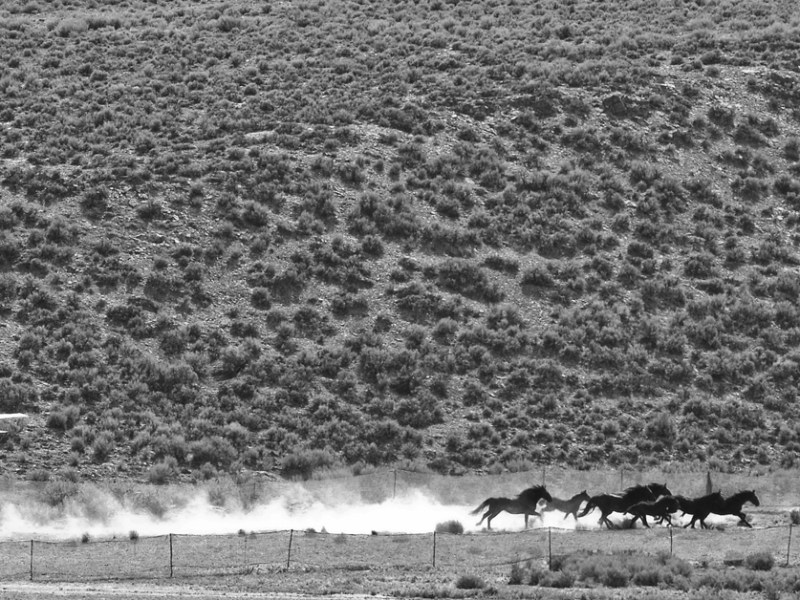
While Smith and a dozen or so others watched on for hours, a helicopter commissioned by the Bureau of Land Management herded one band of horses, then another, toward a trap. Once inside, they were sorted and trucked away.
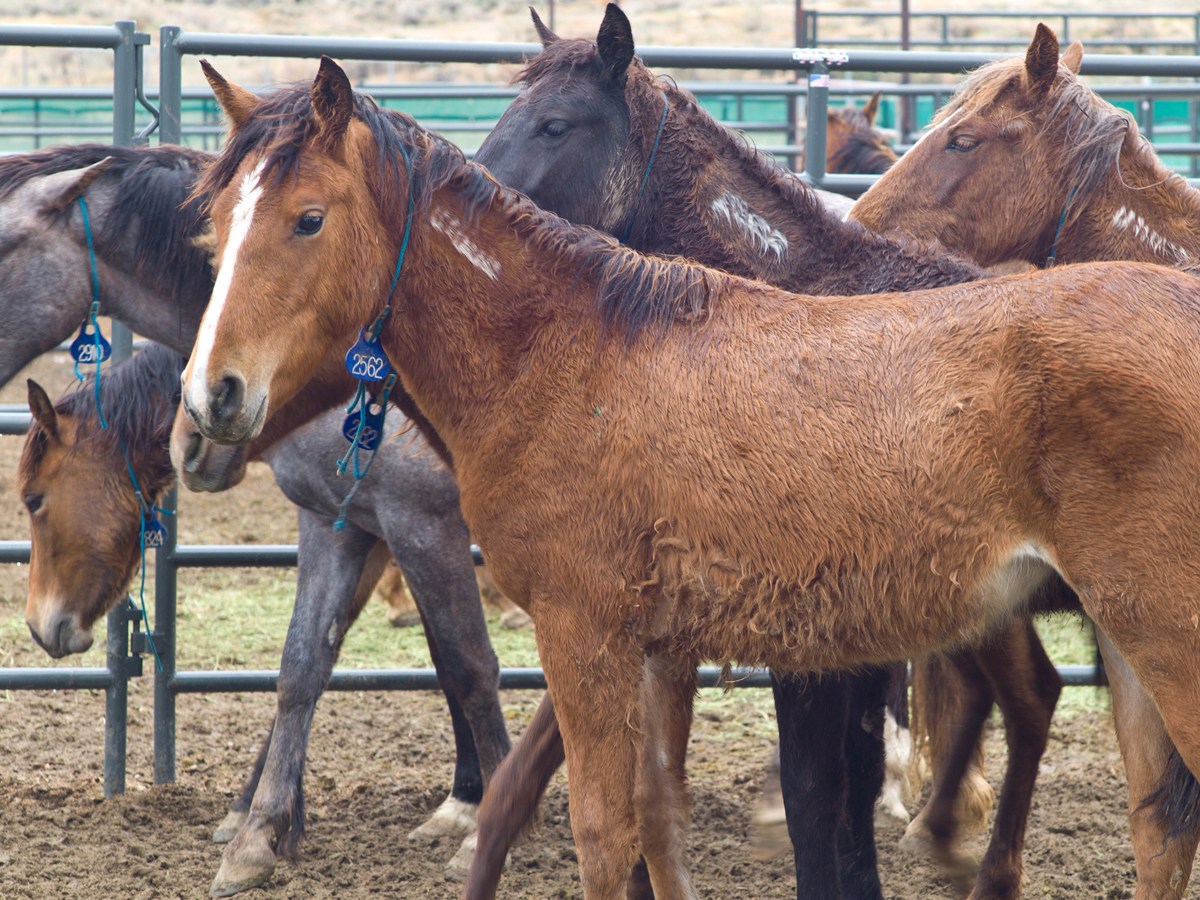
The animals were members of what the BLM considers the White Mountain Herd. It’s vastly overpopulated, at least going by what the federal agency considers an “appropriate” number for this landscape. By day’s end, 144 animals — 52 stallions, 63 mares and 29 foals — had been removed, which meant the crews were almost exactly a quarter of the way to their goal of taking 586 mustangs off the range over the next couple weeks.
The White Mountain Herd’s horses are well known enough that they’re being allowed to persist. The BLM even advertises a scenic drive that winds through the heart of the herd management area. The plan is to maintain in the neighborhood of 205 to 300 horses in this region, which reaches from Rock Springs northwest to Seedskadee National Wildlife Refuge.

The Adobe Town Herd, in the Red Desert, is also being allowed to persist: BLM plans call for 225-450 horses here.
The neighboring Salt Wells and Great Divide Basin herds, meanwhile, are slated for elimination.
Wild horses compete with sheep, cattle and native wildlife for forage and other resources. That fact is particularly problematic in the eyes of some, and a prime driver of horse policy in this “checkerboard” swath of southwest Wyoming where private and federal land interchange in square-mile blocks that meet at the corners. The cattle and sheep-centric Rock Springs Grazing Association owns and leases about 1.1 million acres of private land in the checkerboard — and for decades fought the BLM over wild horses.
Litigation and more litigation
A year ago, the association sued, asking a court to compel federal land managers to remove free-ranging mustangs from their unfenced land.
After the BLM finalized an environmental impact statement calling for trimming the two herds and eliminating two others in spring 2023, a coalition of 11 wild-horse advocates came together to file a suit of their own challenging the decision.
U.S. District Court of Wyoming Judge Kelly Rankin, a Biden administration appointee, ruled in the BLM’s favor in both lawsuits on Wednesday.
“The Court agrees that … wild horses are improperly maintained on private lands,” the federal judge wrote in his decision on the Rock Springs Grazing Association’s complaint. “However, this maintenance, although ‘improper,’ does not necessarily require an immediate remedy.”

Rankin again sided with the government on each of the “litany” of claims brought by wild horse advocates, who argued the BLM arbitrarily and capriciously violated the Wild Free-Roaming Horses and Burros Act of 1971 and several other federal laws.
“Ultimately, however, the Court finds that each contention fails for either conflating the [BLM’s Resource Management Plan amendment] with a removal decision, misconstruing BLM’s obligations, or [because it is] contradicted by the record,” the judge wrote.
Lyons, Colorado resident Carol Walker was one of the plaintiffs. The day after Rankin’s ruling, she joined Smith on the ridgeline observing the roundup.
“I don’t do it because I like it,” Walker said. “It’s because I know the contractors will treat the horses better if there’s public here.”

Walker joined an appeal filed Friday in the Tenth Circuit Court of Appeals.
“My concern is the BLM is going to try to zero out these herds as fast as they can,” she said, “before our appeal even gets here.”
Represented by Eubanks and Associates, a similar coalition of wild horse advocates, environmental groups and individuals joined the appeal.
“We expected this case to be decided by a higher court, and we are returning to the Tenth Circuit Court of Appeals, where we have already twice prevailed in defending the Red Desert’s wild horses from this special-interest-driven eradication plan,” Suzanne Roy, executive director of American Wild Horse Conservation, said in a statement.

A phone call to the Rock Springs Grazing Association went unreturned.
Because of the protracted legal battle that’s likely to be extended further yet, it’s unlikely that BLM will immediately remove the entire Salt Wells and Great Divide Basin herds, said Brad Purdy, the agency’s deputy state director for communications. Although the agency completed a revision to its Resource Management Plan for wild horses — and Rankin upheld that plan — there’s still a requirement to study the action of eliminating a herd under the National Environmental Policy Act.
Roundups could continue
BLM-Wyoming started that NEPA study process in June, proposing to remove roughly 5,000 mustangs from three of the four horse management areas in the Rock Springs Field Office — including the two complete herd eliminations. With the appeal expected, though, it’s unlikely that the required environmental assessment will be completed anytime soon, Purdy said.
That’s not to say federal contractors will stop rounding up horses in the checkerboard anytime soon.

Nationally, BLM is aiming to take 20,000 wild horses off the landscape in 2024. Numbers have come down from the high point, but the current population of about 74,000 horses and wild burros nationwide is still nearly three times the “appropriate” management level — a dynamic that holds true in southwest Wyoming, where there are thousands more horses than the agency and many residents desire.
“Could BLM do a gather to bring those [herds] back down to the [target population]? I think we could,” Purdy said. “But I don’t think we could zero out the herd, because that’s under litigation.” Essentially, intensive roundups throughout the region could continue — and if they do, it’ll put BLM in a better position to complete the whole herd removals, if or when the litigation wraps up.

For horse advocates, those roundups aren’t especially fun. Descriptions like “unspeakable” and “cruel” were common among the observers. Cheyenne resident Barry Smith — Robyn Smith’s husband — wouldn’t even watch.
“I get too emotional,” he explained from the cab of his SUV, where he waited out the roundup.
“Some of the pilots are better than others,” Barry Smith said. “Some are pretty good, and if the horses slow down, they kind of hold back and stay higher. Others overrun them, I think.”
Jay D’Ewart, the BLM Rock Springs Field Office’s wild horse and burro specialist, was the man in charge Thursday. While taking lunch in his pickup, he professed to having something in common with the wild horse advocates who kept an eye on his operation.

“I’m just like them, I love horses,” D’Ewart said, “I own them, I use them, I ride them — I just like it.”
He loved seven previously rounded-up mustangs so much, in fact, that he took them home. Some of those horses came from herds in line to be eliminated.
D’Ewart hadn’t yet caught up on the court ruling, having been tied up prepping for the weeks-long roundup. But it’s a decision that could make him a busy man.

Why are you doing it the way they are. These animals have been there for so long it’s their home. And when they say eliminate, I sure hope they are going to a safe place and taken care of.
No, they’re not going to a safe place. They get auctioned off and most people resell them too slaughter houses. Most of that land was purchased for the mustangs. This needs to stop.
To the woman who commented about the the horse being and invasive species so are humans dear so are hum
Money better spent cleaning up mean spirited republican leadership aiming to destroy the wild horses altogether. GREEDY CAPITOLIST REPUBLICONS have,always legislated against the Endangered Species Act and other programs to savev precious wildlife ecosystems. The Cattleman’s Club should be vanished from the face of the Earth. These republicans are fighting against humanity as well. Eliminate any competition of grazing wildlife so they can ENHANCE their WALLETS. FATASS GREEDY REPUBLICONS, rapists, murderers, RIGHTWING GANG ACTIVITY. THEY ALL SHOULD BE TRAMPLED BY HERDS OF WILD HORSES
The horses have been there longer than the people are wanting to eliminate them. Basically just like so many have done to the Native American who was originally here also. Don’t people have anything better to do!!!
What happens to the horses post-removal? That seems like a good addition to the article.
It seems like their goal is to eliminate the complete existence of the horses & burros all over the West. What will happen to these horses? Can they commit to us that not one of them will be sent to kill pens and end up to be slaughtered?
You are absolutely correct
In the past, there have been adoptions at the auctions, but there are always people from the slaughterhouses there. They have some kind of rules they have to follow, but I know at the horrific roundup in Nevada, many of the slaughterhouse people were there under false names, bought horses, then it was found out later, that these people had broken the law. Sometimes the horses get transferred around before going to the slaughterhouse, to throw authorities off. Usually some will come down to a on City, Colorado, where the inmates at the prison, break the horses for handling and riding, then people come and buy them for themselves. But Wyoming, having some of the most odd, argumentative people you’d never want to meet, used the word “eliminate” this time, which really worries me. Remember that this is the state where a man dragged a wounded wolf into a crowded bar, where he and others harassed the dying wolf for hours, before he dragged the wolf out behind the bar and shot it dead. Only one person reported it to the authorities. Authorities did nothing. They investigated, then did nothing. Evidently, the man who dragged the wolf into the bar, has a lot of family in the area, many of whom were in the bar that night the wolf was killed. Being such a small town, everybody is afraid of that family as they are well known from prior incidents, for bullying other locals. I don’t trust people from Wyoming, when it comes to wildlife. They don’t appreciate what they’ve got, so we’re going to have to jump in and help these horses or God only knows what they’ll do to these horses! Anyone from NOCO going up there to the round ups? I’m disabled but I don’t require any help, just a ride. If anyone is protesting, I’d like that information, too, please.
The unpleasant fact is that horses are an introduced, invasive species with no natural predators. So are cattle and sheep, but we control their populations on public lands, a solution we need to do with horses.
Another sad commentary on Wyoming’s treatment of animals in the wild. If it’s not snowmobiles, it’s helicopters. Surely some agency could keep better track of the herd’s size and develop a successful program to sell or donate these excess animals to “homes” that will care for them. I’m thinking private individuals, programs that help people with PTSD, and outfitters – to name a few options.
This just shows the short-sightedness, ignorance, and soullessness man.
BLM’s own employee told RSGA to sue her agency to get the horses removal. This agency is anything but pro horse. RSGA sees blood red. And yeah, I’m not exactly calm about this. Wyoming’s stance on wild horses has cemented my own boycott on beef. I know one person isn’t going to change the landscape but I feel better.
Whoever thought up the checkerboard lands set it up for the horses to fail. PERIOD. It was designed to eventually round horses up.
Ever watch a helicopter pilot strike an animal with its skids because the horses wouldn’t go where they wanted them to? Or knock a burro into somersaults? It’s sickening. There no consequences. Or BLM employee kicking an animal in the face? Or how about the contractor tying his saddle horse to the fence on the other side of a wild stallion. Predictably the stallion charged the gate and broke its neck.
The abuse continues unabated. The agency charged with protecting our wild horses simply turns a blind eye. And horse hating judges allows this stuff to continue unabated.
What exactly is the checkerboard land? Thank you for detailing the true cruelty of helicopter round ups! It’s horrible to say the least. BLM & the department of agriculture work hand in hand, and we know the $$$ backing of the government.
http://www.rangemagazine.com . You can print out their free special articles on wild horse roundups.
Thank God for Wyofile!
It is a fact that wild horses can pose a threat to other wildlife due to their consumption on lands. However, The cattle industry has millions of cattle on public lands in the West which facts show to be an unproductive industry that exists only due to the fact that public range cattle farmers are heavily subsidized by the same Federal government that they complain about. Facts? There are plenty to support this statement–see George Wuethner’s Welfare Ranching: The Subsidized Destruction of the American West.
Thanks for the information, I will definitely read this article. Too bad more folks have no idea. Even if there are too many horses right now, the BLM are sweeping them up everywhere…all the while cattle/sheep continue to devastate the land.
Indigenous at one time but went extinct. Current lines are from Europe and Asia. I wouldn’t consider them feral but as they have nothing in the environment that is a predator for them, they can reproduce and grow herds without any natural interference .
Here is some great information if you want to know more.
http://www.wildhorserange.org/myth-busters.html
The feral horse supporters have a lot of emotional involvement and very little factual information, it seems. I’m not disparaging their point of view. I have a lot of emotional involvement with the native wildlife that are being pushed out by the feral horse herds, but I try to at least be informed and realistic. They like to make it a simple horses-vs-cattle argument, but the reality is that the native flora and fauna are being devastated in many areas by the over-population of feral horses, and there are no real solutions other than eliminating the horses. I support common sense solutions from the BLM and other land managers.
Thank this common sense reply. Too much of pretty much anything is a problem, and demanding others sacrifice their ability to raise food for humans by prioritizing feral horses is not real smart.
Thank you for this very accurate and well said statement. I suspect many kinds of animals have lived not only on Wyoming land, but all land and water over time. Why only turn usage back 100 years how about 500 or a thousand or more?
I say this: Horses and dogs are Gods special gift to humans. Both have been living with and helping humans for thousands of years. Horses have helped change the history of the world involving migration, transportation, with their loyal dogs always following along.
Injuring animals in any way is shameful, running horses to death with helicopters is cowardly and despicable. Selling the survivors to the killers to be made into steaks for those who eat horsemeat is cannibalism! You may not agree but that’s my take on this subject.
So what happens with the horses they gather? We live across from Wild Horse Ranch…the real estate company was paid to get wild horses. The horses are now overcrowded and neglected, not fenced in properly, and a problem for home owners. They should stay on their natural habitat, what they have developed as their natural habitat. BLM land should not be a cheap way for cattle and sheep ranchers to graze their animals.
What about the native wildlife (deer, antelope, elk) that the horses displace and outcompete? Where should they inhabit?
If you want to call them Wild Horses, I think we need to manage them as wildlife and not this “Welfare for Feral Horses on public lands” (Wild Horse and Burro Act) that we are stuck in that severely and negatively impacts actual wildlife.
The overall big problem is that ol’ elephant in the room – livestock overgrazing. Plenty of evidence shows that there is trespass grazing, that ranchers take more than their fair share of water, grazing etc. A recent concern over thirsty wild horses at Muddy Creek for example was due to the rancher there taking water for his alfalfa fields/cattle AND overstaying welcome.
It just takes a bit of delving to see that livestock overgrazing is the number one problem, and that removal of livestock, or MUCH better management, would help. In fact complete removal and in the field studies suggest that the land would improve massively.
Here is another reason to hate the federal govt. killing wild horses on public lands to support ranchers who basically use our public land for free. Looks like it pays to buy politicians.
These are animals that have done so much in the history of America. We repay them in this cruel way. I remember the Buffalos being nearly extinct and now we have worked to respect and save them. Horses, mules, buffalo have been part of the American History and then our Government wants to destroy them. Wow I am ashamed of being an American right now. First the Indigenous people, then the majestic Animals that this Country destroys. Sickens me that what has happened since white man showed up.
Solutions please!!!! Most wild horse advocates are continuing to submit comments based on emotions – comments that fail to address the root cause of the problems – mixed land ownership. How about promoting legislation in congress which creates an easy, unencumbered pathway to affect land swaps in the checker board. However, there is another developing concern which isn’t talked about enough – and that is the economic development projects in SW Wyoming many of which will be located on the privately owned sections of land in the checker board thereby avoiding dealing with the BLM’s EISs and time consuming and expensive permitting requirements. Literally, the wild horses will be increasingly grazing around trona projects, natural gas infrastructure, solar farms, wind turbines, power transmission lines, roads, etc. 50% OF THE LAND IN THE CHECKER BOARD IS PRIVATE LAND and has unique land usages. Not so in many other blocks of federal land throughout the west – lands that are not screwed up by the checker boarding. This article addresses the legal issues and federal court ruling in the checker board land ownership pattern and should not be construed to apply to other federal lands in the west. So far , no one has come up with any realistic solutions to the checker board land ownership mess – trading land is the best solution I can think of – how about promoting some new solutions to the checker board mess – so far its been mostly addressed in the courts such as the corner crossing case. This problem is so difficult that a good solution may be impossible. Finally, this article contains some excellent photographs – has it ever crossed your mind that there’s a 50/50 chance the people in the photographs where standing on private land not federal land and more than likely they crossed private land to view the roundup??? Fortunately, no one is opposed to crossing private land in the large pastures – not the case at Elk Mountain though.
While your suggestion about land swaps holds merit, the truth of the matter is this: what incentive does a private land owner have to swap private land for federal land when they already have the use and control of the Federal land without having the tax responsibility or liability?
Spot on , let the horse lovers buy up the privately owned land, and since it so that they can support and defend the horses that they love so much, or treat them like any other wildlife, and have a hunting season on them to reduce their numbers to manageable numbers just like other wildlife. There are a lot of people that eat horse meat might as well make him make use of them. The taxpayers are paying millions of dollars a year to to board these horses in private pastures in the Midwest, waiting for them to die talk about a waste of money that pretty much covers it
Make no mistake, the BLM and the government are pushing towards the extinction of wild horses and burros. While there is disagreement about the wild horses and burros being native, the livestock certainly aren’t. Neither are the drilling, fracking and mining operations.
I want the round up and zero elimination stopped! I want future generation to see horses in the wild as I have. They are protected but they are brutally being removed and some die as a result. I am for managing the size of the herds but with birth control. Spent my tax money on that, not to have them waist away in holding. Too many are there already.
I’m in the 🇬🇧 wont be visiting Wyoming as a horse loving USA loving tourist. The word is spreading about your famous and wonderful mustangs being treated in such a disgusting way. Use the money to humanely manage them for future generations to enjoy. Not for ranchers greed….shocked, in the uk
It’s a very knotty problem, created by a federal law passed in 1971. Naturally, the law was written and passed by U.S. Legislators, most of whom didn’t know how the coffee got into their cups. The vast majority of these people had never tried to grow livestock nor had any background in agriculture. The same situation remains today.
The current mustang population has the ability to double its number every four years!
Without engaging in sterilization, it cost the American taxpayer approximately $48,000.00 per horse to maintain it over its lifetime: at least that was the figure when I retired as the Information Assistant for the Rocky Mountain Regional Forester….and managed (as a cooperative effort) half of the Public Room of the Bureau of Land Management’s Colorado State Office. I also learned that sterilization programs, despite theirs costs and their inherent immediate dangers to man and horse, destabilize the natural band arrangements formed by the herds themselves. Sterilized, mares and stallions are generally ostracized by the animals left in tact and die brutal deaths on Open Space after living a life without the construct of the herd.
Farmers and ranchers aren’t any more “greedy” than any other people who raise the food we eat….plant or animal! That may be true in the U.K. as well. I should mention that the Bureau of Land Management regulates grazing on Public Lands to accommodate all other wildlife on the same ground…such as Pronghorn, Deer, Elk, and various species of grouse. It’s not an easy task…usually generating discord amongst all factions.
Robert, I appreciated your read to see a point of view from someone who has insight from his work. So with that information, what do you pose as a resolve to help this problem? Certainly sterilization doesn’t sound like a good thing when an animal is left alone and suffers a cruel death as well. I have to say that helicopter round ups are cruel and we know that they cause death to horses and burros also injury that may lead them to be euthanized. Help me understand, please. Thank you.
The cattleman’s anniversary have too much power in Wyoming. Conservationists and environmentalists, especially scientifically based ones should be listened to more often!
“The court agrees that ……….wild horses are improperly maintained on private lands,” – so it comes down to the publicly owned feral horses are “trespassing” on privately owned land. The only way this could have been avoided is large land trades/swaps which block up the checker board land ownership into large blocks of land containing federal land with some state sections and large blocks of private land with with some state sections. However, the opportunity to affect large land trades past many years ago – when the UP still owned the checker board sections. The article mentions that the Rock Springs Grazing Association leases the grazing rights for 1.1 million private acres in the checker board – I assume this is the land Occidential Petroleum sold for over 1 billion dollars to another oil company – the land the State of Wyoming attempted to purchase. Bottom line is that the grazing association has the right to graze on those acres; and that, it is private land. And, the judge agreed. Creation of the checker board land ownership pattern in the 1800s obviously was a huge mistake and not only causes these grazing issues but also causes the corner crossing legal quagmire. The only ultimate solution is large land trades – but when you try to affect a large land trade with the Federal government it can be mission impossible due to a myriad of issues like tribal concerns, archaeology, paleontology, T&E species, etc. The other option is to fence the private sections such that the horses can’t graze on the private land but that is impractical and would only create more problems. In the meantime, the BLM is doing the right thing by maintaining herd sizes at appropriate levels. One can only hope that the relocated horses are lucky enough to find forever homes where they can run free again.
And what will happen to these 5,000 horses? You can’t tell me they think they will find homes for them all.
Abbey. Use the meat to feed the homeless
They should not be just eliminated. Horse meat is still eaten in many countries. The meat should be used to feed the homeless
They need to come off the range, now.
I’m afraid I disagree. The livestock overgrazing needs to be addressed, then and only then should there be any consideration of the removal of any other animal. There’s FLPMA, but ultimately some livestock (over) grazing is on land designated – designated – for wild horses under the 1971 Act. (Some of the land is lost as boundaries are made smaller).
Mr. Kochmrl, filing an intention to file an appeal is not an appeal, just a place holder in case you choose to appeal, without any commitment to file an appeal.
Someone needs to inform the author of this article that new scientific evidence has proven that wild horses are native to America and that he needs to stop mislabeling them as “feral”.
Feral simply means they are running wild. Cats go feral. Hogs/virtually any domestic animal will resort to running wild.
Sources?
https://new.nsf.gov/science-matters/horses-part-indigenous-cultures-longer-western
The information in your source doesn’t suggest feral horses are native. Perhaps they were here earlier, but still not indigenous, native species.
DNA analysis shows the feral horses of today are of European decent.
That’s just what the article says, Gordon!
So very sad that this is going on. I blame the cattlemen out there. Cattlemen war has gone on for years guess it will never end until all horses are gone.
True, the wars have gone on for many years… even down to men and women killing each other over cattle and sheep grazing.
I sometimes think there’s not been a lot of forward movement!