

WyoFile now provides Al-generated audio versions of all articles.Feel free to send feedback to casey@wyofile.com
Do you have questions about this story? Or information to share? Reach out to Maya Shimizu Harris at maya@wyofile.com.
CASPER—Before Blaise Chivers-King sued him for alleged abuse at the Wyoming Boys’ School, employee Mike Nelson thought he had a positive connection with the former resident.
“Up until the filing of this lawsuit, I would have sworn that I had a good relationship with Blaise,” Nelson said Friday in the trial spurred by Chivers-King’s lawsuit. Nelson, who worked as a risk management officer, a dorm director and a dorm supervisor when Chivers-King was at the school, testified that Chivers-King called him at home twice one Halloween when he was a resident. “I allowed staff to let Blaise call me direct at home” if they thought it would prevent him from escalating, Nelson said. Chivers-King also called Nelson twice after he had left the school, according to Nelson.
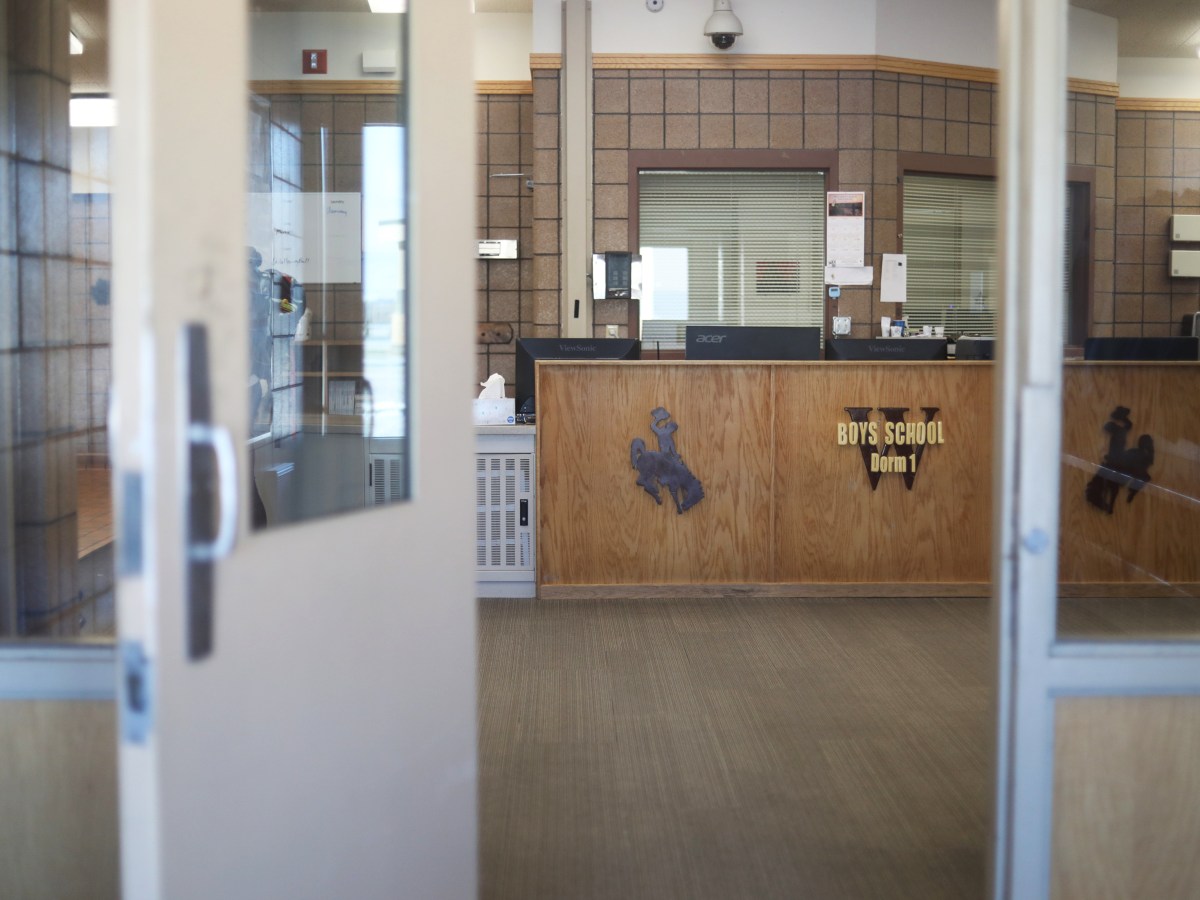
Chivers-King is one of six former boys’ school residents who sued school staff in 2024. The school, which detains delinquent boys ages 12 to 21, is a 38-acre residential facility near Worland that’s overseen by the Wyoming Department of Family Services. Chivers-King, who spent time at the boys’ school between 2020 and 2022, alleged school staff violated his 14th Amendment rights by placing him in isolation, using excessive force and infringing on due process. He accused Nelson of unnecessarily placing him in isolation.
Nelson’s testimony portraying Chivers-King’s time in isolation as humane was challenged by another staff member’s testimony who said the teenager’s condition degraded. Spotty record keeping also raised questions about just how much isolation Chivers-King experienced.

A central piece of evidence Chivers-King’s attorneys have presented to the jury are logbook entries that record staff’s interactions with the former resident while he was confined on multiple occasions in cinderblock detention rooms at the state facility.
Based on those entries, Chivers-King often interacted with other people for less than an hour a day and was only let out of the room to take a shower. Chivers-King’s attorneys showed the jury documents that outlined a schedule showing activities that a day in detention was supposed to include, such as school and reading assignments and physical exercise. They contrasted that with logbook entries, which didn’t reflect that Chivers-King engaged in those activities most days he was in detention, nor do they show that a mental health practitioner visited him when he was harming himself.
Nelson testified that the logbook “is incredibly incomplete” — some staff just noted that they checked Chivers-King, while others added more details. Regardless, he said that staff were “checking in with Blaise regularly, often,” including having conversations with him. “About as much as Blaise would allow, staff would be interacting with him.”
Throughout the trial, Chivers-King’s attorneys have often brought up an incident in which Nelson made Chivers-King clean his own blood after the former resident had been banging his head against the wall in a detention room. “There’s an obvious biohazard present,” Nelson said when a defense attorney asked him why he made Chivers-King clean the blood. “It’s the safest way to clean a biohazard.”
Robin McIntosh, a former boys’ school employee who worked at the facility from 2007 until March 2026, when he was put on administrative leave, painted a different picture of Chivers-King’s time in detention.
McIntosh testified that staff confined Chivers-King alone in detention rooms “very frequently” and kept him there for far too long. “He would actively degrade the longer he was in there,” said McIntosh, who said in his deposition that he was put on administrative leave for encouraging another student to sue the school. “It was a good excuse to keep him in there because he wasn’t meeting expectations.”
Defense attorneys suggested McIntosh may have been motivated to speak against the school because of conflicts with staff during his time at the facility.
According to McIntosh, staff should have noted in the logbook when they opened the detention room door to visit Chivers-King and if a medical professional had visited him. McIntosh testified that staff would antagonize Chivers-King. “It was cultural,” he said. “Sometimes staff would make degrading comments to escalate a kid.”
When an attorney for Chivers-King asked him why he agreed to be a witness, McIntosh said he “felt that it’s important to show what was happening inside the facility.”
“What was going on inside the facility was greatly hidden from the public,” he said.