

I’m going to do something that’s very uncharacteristic for me: be positive about what happened at a Wyoming Republican Party leadership committee meeting last week.
It could be painful, but here goes.
Opinion
The panel has long leaned to the far right, and a meeting to decide who the GOP would endorse in the Aug. 18 primary was no exception. But I was encouraged by how much internal opposition surfaced to the idea of party leaders endorsing candidates in the first place.
Members of the party’s central committee who disagreed could have stayed silent and, for the sake of party unity, continued to let the public think the GOP is actually united. It is not, and nothing proves that louder or clearer than what some conscientious members said in their dissents.
In the top three races, the committee endorsed Rep. Harriet Hageman for U.S. Senate, Secretary of State Chuck Gray for the U.S. House, and Brent Bien for governor. It marked the first time in decades that the party chose not to remain neutral in a primary.
I believe the party weighing in to sway an intraparty election is against Wyoming law, and I think state Republican Party Chairman Bryan Miller knows that full well. He’s hoping to win a federal lawsuit, and in doing so overturn the state’s ban on using party resources to help individual primary candidates. In other words, he wants to overturn the common-sense law that bars parties from hand picking their favorite — and most obedient — candidates instead of letting voters decide for themselves.
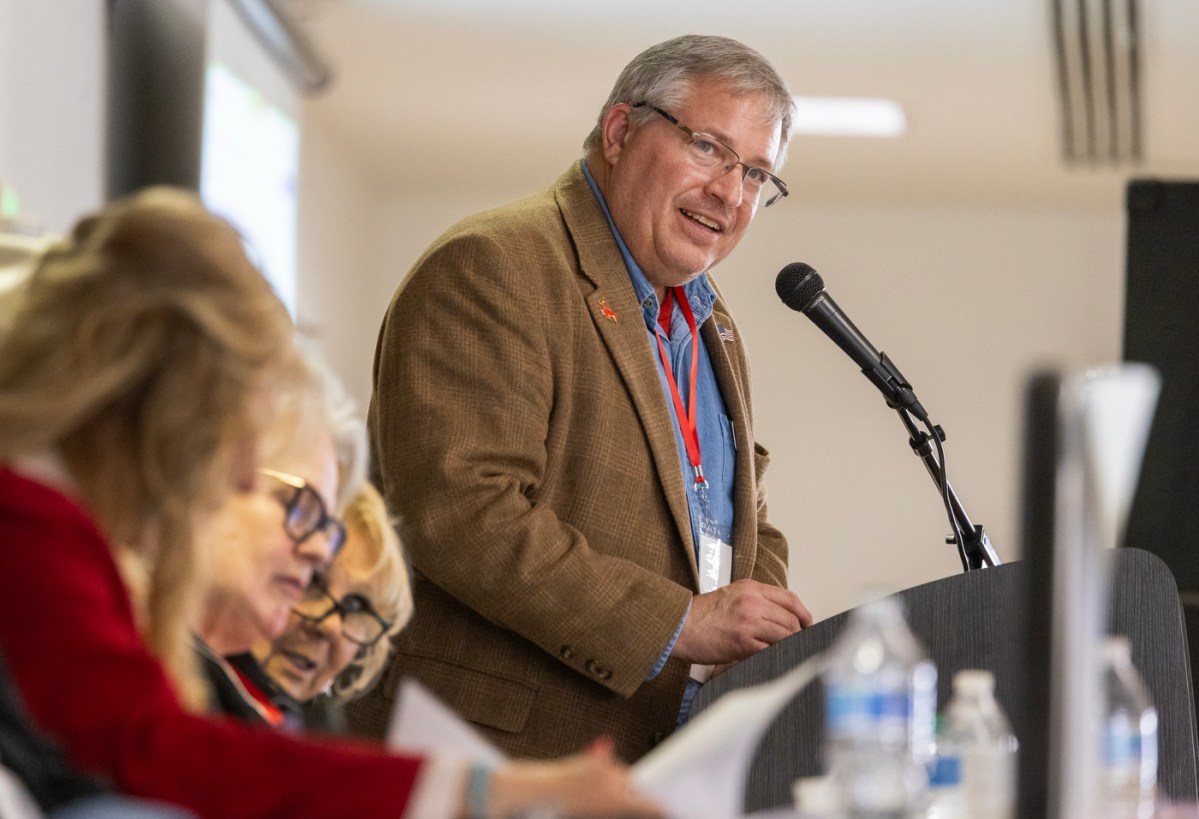
“I don’t think it’s a good idea to be endorsing candidates at all,” said Hot Springs County GOP State Committeeman Phil Scheel. He voiced his dissent when the panel of about 50 voting members were deciding who to endorse for the U.S. Senate.
If the party values what its members think, Scheel’s comments should have prompted debate on the controversial issue. But state Republican Party Vice Chair Bob Ferguson foreclosed the discussion by ruling Scheel’s comment out of order.
I understand Ferguson’s position: A majority of delegates voted to establish a process for vetting and endorsing candidates at its April state convention. Shutting down any opposition to that move may be within the leadership’s rights, but it’s simply not smart politics.
If already engaged party members who’ve shown up at the meeting to vote on endorsements want to address their belief that the party is making a big mistake, why not let them? Not allowing the committee’s minority to state the obvious — that the party isn’t speaking in one voice on this issue — will only further antagonize supporters of candidates who didn’t make the grade.
Several Republicans have told me they’re troubled by the fact that how much money candidates have donated to the party is one of the factors used to determine who gets endorsed.
Strangely, even when a member of the committee agreed that it should endorse Gray but questioned his policies on election issues, that attempted conversation was also shut down by Ferguson, who ruled it wasn’t germane.
“I’m endorsing him, all I’m saying is that a lot of things Chuck has said about voter integrity and getting rid of voter dropboxes is not true,” said Mitch Benson, a state committeeman from Fremont County.
Miller stopped everything when he said the debate had reached the three-minute time limit. But there was no “debate,” the clock ran out over a disagreement about whether Benson could fully state his position or be muted.
Not allowing Benson to discuss Gray’s record in office was hypocritical. Earlier, when Scheel questioned the endorsement process before the vote to endorse Hageman, Ferguson said the committee should be focusing on Hageman’s record. So why is an opinion about Gray’s competency in his current job not germane?
Niobrara County GOP Chair Janae Miller saw an opportunity to publicly oppose the endorsement process without being ruled out of order for saying it out loud.
“Niobrara County constituents have been vocal in their opposition to endorse any candidate no matter their excellent or poor performance,” she wrote in the Zoom meeting’s chat. “They want the voters to decide at the polls.”
The endorsement votes for the three major candidates demonstrate that a significant portion of the members agree with Janae Miller.
If you combine the “no” votes each candidate received with the abstentions, here are the results: Hageman, 32-19; Gray, 33-18; Bien, 34-17. While each won their endorsement by about two-to-one, that’s a much closer vote than most observers expected.
If the party wants its endorsements to have any credibility with voters, it shouldn’t effectively say it doesn’t care what members think if they don’t agree. Why should people stick around and participate if all it’s going to do is rubber-stamp what its leaders have already decided?
Bryan Miller told the committee last week that he believes the state law, which prohibits the party from spending any money directly or indirectly to promote any candidate, is unconstitutional. He said the party will not give any of its endorsed candidates any money before the primary.
Endorsements have been interpreted to also be banned, a position Miller noted is challenged in the lawsuit.
But there is definitely a connection to the two issues. The party has to spend money to conduct the type of vetting process it has created. It would also be expensive to print and distribute a voter’s guide explaining how the party rates candidates, which Miller has advocated. Spending money for these purposes is definitely an indirect benefit to endorsed candidates.
The party is spending money to finance its expensive lawsuit to challenge state law. It certainly has the right to do that, but people who disagree with that decision also contribute money and time to the party. Why does their voice keep getting muzzled?
If the leadership truly cares about protecting its First Amendment rights, which is one of the prime reasons stated for the lawsuit, the idea that it won’t even let people broach a sensitive subject runs totally counter to its legal argument.
The best thing opponents of party endorsements like Scheel did was convince the committee to not pass an extremely dumb motion to officially oppose the gubernatorial candidacy of state Sen. Eric Barlow, R-Gillette, a traditional, mainstream, Wyoming conservative whose unwillingness to kowtow to party leadership contrasts sharply with his radical opponents Bien and Superintendent of Public Instruction Megan Degenfelder.
An anti-Barlow position by the party would have been the only one directly opposing a candidate. Republican leaders should be glad that one was shot down, if they recognize that their new endorsement policy has further polarized a party that was already split into MAGA and old-school conservative factions.
I doubt that the GOP’s endorsement of Bien will have much of an impact on the contest. But if the party decided to officially start attacking Barlow, he would have had a field day slamming it for going to extremes instead of letting the process that’s worked well for 50 years prevail: Let the voters decide.

I wish that these articles discussing the endorsement of primary candidates would stop saying that the Republican Party provided the endorsement. Doesn’t the party officially comprise all registered Republicans in the state? The endorsement doesn’t come from the party; that won’t come until all of the party members have a chance to weigh in on who should be endorsed (i.e., the Aug 18 primary election). The endorsement comes from a few party members who have inveigled themselves into party leadership positions. This kind of endorsement, from The Party is wrong; it is the kind of thing that George Orwell described in his book 1984, as The Party told everyone what to think.
That is the wyoming gullible ol party
Party bosses in a smoke filled Republican back room held a “beauty contest” and picked Senator John Barrasso, a constant media hog who now serves Trump, not our state. You’d think by now the party would have learned its lesson.
If it walks like a duck
And it quacks like a duck
It’s a duck
I am so tired of the free Dumb carcaus waiving the rules in Wyoming. It’s good to hear that some of them still feel that actual laws are important. That our state Constitution is important.
We the people of Wyoming should be able to choose who we want to be elected without interference from ducks
Voting in this primary is going to determine who ultimately gets elected so people in Wyoming get out and vote
I have no problem with good old-fashioned Republicans. I voted for many Republicans, however, the free Dumb carcasses are not and will never be true Republicans.
If it walks like Trump
And talks like Trump
It’s a Trumper and he is not a true republican.
Chucky is constantly complaining about election integrity how about election honesty? That doesn’t seem to bother him.
Yesterday I got a flyer in the mail from a person that’s running for the Wyoming legislature. He said that he was gonna keep Commies (Communist) out of our state. I had to read it like five times to make sure that’s what it was saying.
I didn’t know we had a communist problem in Wyoming. But I’m glad someone’s gonna keep them out.
The way they throw around words like communism. It sounds like the McCarthy era again.
Thank you, Kerry Drake, and WyoFile for keeping us advised of who not to vote for
I won’t be voting for any of the three clowns. Barlow all the way.
Yes let the voters decide and we will. If the WYGOP wanted to change the rules they should have went through the legislature. The party of “law and order” only follows the laws that suit them. So much for being ethical, having integrity, and being transparent.
Remember to vote. Early primary voting is going on now.
I think you said it all Deana. Right now they don’t seem to know what law and order is.