

Since 2022, four Wyoming hospitals have closed labor and delivery wards, leaving 16 birthing hospitals for a state spanning 97,000 square miles. Medical workforce shortages, onerous on-call doctor schedules and mounting affordability challenges have only exacerbated the state’s growing maternity care gaps.
The problem is not unique to Wyoming, but the state lags behind others in embracing and implementing solutions, according to a new Wyoming Women’s Action Network white paper.
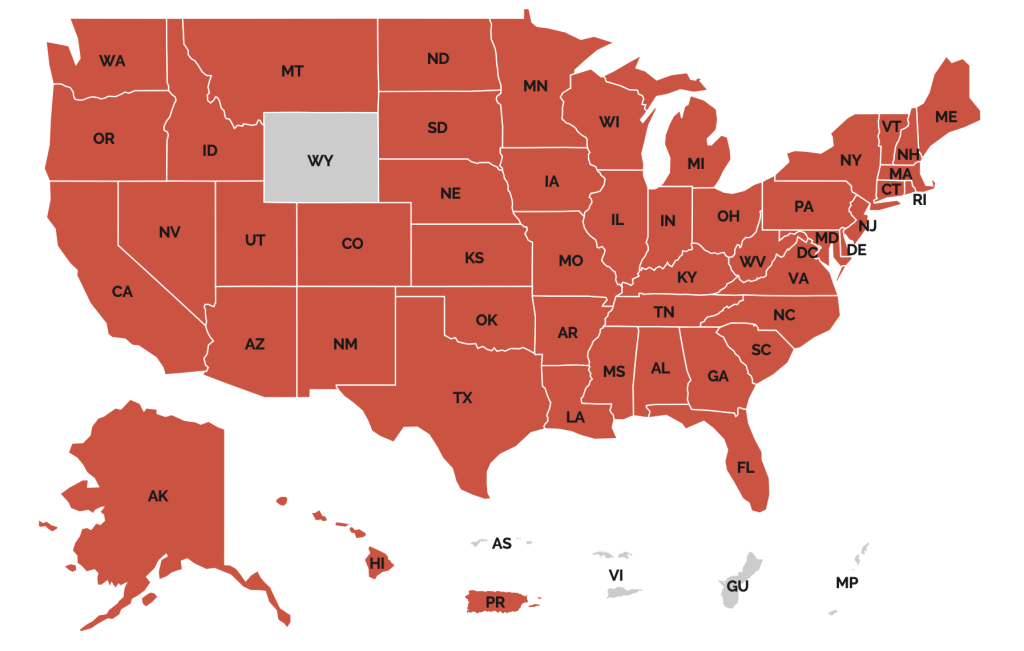
Wyoming, for example, is the only state not to participate in the Alliance for Innovation on Maternal Health, an initiative to support best practices that make births safer and improve maternal health outcomes.
“There are tools that are available to us that really haven’t been a focus of discussion, and could maybe start to make a significant difference,” said Jen Simon of the Wyoming Women’s Action Network. Like so many complicated issues, Simon said, “there’s no silver bullet. It’s going to take [multiple] efforts to really address it. And so, let’s start to identify what low-hanging fruit might be.”
That was one goal of the white paper, titled “The Equality State’s Growing Crisis: What maternity deserts mean for Wyoming and how we can turn the tide for moms and babies.”
By collecting baseline data and policy directions, Simon said, the hope is to underscore an array of steps — even small ones — that can lead to more robust maternity care.
“We do in fact have options,” she said.
Along with joining the Alliance for Innovation on Maternal Care, “low-hanging-fruit” strategies range from distributing low-cost alert bracelets to new mothers to convening an annual summit for sharing best practices.
Rising challenges, falling births
A dearth of maternal health care has made pregnancy and childbirth increasingly tricky in widening swaths of Wyoming, a 2023 WyoFile investigation found.
This is evident in Fremont County, where moms are opting to temporarily relocate to places like Denver and even the East Coast to deliver babies. It is evident in Rawlins, where families have to travel Interstate 80, a notorious stretch of highway that closes frequently in the winter, to deliver in Laramie. And it is evident in Teton County, where overflow patients from elsewhere in the state are straining OB-GYN providers.
Lawmakers made maternity care a top issue of study for the 2024 legislative off-season and began to identify a complicated mix of challenges for providing such care in rural places, though they didn’t pass any policies.
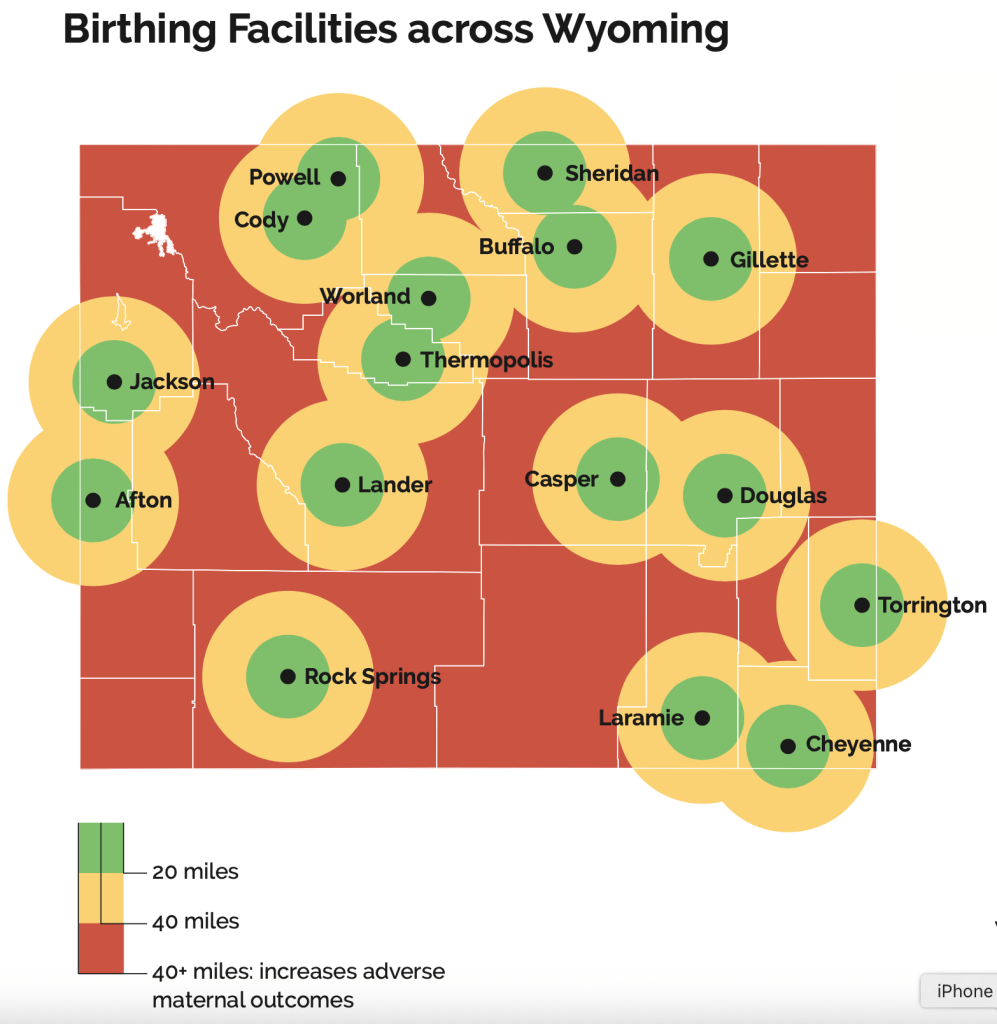
Meanwhile, births continue to fall in many Wyoming hospitals, and a fifth facility, Platte County Hospital in Wheatland, temporarily shut down its delivery services in October.
For the Legislature’s Joint Labor, Health and Social Services Committee, maternity care was the No. 1 priority again during the 2025 off-season, or interim.
Committee members discussed the issue in depth in October and acknowledged the problem’s scope is daunting. Proposed measures, such as one they advanced to authorize freestanding birth centers to get Medicaid coverage for midwife births, are merely “band-aids” that could perhaps keep maternity care limping along in its current state, lawmakers said.
That leads to Simon’s point that Wyoming doesn’t have to focus on large-scale state-level reforms for solutions.
“It’s such a significant challenge to move things through the legislature in every state, not just this state,” she said. The intent of the white paper is “to really be thinking about what would be accessible for hospitals and providers, and what are some best practices that are really simple and straightforward.”
Training, sharing, legislating
The paper’s more accessible recommendations include instituting an annual, statewide maternal health summit — an effort already underway. There are also training approaches, such as the Obstetric Patient Safety Program, commonly known as OPS, which is designed to help medical providers prepare for obstetrical emergencies.
Postpartum birth alert bracelets, meanwhile, represent a simple and inexpensive tool that alerts health care providers to patients who have delivered within the previous six weeks. That can help ensure recognition and response to complications such as hemorrhage, hypertensive crises or infection — leading contributors to postpartum maternal mortality.
There are also local-level models, such as a community-wide prenatal access program developed in Teton County, as well as inclusion in national expertise pools.
“Participation in [Alliance for Innovation on Maternal Health] would give Wyoming access to resources, technical assistance, and collaborative partners to better collect and report data, implement strategies to address identified issues, and ultimately improve maternal outcomes,” the white paper reads.

It also identifies more-involved strategies aimed at improving local capacity, affordability and workforce recruitment. These include initiatives like expanding physician access to remote support from maternal-fetal medicine specialists, administering matching-funds loan-repayment programs for health care professionals or boosting reimbursement for providing maternity services to Medicaid patients.
The Labor Committee in October voted down draft legislation that would provide for increased Medicaid and Medicare reimbursement for OB services and critical access hospitals.
Even though government can play a vital role in improving maternity care, Simon said, she hopes to convey that other meaningful avenues exist.
“Here’s some things that can be done, that hospitals can decide, that communities can decide, that individuals can decide,” she said.
Advances
The paper also highlights some positive steps and strategies that are rolling out in the maternal health realm.
This year, for example, Megan Baker of St. John’s Health in Jackson became the first Wyoming Section Chair for the Association of Women’s Health, Obstetric and Neonatal Nurses, which connects her with resources for training and improved obstetric outcomes for Wyoming moms.
Baker, the manager of women’s services at St. John’s, has spearheaded initiatives to bolster the hospital’s maternal health offerings. St. John’s recently became Wyoming’s first hospital to gain a “maternal level of care” designation. She also helped obtain a statewide grant for OB safety courses and acquire alert bracelets for her facility.

Wyoming medical professionals and hospitals will need to work together to combine resources to create a stronger network, Baker said. She is also a proponent of small-cost, big-impact programs like the alert bracelets.
“I think we have to look at things differently,” she said. “Share resources, share people and figure out how others are doing it.”
If Wyoming’s trend continues, experts worry that mothers will put off or forgo prenatal care, travel long distances in difficult weather or give birth in emergency rooms with nurses who aren’t trained in labor and delivery, which could have dangerous or even deadly results.
The erosion in care also poses existential threats to communities, as adequate health care is crucial to attracting young families to rural towns, state leaders say.
“Being able to have a baby, safely, in Wyoming is a harbinger of our state’s present and future prospects,” Wyoming Women’s Action Network Board Member and Teton County Commissioner Natalia Macker said in a release. “The health of our moms, babies, and families is a clear indication of how healthy our hospitals, communities, and economy will be.”
Dear Ms. Dickinson–
What particular crazy Wyoming medical negligence case are you referencing?
Bob Schuster.
Wait…you mean to tell me there were solutions to Wyoming’s problems all along??? Ya, our education system is top notch. People here can barely read and write. The vastness of stupidity here is unbelievable sometimes. Chemtrail’s it is! 🤣
Wyoming is joining Idaho in the trek to the health care desert.
Incredibly unacceptable.
What entity is responsible for the state failing to participate in the Alliance for Innovation on Maternal Health?
Hey don’t worry, they will spend the next 2 weeks debating chemtrails.
First of all, we neget a grip on the law suit craziness that has been so prevalent. Medical things can go bad at the drop of a hat, the person doing a home delivery needs access to a hospital and hospitals do not want problems because of potential for lawsuits.
We need to make it much more difficult to succesfully rake in big buck from one.
IWho ever decided that health care providers were a wonderful target for lawsuits, was really dumb. Overall we have lot more than we gained by making providing health care such a target.
Thank you, I didn’t realize the amount of health care lost.
Maybe someday you MAGA folks will wake up and realize you’ve been duped by your members of congress, your state legislature and Don the con. A state filled with tax evading fake christians is ruining the lives of your Wife, Daughter, Sister, and Mother. I’ve witnessed my native state turn into a quagmire of churning nonsense. Vote them ALL out of office.