


When Banner Health announced in September that it would pause labor and delivery services at Platte County Hospital in Wheatland, it marked the fifth Wyoming hospital in recent history to shutter a birth facility.
Like facilities before it in Evanston, Rawlins, Kemmerer and Riverton, the hospital called it a difficult decision. Provider challenges like physician recruitment, declining births and profitability in Wyoming are steep. The result is a loss of services and large gaps in service here.
As lawmakers on the Legislature’s Joint Labor, Health and Social Services Committee spent most of Thursday wading through measures aimed at fortifying maternity care in the state, they acknowledged that the trend will be difficult to reverse. There were many references to the draft bills as “band-aids” that could perhaps keep maternity care limping along in its current state.
Ultimately, the panel advanced two of the five measures. The only draft bill to receive unanimous support would authorize freestanding birth centers to be covered by Medicaid for births handled by midwives.
The second bill that advanced, a divisive measure that ignited lengthy debate, would set rules and regulations aimed at protecting pregnancy centers, which are typically intended to discourage women from seeking abortions. The bill would prohibit the state or any municipality from compelling a pregnancy center to perform abortions, provide abortion medication or counsel in favor of abortion, among other acts.
Critics wondered if the measure even belonged in the discussion of fortifying maternity care.
“Please abandon this misguided bill,” said Britt Boril, executive director of WyoUnited, a reproductive rights organization. “It in no way helps us solve our issues with the maternity care deserts that I know we have a shared desire to alleviate. In fact, it aims to shield unregulated pregnancy centers from oversight.”
The committee advanced the measure on a vote of 12-2. That puts it on track to be among the committee-sponsored bills going into the 2026 session, which are historically more likely to pass.
The problem
A dearth of maternal health care has made pregnancy and childbirth increasingly tricky in widening swaths of Wyoming. That means families going to extraordinary lengths to deliver babies; doctors spread thin or on the brink of burnout and hospitals juggling the complicated cost formulas in thinking about maintaining labor wards.
If the trend continues, experts worry that mothers will put off or forgo prenatal care, travel long distances in difficult weather or give birth in emergency rooms with nurses who aren’t trained in labor and delivery, which could have dangerous or even deadly results. Births in the state, meanwhile, continue to fall.
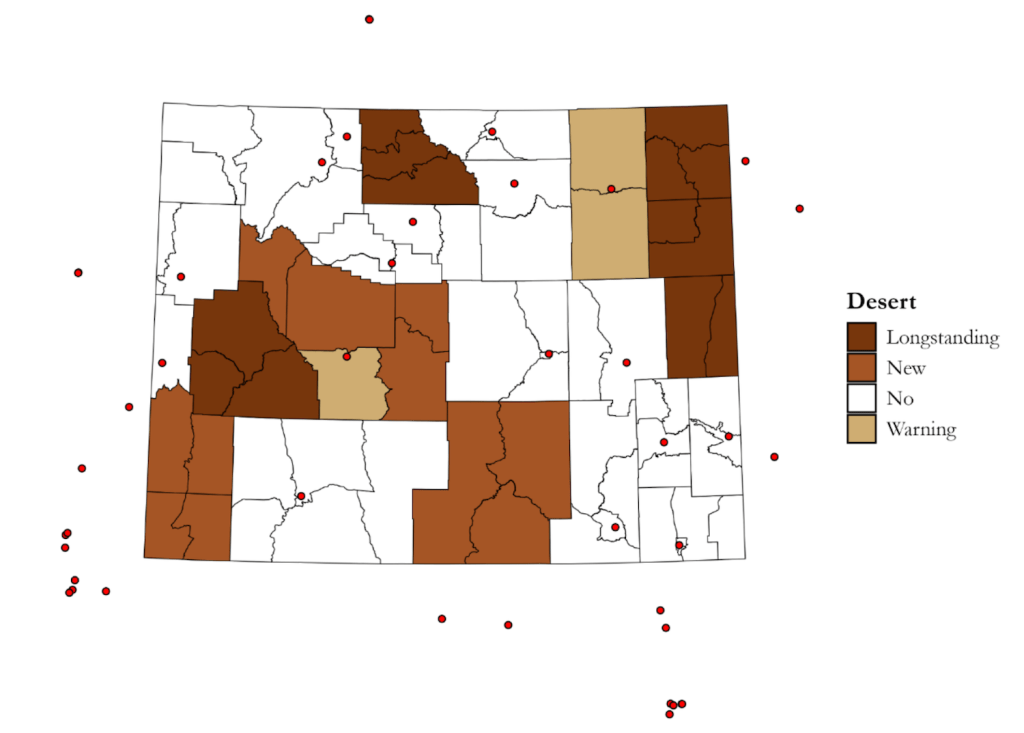
The erosion also poses existential threats to communities, as adequate health care is crucial to attracting young families to rural towns, state leaders say. And though lawmakers and health care professionals have been searching for solutions, no single answer has emerged.
Wyoming isn’t alone, and legislative staff furnished the Labor Committee with a report highlighting strategies implemented in other states to improve maternal health care. They include expanding Medicaid to cover doula services or permit telehealth; creating incentive programs for maternal health care professionals; and integrating midwives into the state health care system.
Wyoming does grant certified nurse midwives a full and independent practice authority and provides midwives with a 100% Medicaid reimbursement rate.
The measures before the committee on Thursday represented an array of strategies to ease operations and costs for maternal services.
What advanced, what didn’t
The committee first considered a bill that would provide for increased reimbursement for obstetric physician services and critical access hospitals. That includes reimbursing OB-GYN services at 105% of the current Medicare rate. Critical access hospitals that offer labor and delivery services authorized under Medicaid, meanwhile, would be reimbursed for inpatient services at 100% of the actual cost for the services.
The measure could help with physician retention and family practice residencies that serve Medicaid patients, Cheyenne OB-GYN Jacques Beveridge said. “I think it could go a long way,” he said.
The Wyoming Medical Society also supported it. “We see it as a stabilization measure,” said Executive Director Sheila Bush, noting that it could be one of many strategies aimed at making shifts, even small ones. Eric Boley with the Wyoming Hospital Association echoed that.
“I think this is one opportunity to work on a much bigger problem and a bigger process,” Boley said. “I think this is an important bill if we want to sustain what we currently have, but it will not fix those [facilities] that have closed.”
Lawmakers, apparently wary of increased state expenses, did not support the bill. It died on a vote of 6 to 8.
They did, however, support a bill regarding extending Medicaid coverage to freestanding birth centers. These facilities are designed to provide a comfortable setting for uncomplicated births. They are not part of hospitals, but often do have partnerships with nearby hospitals or doctors in case more specialized care, such as a cesarean section, is needed.
Birthing centers’ appeal relates in part to expenses. They come with lower fixed costs because they specialize in vaginal births without medical complications, need less equipment and employ midwives, who are paid less. They could establish in regions with delivery service gaps as an option for straightforward births.
The committee was favorable.
“I look at this program as bringing a little rain to the maternity desert,” said Sen. Lynn Hutchings, R-Cheyenne.
Lawmakers did not advance a related bill, which would mandate private insurance coverage parity for freestanding birthing center services.
Abortion debate
The pregnancy center bill took up most of the committee’s time. Sen. Charlie Scott, R-Casper, noted that the document’s format itself was unusual. “Is this a national bill that has been copied?” he asked.
The 12-page bill draft includes much preamble, including statements about national events. It prohibits municipalities from interfering in specified pregnancy centers operations, and would impose severe penalties. Under the bill, a pregnancy center or any person aggrieved by a violation of the act can sue for up to three times the actual damages sustained.
To present the bill as a maternity care solution is disingenuous, critics said Thursday. Pregnancy centers disguise themselves as medical facilities when their true intent is to advocate against abortions, Boril of WyoUnited said.
Emma Laurant urged the committee to stop spending energy on divisive abortion measures “and actually support increasing practical solutions, such as expanding birthing centers and attracting OBs to the state to take care of Wyoming women and their tangible health and any subsequent children they choose to have.”

Valerie Berry, executive director of LifeChoice Pregnancy Center in Cheyenne, defended her center as a sound medical facility that provides quality care from licensed professionals.
Sen. Scott wondered if there is a current crisis in Wyoming regarding pregnancy centers and threats. Berry said they are happening around the U.S., though she isn’t aware of issues in Cheyenne.
Denise Burke, senior counsel with Alliance Defending Freedom, said the bill “was designed to protect Wyoming’s pregnancy centers from censorship or discrimination simply because they do not offer, refer for or counsel in favor for abortion, abortion-inducing drugs or contraceptives.”
Burke, who resides in Kansas, also said she isn’t aware of any potential threats in Wyoming.
Rep. Rachel Rodriguez-Williams, R-Cody, who chairs the Wyoming Freedom Caucus and was lead sponsor on the abortion ban now before the state high court, pushed back on Scott’s question of the bill’s provenance. She drafted a previous version of it with staff, she said, and it’s modeled specifically for Wyoming.


I am a retired CNM and delivered several hundred babies on the Navajo Nation in AZ. We were certified as all other CNMs. We had the same restrictions and requirements as anywhere in the country I n rural areas. Perhaps it would be helpful to find out some of their protocalls and perhaps Wyoming could settle on a few places accessible to a wide variety of ways to work this out.
If for instance Riverton and Lander plus the surrounding area were to work together to have access to a central point that doctors who did deliveries could share.
There must be a way to do this expecially when we have active CNMs already working.with the oriblem.
Crisis Pregnancy Centers are not “ sound medical facilities(s) “ that provide “quality care “ . They are non-profit anti-abortion centers that are staffed mainly by volunteers with over-site by volunteer medical staff present a few hours a week. The ultrasounds provided are not useful for anything other than the anti-abortion position as they are not accepted by licensed medical facilities. Representative Rodriquez- Williams, the founder of a crisis pregnancy center and her anti- abortion colleagues are pushing for special protections for the centers in order to protect them from regulations that would require medically accurate information be provided in the centers. This is unconstitutional special legislation as the centers have the same free speech protections as all nonprofits enjoy. The U.S. Supreme Court reaffirmed this protection in a 2018 case. There is no instance of a crisis pregnancy center in Wyoming ever being in danger of losing any rights from any official action.
My domestic partner of 22 years worked at our critical access hospital for over 20 years as an R.N.. Much of that service was in labor and delivery. It was routine to practice being able to transport, safely and securely, a labor patient from the delivery room to the O.R. for a c-section in less than 5 minutes. I don’t see how any ”free standing” birthing facility would be able to accomplish this critical transfer. The money saved by having a Certified Midwife would have to be spent having to construct each of these facilities with a surgery suite. Even if that were the case how long would it take for anesthesia and physician to get there? We really need to adequately fund our critical access hospitals so they can continue to offer obstetrical services.
After doing all they could do to drive anyone of childbearing age out of the state, Wyoming legislators are surprised that hospital maternity services are drying up. Just one clue to the collective intelligence of state legislature.
If a 16-year-old wanted to adopt a child, the government wouldn’t allow it. She isn’t done with her education, she can’t financially support herself, and isn’t a legal adult. But if she gets pregnant, the government can ban her from getting an abortion. How is that logical?
They want women to have children, but they want them to have them out of state. Yeah that makes sense. Meanwhile what few youth we have are leaving the state for greener pastures. Wyoming’s already old.
The fake tax evading Christian’s are putting their foot on your wife, your girlfriend, your mother and sisters. Do you think you’ll ever have the backbone to vote them out?
Crayon’s and coloring books! Congrats on contributing absolutely nothing yet again to Wyoming’s flailing future! 😅