


CHEYENNE—State lawmakers continued work this week to address funding for Wyoming’s K-12 public education system, attempting to close shortfalls identified by courts in critical areas, including school safety, nutrition and technology.
The Legislature’s Select Committee on School Finance Recalibration heard testimony and public comment on how to tackle these issues.
In February 2025, Laramie County District Court Judge Peter Froelicher issued a 186-page order finding that the Wyoming Legislature had unconstitutionally underfunded public schools. The judge ruled that the state failed to provide sufficient resources for key areas, such as nutritional programs, school resource officers and technology.
The state appealed the decision to the Wyoming Supreme Court, which issued a stay pausing the lower court’s mandate while the state’s appeal proceeds. When the committee began its work, the stay had not yet been issued, and no final ruling has been made to date.
Co-Chair Sen. Tim Salazar, R-Riverton, expects the court to pay attention to the committee’s actions in the coming months.
On Tuesday and Wednesday, the committee heard from consultants with Picus Odden and Associates, who presented proposals to ensure these programs are funded in compliance with the state Constitution.
School safety
The court order determined that “all Wyoming public school students are entitled to the benefit of SROs.” Not every school is required to have its own full-time school resource officer, but the order does require students to have access to SRO services.
Picus Odden estimated that 172.5 SRO positions are necessary to meet the requirements, at a cost of $15.8 million annually for personnel alone, and $17.1 million annually in total, including professional development, equipment and supplies.
The model, based on the recommendations provided by Picus Odden, proposed one SRO for each high school, one for every two middle schools and one for every three elementary schools.
During interviews, school district personnel emphasized how professional development allows SROs to work effectively and the necessary equipment allows them to perform their responsibilities.
Currently, school districts contract with local sheriff’s offices or police departments to provide SRO services.
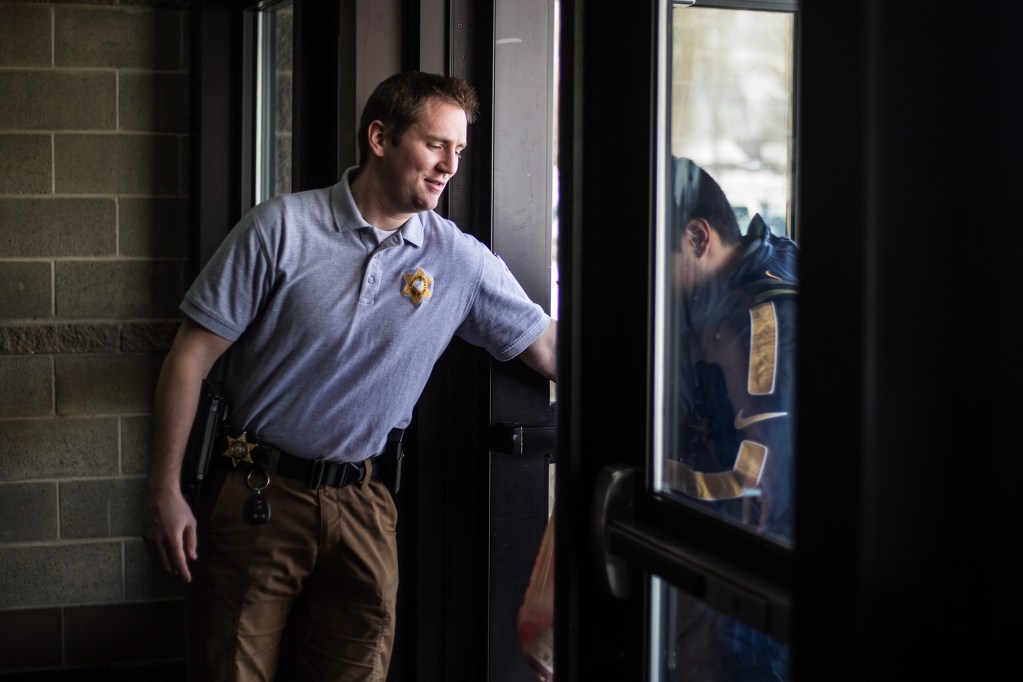
Manny Fardella, a Cheyenne Police Department officer and president of the Wyoming School Resource Officers Association, spoke on behalf of SROs in the state and about his experience in Laramie County. He disagreed with the notion that SROs are simply there to be security.
“Our school resource officers are more than a security guard. We become part of a school family. To many, we become members, trusted people,” he said.
Jeremy Smith, the business manager for Sheridan District 1, spoke about making sure this funding would not be categorical, meaning that it could only be spent on SROs. Smith stressed that this funding could also be put toward additional district-specific safety needs.
The committee requested that a bill be drafted based on Picus Odden’s recommendations, but did not include professional development or equipment.
Food service programs
The court’s ruling determined that the school funding model not including a nutrition component was unconstitutional because “nutrition is an essential component of a quality education.”
To remedy this, Picus Odden’s proposed options would ensure all students have adequate access to food by covering the difference between food service revenues and expenditures. The consultant’s research estimated the difference during the 2024-25 school year was $17.8 million.
The first proposed option was to provide employee benefits such as health insurance and retirement contributions to food service staff, as they are currently excluded from both. This option would cover about $9 million in district food service costs.
This option would only cover about half of the current statewide difference and would provide limited or no support to districts that contract for food services, meaning it would have to be combined with another option.
The second option would reimburse districts a fixed percentage of food service expenditures; reimbursement rates vary from 10% to 30%. The state could set the rate to reflect the difference between revenues and expenditures statewide.
However, due to the difference varying widely by district, this approach would not cover the difference for 29 of the state’s 48 districts.
The combination of options one and two would leave shortfalls in 25 districts uncovered, according to Picus Odden.

The final option would fund food services using the same general approach used to determine funding for other school resources. Under this approach, the Legislature would determine the variables used to calculate the appropriate level of funding. Under Picus Odden’s recommended assumptions, $17.1 million would be provided for food service worker staffing and $5.8 million to food service director staffing, for a total of $22.9 million.
Option three would leave 12 districts with shortfalls uncovered, Picus Odden officials said.
Public comment on the subject was divided, with some preferring the combination of options one and two, and others exclusively preferring option two because their districts contract for meals.
Brian Farmer, the executive director of the Wyoming School Boards Association, explained why there is no perfect fix for this issue.
“There is wide variability, and it’s really challenging because you can come up with something that works great for parts of the state but not necessarily others,” he said.
The committee unanimously requested a bill draft using option two, at a reimbursement rate of 30%, which equates to $17.5 million.
Technology
Judge Froelicher’s order also stated that a computer must be provided for every student, though there has been concern from local communities and parents regarding the amount of screen time students experience. Picus Odden took those concerns into account and provided eight different choices to address them.
The options ranged from the recommended 1:1 ratio for all grades to a 1:3 ratio for all grades and included options five and six, which provide no computers to students in kindergarten through second grade.
The recommendation from Picus Odden is a comprehensive estimate to provide computers at a 1:1 ratio for students and school staff at $208.95 per Average Daily Membership. Also known as ADM, this is the state’s way of calculating student enrollment. Additional operational costs for networks and learning management systems are estimated at $235 per ADM, for a total of $443.95 per ADM, leading to a $16.7 million total cost statewide. The options provided variability concerning the ratio and whether computers would be given to students in kindergarten through third grade.

Sheridan County’s Smith noted how this funding could be best used for each district.
“I think having a tech director position in every district would help solidify how we actually operate in real life,” he said.
The committee agreed to request a bill draft with no computers for grades K-2, and a 1:1 ratio for grades 3-12, at a cost of $395 per ADM. State Sen. Chris Rothfuss, D-Laramie, also asked that the bill draft include a minimum of one tech director and a part-time tech specialist for every district, based on testimony provided.
Next steps
The recalibration committee will meet Oct. 21 and 22 in Casper to continue discussions and make changes to the bill drafts as necessary.
Sen. Salazar expressed optimism about progress the committee had made, but acknowledged the primary task was ensuring compliance with the judge’s order.
“I think it’s important to go forward because I want to give the third branch of the government the understanding that we are trying to do the right thing in regard to the order,” he said.

Very helpful update on the school funding issue. I notice there are still some areas that were not mentioned, i.e., Sports programs, Extra curricular programs like Forensics, Debate, music, art, shop and home economics, civics requirements. Where do these stand and what is ahead?
And just how much was spent to get these findings from Picus Odden and Associates. I’m trying to comprehend how making food staff employees eligible for health insurance and retirement will help the schools meet the required nutritional standards.