


A recent WyoFile opinion piece by Kerry Drake offered commentary about the GENIUS Act, bipartisan federal legislation designed to provide regulatory clarity for stablecoins. While we always welcome thoughtful discussions about digital asset policy, Drake’s piece contained inaccuracies about the legislation’s current status and Wyoming’s ongoing bipartisan efforts.
Opinion
Since 2018, Wyoming’s Select Committee on Blockchain, Financial Technology and Digital Innovation Technology has approached digital assets with a clear and consistent vision: to regulate in a way that enables innovation rather than restricts it, while ensuring robust protection for consumers and financial markets. Our simple, but impactful, goal has been to encourage responsible innovation, protect everyday users and firmly position Wyoming as a national leader in financial technology.
This approach has yielded significant results. Wyoming is recognized internationally for its progressive, clear and responsible digital asset legislation, having passed more than 35 bipartisan laws covering everything from decentralized autonomous organizations to digital identity and custodial standards. Our state has proven government can work effectively and cooperatively to foster innovation while safeguarding the public interest.
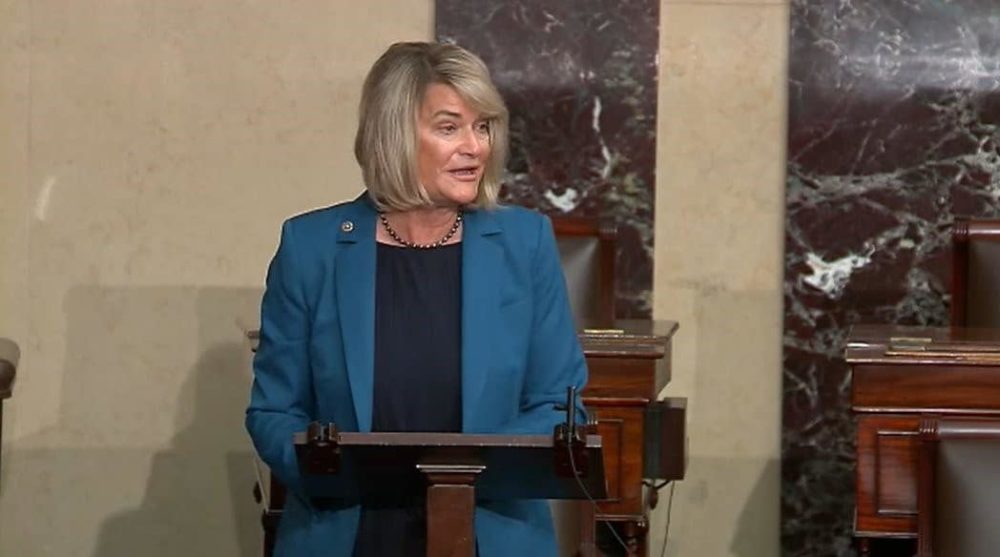
U.S. Sen. Cynthia Lummis has been instrumental in advancing this bipartisan model at the federal level. She has worked closely for years with Sen. Kirsten Gillibrand, a New York Democrat, forging a rare and effective cross-party partnership focused on building a responsible digital asset framework for the nation. She has championed the GENIUS Act, which stands for Guiding and Establishing National Innovation for U.S. Stablecoins. The law would implement a comprehensive federal regulatory framework for stablecoins. These digital assets are designed to serve as a means of payment and maintain a stable value relative to a fixed amount of national currency.
Sen. Lummis’ legislative approach mirrors Wyoming’s proven strategy: regulate to enable rather than restrict, balancing innovation with robust consumer protections.
The GENIUS Act itself is not about political posturing or partisan fights. Instead, it seeks to provide clarity and consumer protection in a sector — currently resembling “the bad part” of the old Wild West — that’s confusing, inconsistent and potentially risky. Clear regulatory guidelines at the federal level are essential if we want to avoid stifling innovation or leaving American consumers vulnerable.
Some have suggested that the GENIUS Act’s progress hinges on the support of Sen. Elizabeth Warren, a Massachusetts Democrat. It’s important to clarify that she was not directly involved in the negotiations surrounding this legislation and has consistently expressed opposition to digital asset frameworks of any kind. The reality is that there is no version of a stablecoin bill that would earn her support. That’s why bipartisan efforts like those between Lummis and Gillibrand are so critical — they reflect a genuine commitment to thoughtful policymaking rather than ideological opposition.
Despite assertions to the contrary, the GENIUS Act recently advanced through the Senate with substantial bipartisan support on a 66-32 vote, thanks to Lummis’ determined bipartisan negotiations. Wyoming’s leadership on digital asset regulation serves as a positive example of effective governance. This work is not about partisanship but about partnership, demonstrating how lawmakers from both sides of the aisle can deliver real solutions. Our collaborative efforts in the Wyoming Legislature, alongside Lummis’ leadership in Washington, show that Republicans and Democrats can navigate complex issues together, crafting policies that protect consumers, foster innovation and strengthen America’s position in the global digital economy.
In a time when cooperation seems increasingly rare, Wyoming’s approach illustrates what can be accomplished when lawmakers prioritize solutions over politics. We are proud to continue this bipartisan tradition and remain committed to making Wyoming a beacon of responsible, innovative governance in the digital asset space.


First, Cynthia Lummis is a strong supporter of the SAVE Act which could deprive many legal voters, including married women who took their husband’s name, from voting. Second, she champions the weird idea that women’s sports need to be protected from transgender persons, which is false. We all exist on a spectrum, and I guarantee that the most virulent, steroid taking males are not playing in women’s sports. Third, she is known as the crypto-queen, owning hundreds of thousands of dollars in crypto (conflict of interest?). She is also a strict anti-visionary of women’s reproductive rights–that is she gets to crawl into another woman’s body and decides what can happen. She also tries to hide her crypto purchases (https://www.cnbc.com/2021/10/07/senator-cynthia-lummis-discloses-a-bitcoin-purchase-worth-up-to-100000.html). What in the h*ll is a Democrat writing an article to support such a despicable anti-woman, anti-poverty, anti-billionaire supporter? So disappointed.
This is the best article on Crypto I have seen. You have to read the whole thing…it is the wild west…quotes Zeke Faux, a reporter at Bloomberg, who wrote a book about Crypto. It looks like much or all of crypto is corrupt…
https://www.nytimes.com/2025/05/28/opinion/ezra-klein-podcast-zeke-faux.html?searchResultPosition=2
Wyoming pols, including Lummis and the two authors of this piece, seem interested only in pumping the value of their personal stashes of griftocurrency rather than in the national interest. This is an immense conflict of interest which should be investigated by the appropriate ethos bodies. The dollar is the world’s reserve currency, and the promotion of others (especially ones that can be manipulated by foreign governments and oligarchs) weakens our nation. We must oppose this grift.
I think it would be helpful to come up with a plain English explainer because most of the resources I’ve encountered as I explored cryptocurrency are awfully dense and abstract. And as an asset class the people most strident telling you to buy it are the ones that own the most of it so it seems not super predictable and pretty volatile and a lot like gold. So education here is critically important. But the other issue I’ve become aware of as I’ve explored Rocky Mountain Power’s proposed 40% rate increase that ended up being about 30% approved by the public serving commission is not only the choice to require 20% of their portfolio to be from coal which required millions of dollars of expenses to retrofit plants that had just been renovated to burn natural gas to continue burning coal but also the regulatory infrastructure we created as a state for cryptocurrency which has brought a lot of cryptocurrency miners who are placing strain on the grid and requiring upgrades. A minor cause might be some of the renewable wind energy projects, which the people of Wyoming generally resent it seems. I am sensitive to the budgetary impacts on individual consumers in particularly retirees on fixed incomes in the impact that this legislation has because of cryptocurrency mining on their electric and power bills. I don’t think it’s fair to saddle everybody with the cost of upgrades to the grid because of cryptocurrency mining and I do think whether legislatively or as a business decision by Rocky Mountain Power, they need to implement some kind of rate increase or demand charge for miners. I know people who’ve made a lot of money in crypto, mostly by mining but I’ve also known a lot of people who’ve lost a lot of money. I think it is still yet too volatile to allow people to invest in crypto inside of traditional retirement vehicles but I think Congress could create an appendage that enables them to do so without facing capital gains on a Roth kind of account in a taxable brokerage account. But I don’t think pensions and in tax favored accounts or tax deferred accounts it’s a good idea to allow crypto as an asset class. I also think as this technology evolves that it is a good idea to regulate it as well to protect investors and consumers.
CBDC as much as they say it isnt, is where the “GENIUS” act is heading.
“Bipartisan” support bailed out corrupt Banks over 15 years ago. Divided partisan politicians always seem to “come together” when $$$$$$$ is involved.
When your money is completely digital it doesnt take much to “turn it off” Ask the people of China or a Canadian trucker.
I enjoyed this article. There are some bright people for bitcoin and against it. I would like to see more articles explaining exactly what bitcoin is, differences between types, advantages, disadvantages, safety, dangers, etc.
Thanks