
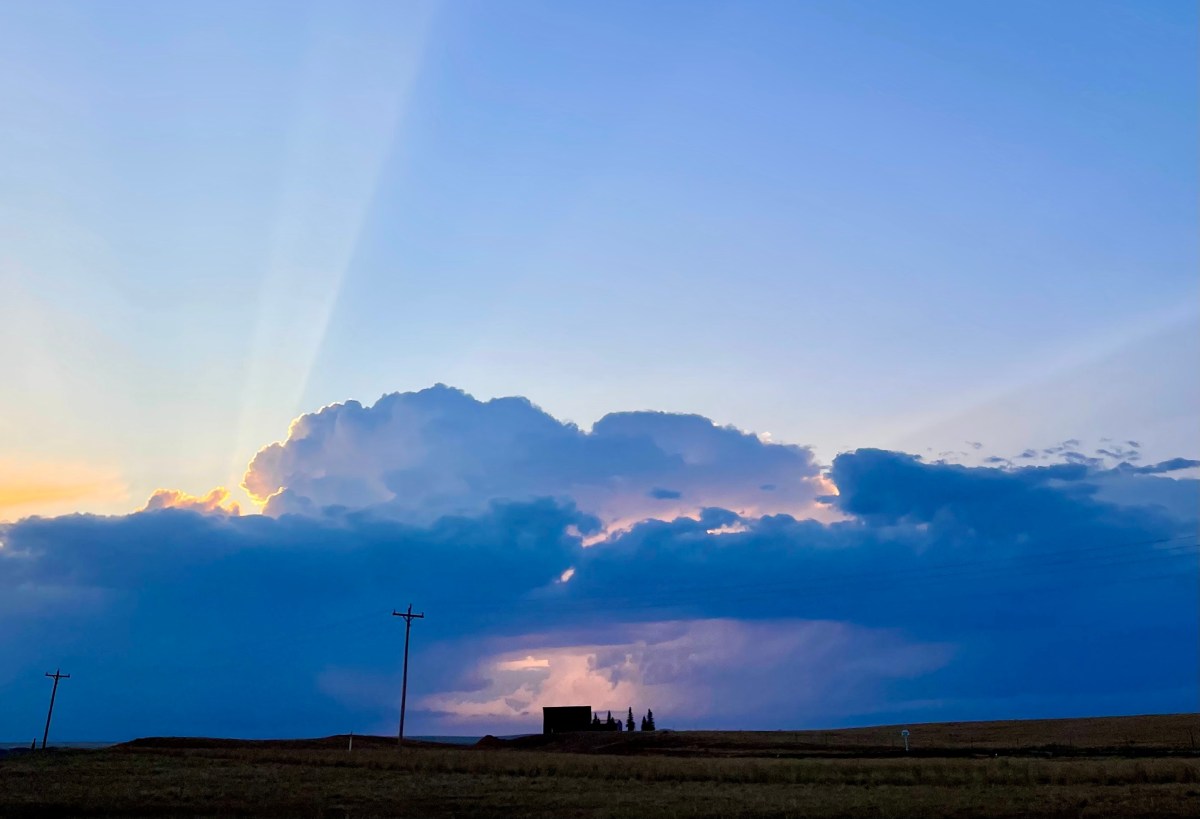
The streaks of light and shadow that often accompany Wyoming sunrises and sunsets have a name — crepuscular rays.

Stemming from the Latin “crepusculum,” meaning twilight, the sunbeams can appear at any time of day, but are most noticeable as the sky changes at dawn or dusk, as photographed on Tuesday evening in Laramie. 

Sunlight shooting through gaps in clouds or other features of the horizon causes the optical phenomenon, while tiny particles like dust, water vapor or pollen, suspended in the air, scatter the light, making it visible to our eyes. 

Though the beams appear to fan outward from the sun, crepuscular rays are parallel. It’s similar to how lines on a highway or railroad tracks appear to narrow in the distance. 

The next time you spot crepuscular rays, turn your back to the sunset for a chance to see a more elusive phenomenon. Though less vibrant, anticrepuscular rays appear in the opposite direction of the sun and can give the effect of the horizon being cut in half, visible in the photo below. 
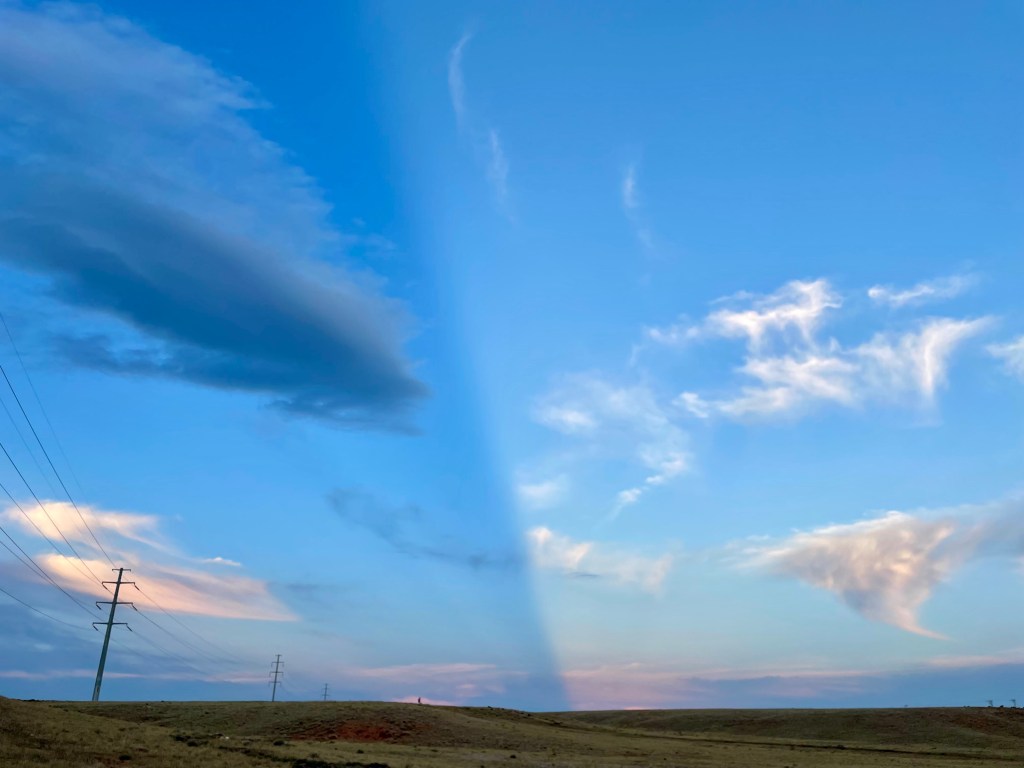
Anticrepuscular rays appear in the opposite direction of the sun and can give the effect of the horizon being cut in half, as pictured the evening of July 29, 2025 in Laramie. (Maggie Mullen/WyoFile)

Maggie Mullen reports on state government and politics. Before joining WyoFile in 2022, she spent five years at Wyoming Public Radio.

Join the Conversation

1 Comment

WyoFile's goal is to provide readers with information and ideas that foster constructive conversations about the issues and opportunities our communities face. One small piece of how we do that is by offering a space below each story for readers to share perspectives, experiences and insights. For this to work, we need your help.

What we're looking for: 

  • Your real name — first and last. 
  • Direct responses to the article. Tell us how your experience relates to the story.
  • The truth. Share factual information that adds context to the reporting.
  • Thoughtful answers to questions raised by the reporting or other commenters.
  • Tips that could advance our reporting on the topic.
  • No more than three comments per story, including replies. 

What we block from our comments section, when we see it:

  • Pseudonyms. WyoFile stands behind everything we publish, and we expect commenters to do the same by using their real name.
  • Comments that are not directly relevant to the article. 
  • Demonstrably false claims, what-about-isms, references to debunked lines of rhetoric, professional political talking points or links to sites trafficking in misinformation.
  • Personal attacks, profanity, discriminatory language or threats.
  • Arguments with other commenters.

Other important things to know: 

  • Appearing in WyoFile’s comments section is a privilege, not a right or entitlement. 
  • We’re a small team and our first priority is reporting. Depending on what’s going on, comments may be moderated 24 to 48 hours from when they’re submitted — or even later. If you comment in the evening or on the weekend, please be patient. We’ll get to it when we’re back in the office.
  • We’re not interested in managing squeaky wheels, and even if we wanted to, we don't have time to address every single commenter’s grievance. 
  • Try as we might, we will make mistakes. We’ll fail to catch aliases, mistakenly allow folks to exceed the comment limit and occasionally miss false statements. If that’s going to upset you, it’s probably best to just stick with our journalism and avoid the comments section.
  • We don’t mediate disputes between commenters. If you have concerns about another commenter, please don’t bring them to us.

The bottom line:

If you repeatedly push the boundaries, make unreasonable demands, get caught lying or generally cause trouble, we will stop approving your comments — maybe forever. Such moderation decisions are not negotiable or subject to explanation. If civil and constructive conversation is not your goal, then our comments section is not for you. 

Your email address will not be published. Required fields are marked *