

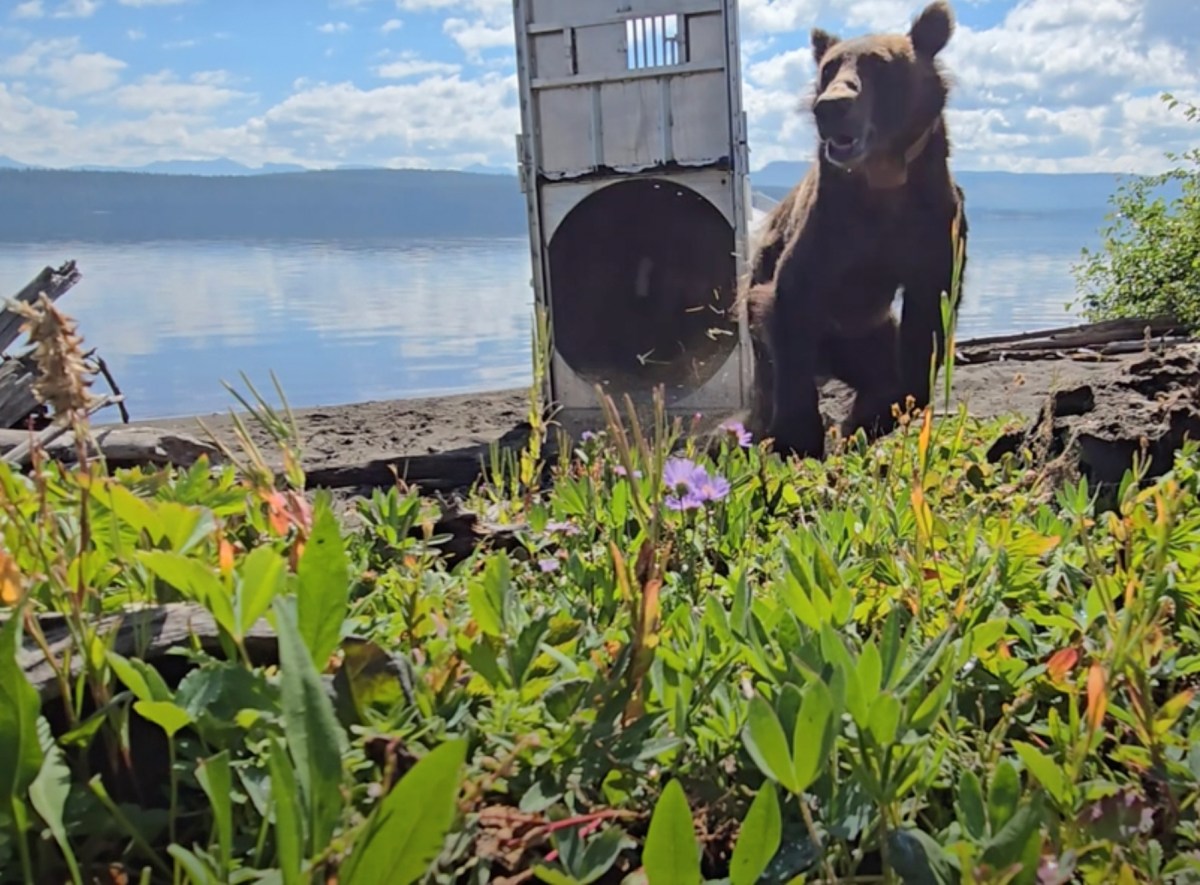
To increase the genetic diversity of an island population of grizzly bears, Wyoming and Montana wildlife managers recently worked together to import fresh bloodlines into the Greater Yellowstone Ecosystem.
Wyoming Gov. Mark Gordon and Montana Gov. Greg Gianforte sent word on Friday that two grizzlies had been moved from northern Montana’s Northern Continental Divide Ecosystem (sprawling out from Glacier National Park) to the Yellowstone region in late July. The operation, which was anticipated for months, imported a subadult female grizzly to the Togwotee Pass area on July 30 and a subadult male grizzly to a remote corner of southeastern Yellowstone National Park the following day.
Future operations could move additional grizzlies north from Wyoming into Montana, Gordon said in a video message. Bears have already been documented moving south to north without human intervention, but not in the opposite direction — toward the isolated Yellowstone population.
“This arrangement is critical to delisting the grizzly bear in the Greater Yellowstone Ecosystem,” Wyoming’s governor said. “Today’s effort demonstrates our ability to further link genetics and maintain healthy populations of grizzly bears.”
Trucking bears from one ecosystem to another came about because of a judge’s decision.
After the U.S. Fish and Wildlife Service turned over jurisdiction of Yellowstone-area grizzly bears to the states of Wyoming, Montana and Idaho in 2017, environmental groups sued and won. The case was decided partly on genetic diversity concerns, and the ruling was upheld by the U.S. 9th Circuit Court of Appeals in San Francisco.
Despite the court’s ruling, biologists most familiar with the Greater Yellowstone population say the current level of genetic diversity is not “in dire straits,” Interagency Grizzly Bear Study Team Leader Frank van Manen told WyoFile in late 2023.
“We have a little bit lower genetic diversity than other populations, but it’s not declining further,” he said. “It’s moderate genetic diversity, is how I would classify it.”
Grizzly bears, which once numbered an estimated 50,000 animals in the Lower 48, were first listed as protected animals under the Endangered Species Act in 1975. The regional population has steadily grown since it bottomed out during the 1980s, when there were as few as 136 of the bruins remaining. Nowadays there are an estimated 1,000-plus bears, and they’ve occupied much of the mountainous habitat in the Greater Yellowstone Ecosystem, where grizzlies are likely to stay out of trouble.
The governors’ announcement pressured the Fish and Wildlife Service to proceed with delisting grizzlies in the Yellowstone region. The agency announced late last month that it’s pushed back its timeline again, and now does not anticipate making any decisions until January.

“Wyoming’s grizzly bear recovery efforts are monumental, expensive and frustrating,” Gordon said. “We spend about $2 million a year managing this bear, and yet time and time again we meet a bar set by a court only to see that target moved over again.”
Notably, the states’ translocation of bears will only work to shore up any lingering genetic diversity concerns if the two animals brought to Wyoming successfully reproduce. Wildlife managers fit the bruins with GPS collars and will continue regular genetic monitoring to ascertain if that happens.
Environmental groups that have litigated grizzly bear management have indicated that trucking animals into the Yellowstone region does not placate their concerns.
“My perspective would be that it undermines their claim of recovery, if they have to translocate bears,” Western Environmental Law Center senior attorney Matthew Bishop told WyoFile in late 2023. “The goal should really be to get bears back in the Bitterroot [recovery area], and get some connectivity between subpopulations. Then maybe start thinking about delisting and recovery, but I don’t think we’re there yet.”

Don’t you think you need to address Wyoming’s animal cruelty issues before bringing more wild animals into the mix if I were a bear and had my choice I would certainly not pick that state until it was civilized
Yes Wyoming, Delist Grizzlies so you can hunt , kill and trap them. You have no respect for wildlife.
Sad that we people can’t learn to live with these Grizzlies. Life is tough for bears as their domain shrinks as well for other species.
Wow. Two whole bears moved from Montana to Wyoming. Big whoop from Guv Gordo and G. ‘Gung Ho’ Gianforte , and a short sermon to the choir and church janitor from the politically compromised director of the interagency Grizzly cardinals.
Honestly, it’s two drops in the bucket. That bucket has millions of acres of unoccupied Grizzly habitat that only 150 years ago was full of bears across the Lower 48 States. Till we started extirpating them ( that’s a fancy word for grizzly genocide).
Keep in mind the States had to be forced at legal gunpoint to move the bears . Previously they fought the notion on ideological and political principle that were separate from any accepted biolgical, ecological , environmental, and plain old public land policy parameters.
What needs to happen is (A.) multiply this 2-bear emigration by a factor of 10…bring down 20 bears, send up 20 bears along this one vector, and (B.) export a good number of those ‘ surplus’ Greater Yellowstone-Wyoming grizzlies to other habitats in other states.
Wyoming is hellbent on controlling bear numbers inside Wyoming to stay between a floor of 500 bears and a ceiling of ~ 750. Wyoming’s tool for doing this ? It’s called Killdown.
What really needs to happen is the translocation of 200 Wyoming grizzlies to empty islands of prime Griz habitat , in order: the Selway-Bitterroot wilderness of Idaho; tribal lands; central Idaho; North Cascades; Uintas ; San Juans of Colorado. Then comes the secondary griz habitat in ~ 15 other locations in the American West.
Once this repatriation begins in earnest in the West, we’ll know that Wyoming is finally serious about following the prime directives of the Endangered Species Act to the letter, and good conservation in spirit … recovery, restoration, sustainability for at least 150 years going forward. Killdown culling will not be necessary.
You don’t want to hear what I really think about Guv Gordo’s ill-informed grousing about griz management. Suffice to say the GYE Grizzly bear is not yours to manage and treat like domestic livestock or a nuisance animal, Gordo. It’s not Wyoming property, it’s America’s bear. Time to recalibrate using something besides failed lawsuits and false narratives.
Finally – what took so long. Ranchers are constantly improving the genetics of their herds with relatively simple purchases of bulls and breeding cows – for many ranchers it’s a routine matter. Private interests can affect genetic improvements quickly – its a simple matter which does require brand inspections and paperwork but the paperwork is routine. So why does it take a governmental project so long to transfer a few bears from one ecosystem to another ??? Hopefully, it will become a more routine genetic improvement matter now that the precedence setting relocations are being affected. Too much red tape and legalize interference has delayed what should have been a no brainer years ago – just get the job done.
Ya gotta keep those Grizzlies on the Move!
I wonder what “they’re” doing up there in the White House Ecosystem these days? Will Trump do the honorable thing, like Biden, and stumble naked amongst Grizzly Bears here in Wyoming before Summers End?