

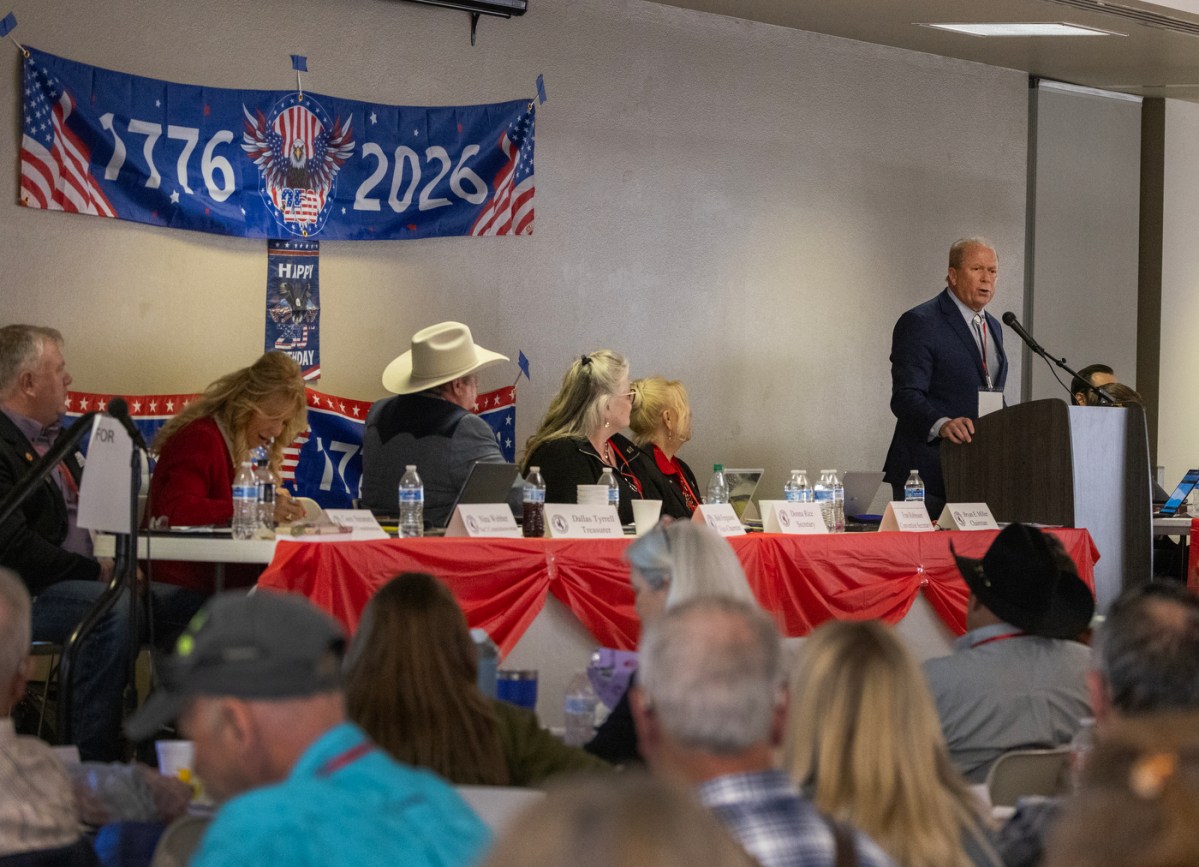
Finally! The Wyoming Republican Party did something that will help the Big Empty.
Opinion
When my party voted at its recent convention to sue the State of Wyoming to free itself from the shackles of statutes that constrict it, that set in motion a process that will hopefully liberate us all from the shackles of partisan politics. For far too long, political parties have acted as some sort of third wheel, imposing themselves between people and government, and have usurped power that belongs to citizens.
The tail has been wagging the dog, and it’s high time to cut off the tail.
The state shouldn’t wait for a lengthy and expensive lawsuit; the Wyoming Legislature should take the first opportunity to convene, and open up Title 22 — our election code — with a chainsaw, not a scalpel. Every reference to political parties in state law should be mercilessly excised and tossed into the bin marked “medical waste.” It’s time to heal our body politic!
Extreme? Not when you grasp that political parties are nothing more than private membership organizations, no different than the Kiwanis or Elks clubs. Yet, over the decades, laws have been enacted that grant parties extraordinary power to influence citizens’ lives, and their exercise of that power has embroiled the entire state in their internal scandals and controversies.
Here’s our chance to put a stop to that nonsense.
If the Wyoming Legislature acts courageously, we’ll not only liberate ourselves from the clutches of political parties, but we’ll save a wagonload of public money, to boot. Political parties are expensive stepchildren to maintain, so let’s kick ‘em out of the house.
County and state government should only be legally required to conduct general elections, and costly partisan primaries should be things of the past. How the parties nominate candidates for the general election should be their business and not ours.
Parties could hold karaoke contests with applause meters to select candidates if they choose, or thumb-wrestling tournaments for all that we care. All we need are the names for the ballot. And we can save ink on those ballots if we don’t put a hyphenated letter behind the names.
Anyone else gathering, say, a thousand signatures would also appear on the ballot. If no candidate in a race receives a majority vote, then a quick runoff election would be held between the top two vote-getters.
We could even repurpose those fancy caucus rooms in the Capitol for the public to enjoy, instead of for the exclusive use of party card-carriers.
The only oxen to be gored in this scenario are the yard-sign makers and advertisers who rake in big bucks during primaries. But the rest of us would be emancipated from party bullshit.
Political parties should no longer be involved in filling vacancies in elected offices. Instead of parties anointing finalists for county commissions or the governor to select from, every vacancy should be filled via a special election. We can pay for those elections with the money we save by not having primaries.
A vacant seat belongs to the people of Wyoming, not to a partisan organization, and the people should fill it directly. Eliminating the role of parties in our civic system will allow citizens to interact directly with their government instead of through partisan intermediaries with differing agendas.
Political parties should conduct their own business without interference from government. And vice versa!
This is not such a radical notion if you consider that the words “political party” occur nowhere in our federal or state constitutions. They shouldn’t occur in our statutes either.
In fact, in our entire foundational canon, “political parties” are mentioned only in the Federalist Papers, specifically #10. In that letter, James Madison called the parties “factions” and predicted their disruptive influence and the danger of granting them too much power in a democracy. Madison, as it turns out, was right.
None of this is to say that you can’t belong to the party of your choice; restricting that would be unconstitutional. Feel free to join any exclusive organization you want, complete with loyalty oaths and secret handshakes. Live by whatever platform blows your skirt up. But don’t pout if the Legislature eliminates laws that allow your organization to impose its dogma on the rest of us.
The GOP’s decision presents the Wyoming Legislature with a rare opportunity. Lawmakers can cleanse, streamline and economize our political system by divorcing us from political parties once and for all. I hope they seize this chance to liberate our political system from the negative influence of partisanship.
Doing so would eliminate a troublesome barrier between citizens and their government.

On the State level, I wholeheartedly agree with Rod’s commentary. On the national level I have a “short” wish list; First, reform Citizens United and do needed campaign finance reform; revise the tax code so everyone, citizen and corporate pay their fair share (whatever that is);
Ranked‑choice voting or open primaries at the federal level (implemented by states, but Congress can regulate federal elections); Independent redistricting commissions — achievable through state action, (Congress can set standards);
Campaign‑finance transparency rules — (Congress can strengthen disclosure requirements without overturning Supreme Court precedents); Institutional Restructuring (Realistic but Politically Sensitive)
Potential realistic reforms: Consolidating overlapping agencies (e.g., merging economic development or science agencies); Revising federal emergency‑response structures to improve coordination for climate‑driven disasters; Reevaluating the size and composition of the federal workforce — not necessarily shrinking it, but reallocating capacity to high‑need areas.
Policy‑Neutral Capacity Reforms (Most Realistic of All): These are the reforms that historically succeed regardless of which party is in power; Improving federal procurement and contracting — reducing waste and increasing competition. This has been historically difficult because of the power of lobbyists and their military/industrial complex and their political donations, for example.
Upgrading cybersecurity and AI adoption — repeatedly identified as a federal priority.
Strengthening inspector general independence — Congress can pass statutory protections.
Enhancing federal weather, climate, and disaster‑response capabilities — widely recognized as necessary.
Constitutional amendments (e.g., term limits, Electoral College overhaul) — needed, but extremely unlikely due to ratification thresholds.
Bottom line, I hope the incoming administration in 2028 will have readied a long list of Trump era executive actions to be reversed.
Not an entirely bad idea Mr. Miller, even if it was presented with tongue firmly in cheek. In this real world though, any observant person knows full well that the odds of the 2 parties ever being neutered are substantially lower than the odds that Trumpty Dumpty would make it through an entire week without telling at least one insipid, hyperbolic lie. The GOP and the Dems have accrued to themselves far too much power to ever be in any danger of being cancelled. Sadly, probably the only thing that could ever cause the two to join forces would a credible threat of their forced dissolution.
It’s a rare occasion when you stop short of the mark Rod, but this might be one. Social clubs should have nothing to do with elections for public office. They don’t get to nominate anyone. If you want to run for office, you file and run. Your 1000 signatures is sadly, more people than have voted in some races. Let the social clubs get together and have their bake sales and silent auctions and write up platforms that have no connection to the real-world solutions Wyoming needs. Afterwards they can pat each other on the back and tell themselves how clever they are.
Ranked Choice Voting.
Sounds great to me!
You continue to be my hero! Thx for this!
Yes! Do it now!
You might be on to something Rod. All the political parties currently do is divide a fractured country further by pitting one tribe against the other. Being able to vote for the most qualified candidates without regard for which tribe they belong to does have some logic to it, or in Wyoming’s case, idiots trying to out-MAGA one another (Gray vs. Rasner). Take away the (R), the (D), or the (I) and voters would actually have to pay attention to what these people running for office are saying before blindly casting their votes which got us Trump and the freedom caucus.
Amen!
Political parties are a relic from the 19th century. The entrenched two party system has failed. More qualified people can be considered for public office. Runoff elections and ranked representation provide for more options in supporting the candidates you prefer.