


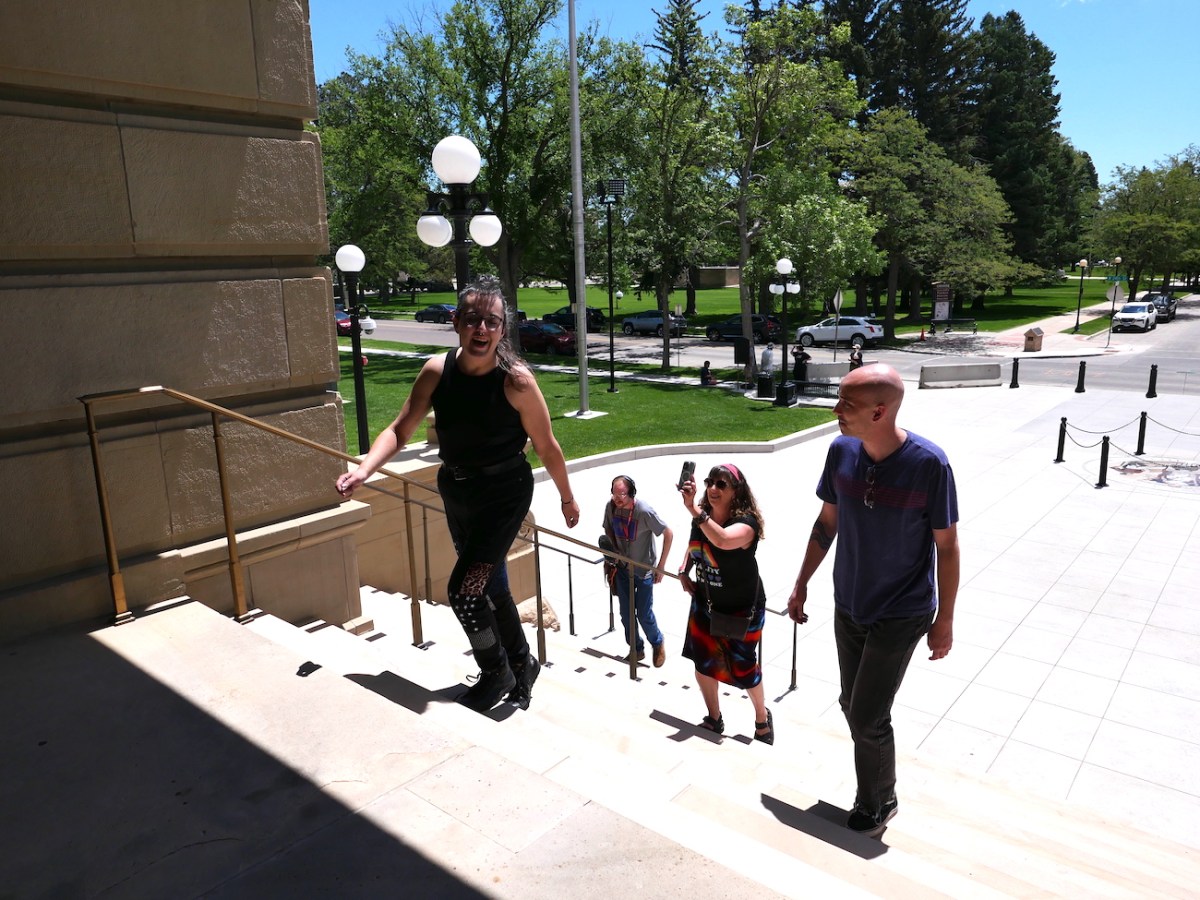
Ríhanna Kelver, a transgender Laramie woman who drew a gun on a man in what she has said was an act of self-defense, isn’t immune from prosecution under Wyoming’s stand your ground laws, a judge ruled Monday.
“While Ms. Kelver did not have a duty to retreat because she was not the initial aggressor, she was not entitled to use deadly force because she was not in danger of imminent death or serious bodily injury and a reasonable person in like circumstance would not have judged her actions necessary to prevent imminent death or serious bodily injury,” Albany County District Judge Misha Westby stated in her ruling.
Kelver, who is facing felony charges for aggravated assault and possession of a deadly weapon, can still raise self-defense arguments if the case moves to trial, Westby stated.
The case against Kelver, a vocal trans rights activist, has drawn national attention, with media and observers asking why a trans woman faced criminal charges for her actions in a state with a stand-your-ground law.
The charges stem from a September 2025 incident in downtown Laramie, when Kelver pulled a gun on a man, Scott Durham, after he had pushed her to the ground. The encounter was recorded by a surveillance camera.
Accounts differ as to what led to the altercation. According to Kelver’s testimony, Durham had allegedly taunted her as she sat in front of the Crowbar & Grill before a late-night shift, yelling that “the [Crowbar] should be closing you bunch of fags.” Kelver asked him, “What the fuck did you say?”
Kelver recounted at a hearing last week that Durham allegedly told her: “I’ll fuck you up, faggot,” and “I’ll fucking kill you, you fucking faggot.” According to a Laramie police affidavit, Durham told police that he had yelled “‘fuck the Crowbar because he likes the Buckhorn Bar better,” without using slurs aimed at Kelver.
Kelver began walking toward Durham and his two companions with her right hand near a satchel at her hip, according to video footage and court filings, meeting them in the crosswalk at the intersection of 2nd Street and Ivinson Avenue. The satchel contained Kelver’s firearm.
Durham then “put both hands” on Kelver’s chest and “forcefully shoved her,” causing her to fall. When she hit the pavement, Kelver pulled a pistol out of her bag, racked the slide and pointed it at Durham, who continued to walk past her. She lowered the pistol and stood when “it became apparent” to her that Durham was “disengaging from the encounter.”
When Laramie police later questioned her, Kelver said she had brandished a knife, not a gun, and that her firearm was in her car, the police affidavit states. She later disclosed that she had a gun in her bag. Officers took the firearm, which had a chambered round.
Called to the witness stand during a hearing last week, Kelver said she had carried a pocket knife as a “defensive item” when she was in town. She was having a “PTSD response” after the incident and couldn’t “clearly at that moment recall the events,” she said. “So I was attempting to operate off the best information I could remember, being told I had pulled a weapon. I believed I had pulled the knife.”
Durham is currently considered the victim in the case. The Laramie Reporter and CU Independent reported he was once a member of Patriot Front, a white supremacist group, and has a history of posting online content targeting minorities.
Westby stated that evidence doesn’t show Kelver was the initial aggressor, given that Durham was “the first person to make a physical act of aggression” when he shoved Kelver to the ground. Further, the judge elaborates that “no evidence presented” countered that Kelver “had an honest belief that she was in danger of a further attack” when she drew her gun.
But a “reasonable person in like circumstances” as Kelver wouldn’t “judge her threatened use of deadly force as necessary in that moment to prevent imminent death or [serious] bodily injury,” Westby wrote. By the time Kelver crossed the street, appearing to veer into Durham’s path, there were “only two men in the vicinity,” she explained. After Durham pushed Kelver, he “continued walking” as she fell to the ground, and “did not look” at her again “until she racked the firearm and pointed it at him.”
“He was walking past her position,” Westby writes. “His hands were visible on the video from the shove and even when he is walking past her.” There was “no evidence” that Durham “possessed or mentioned a weapon of any kind.”
Meanwhile, the other man in the vicinity “purposefully walked around” Kelver and didn’t “have any interaction or even look at her” until she drew and pointed her gun at Durham, Westy wrote.
Westby’s decision follows last week’s “John hearing” — named after a 2018 Wyoming self-defense case — to decide whether Kelver could be immune from prosecution under the state’s self-defense laws.
Arguing that Kelver was not the initial aggressor and that she feared further attack, Kelver’s attorney, Laramie-based Andrew Holcomb, pointed to a study that found transgender people experience violent victimization at a rate of almost five times more than non-LGBTQ people. Holcomb asserted that this context is “relevant to how Ms. Kelver perceived the risk that this verbal hostility could become physical violence.”
In her Monday ruling, Westby acknowledged “the general concerns raised by Ms. Kelver as a transgender woman.”
While Kelver can raise a self-defense argument at trial, the burden of proof will be higher.
This is a breaking story and may be updated.

“”Kelver began walking toward Durham and his two companions with her right hand near a satchel at her hip””
This is where the problem lies.
Stand your ground and no duty to retreat does not include advancing towards/escalating a confrontation.