

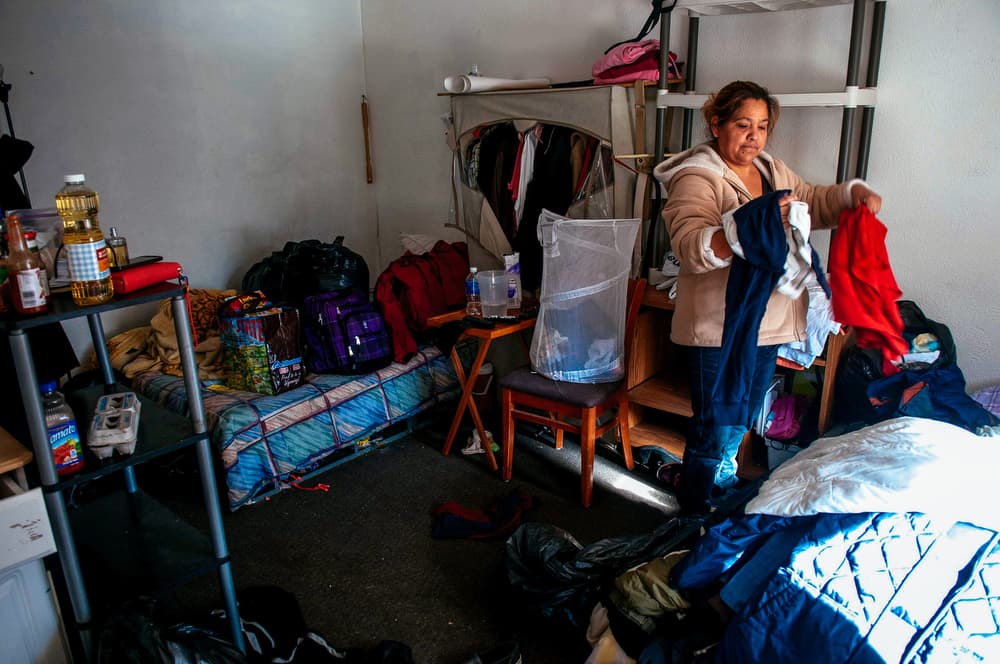
Lack of affordable housing is a persistent and pervasive problem facing resort communities around the west — perhaps nowhere more so than Jackson Hole, where campgrounds, cars and RVs serving as de facto homes dot the valley, and available jobs outnumber places for would-be workers to live.
With the gallery below, which originally accompanied the story Fighting for their dreams by Emma Breysse, Jackson Hole News&Guide photographer Ryan Jones has given the intractable problem human faces: Those of the Retamoza family. The Retamozas, who immigrated legally from Mexico, secured work visas, and found satisfying work in Jackson now face an even larger hurdle — “Find a place to live or leave.” — Ed.

In their room at Flat Creek Inn, Abigail Hernandez, 17, right, and her father, Miguel Hernandez, record a video on Christmas Eve to send to relatives in Mexico. At left are the teen’s mother, Laura Retamoza, and brother, Azari, 15. Retamoza used her favorite large pot to make posole in the space behind their room’s front door.

At a Mexican market this spring Miguel Hernandez wires money to his mother in Mexicali, Mexico. He and his wife are the only members of their families in the United States. The couple support their relatives in Mexico, sending them as much as half of their paychecks so they can afford meat and other things.

Laura Retamoza prepares barbacoa in the makeshift kitchen in her room at Pioneer Motel. Retamoza learned to cook from her mother and ran a taqueria in Mexico before moving to the United States. Despite the limited space in the motel room it’s important to Retamoza that the food her family eats is made with her own hands. “I don’t need a kitchen,” she said. “I just need a small place, and I can cook you anything.” Retamoza and her brother came to the United States “chasing a dream” of opening their own small restaurant.

Retamoza’s husband, Miguel Hernandez, and son, Azari, relax in the Pioneer Motel last October. Despite the decrepit conditions they were grateful to have a roof over their heads. “We can have a lot of problems, but there is always love,” Retamoza said. In Mexico, she said, they lived as a “big family in a small house,” and are used to cramped living conditions.

Retamoza cleans mixing bowls at the Bread Basket of Jackson Hole, where she often works alongside her children. She juggles two jobs to support her family in Jackson and in Mexico. She also uses the kitchen at work to make food she is unable to prepare in her motel room. “I have a good boss,” she said. “I have a good job.”
If the family ends up moving to Victor, one of the possible solutions to their housing crisis, she said she worries she may have to give up the job due to difficulties adding a commute to her work day.

While shopping in April, Retamoza signals to a Smith’s Food and Drug cashier the number of cans of hominy she and her husband, Miguel Hernandez, are purchasing. The couple speak only a bit of English and have a difficult time communicating with people outside the Latino community. Working leaves them little time for English classes, though their children have been able to learn some through their schooling.

Laura Retamoza records a video of her brother, Paco Quintero Garcia, and son, Azari Hernandez. The family uses Facebook to stay in touch with their relatives in Mexico.

Family and friends of Jorge Moreno gather to celebrate his son’s birthday in November. Moreno, who works at the Latino Resource Center, helped Laura Retamoza and her family find a place to live after the Pioneer Motel closed. “This is my other family,” Retamoza said. Moreno helped to translate for her when, as she said, she decided to “speak out for the families who are afraid.”

Retamoza takes a moment to reflect on her 43rd birthday while celebrating at her brother’s house. The family has often spent time there following Sunday church services to get out of their motel and to give her the chance to cook in a real kitchen. “This is a moment when I am happy,” Retamoza said. “I reflect on my life and where I am, and I know I am privileged.”

Laura Retamoza says goodbye to her brother, Paco Quintero Garcia, as he prepares to head out on a mission trip in China before returning to Mexicali, Mexico, to help his family and finish his studies. Garcia is the one who brought Retamoza to Jackson and helped her secure a visa. Retamoza has acted as a mother figure to her brother since their mother died when he was 15. Now she’s supporting him through an education originally interrupted by poverty. She has only a fifth-grade education.

Azari Hernandez helps with the moving in January after his family found a motel closer to his mother’s work. His mom, Laura Retamoza, said she felt sad that her kids had to be behind her carrying their belongings every couple of months as they moved from motel to motel. She said through a translator last month, “We tell our kids, ‘You might have to go back to Mexico. We don’t want you to suffer with us. Your father and I, we can live in a car, but not you.’ And they tell us, ‘We’re going to be together.’”

Retamoza’s husband, Miguel Hernandez, returns to his vehicle while house hunting in April. A friend of the family offered to rent the couple and their two children a horse trailer for $500 a month. They seriously considered it, because their only alternative was to return to Mexico once their motel switched from monthly to nightly rates at the end of the month, but Hernandez was afraid they would get sick.

Wow! These outrageous living conditions existing in the most affluent county in the USA?! Beautiful photographs, beautiful families. Thank you for this necessary and amazing, on various levels, article and the poignant photos.