

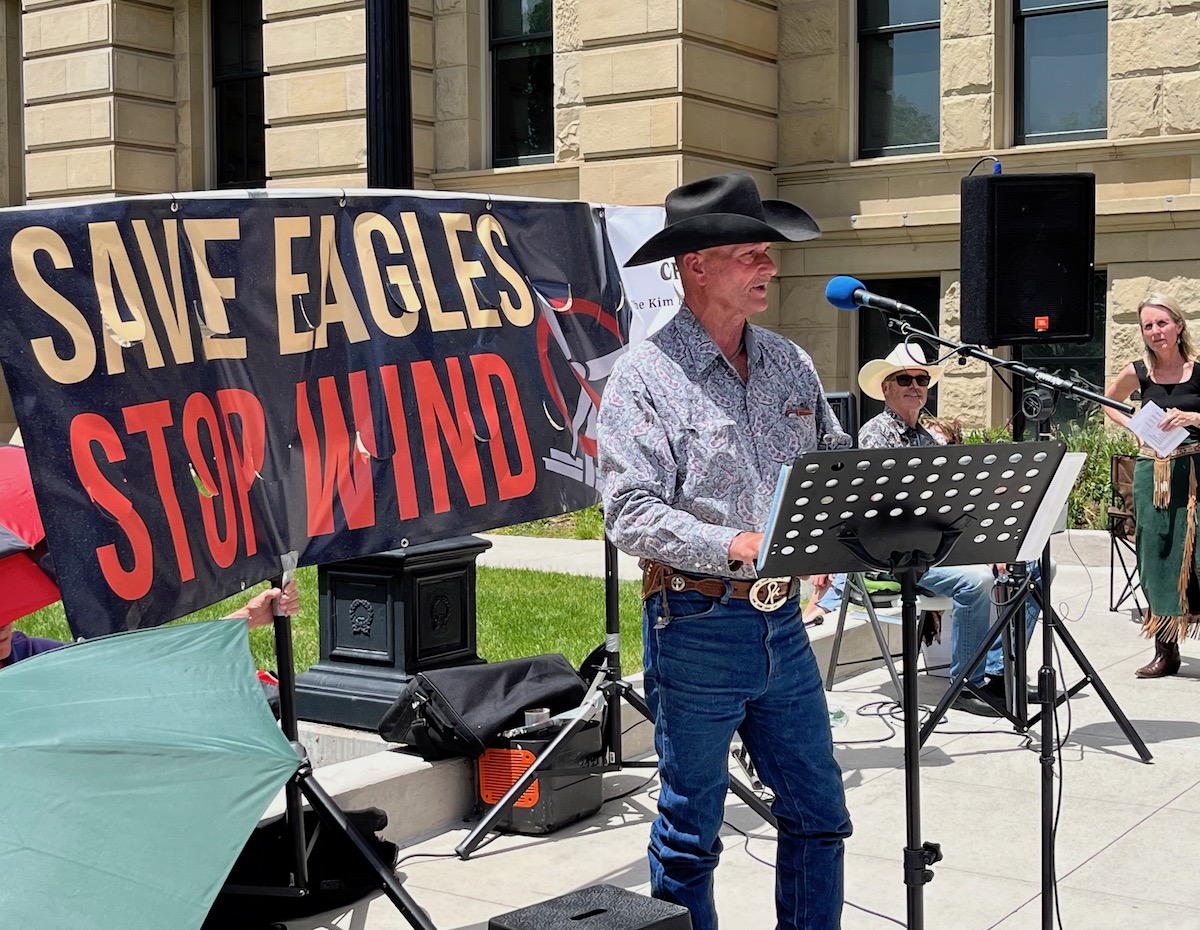
CHEYENNE—Decked out in Wranglers cinched with a horseshoe belt buckle, a paisley button-up shirt and black cowboy hat, Niobrara County rancher Bobby Giesse addressed a crowd of about 50 on a blistering hot afternoon in front of the State Capitol Building.
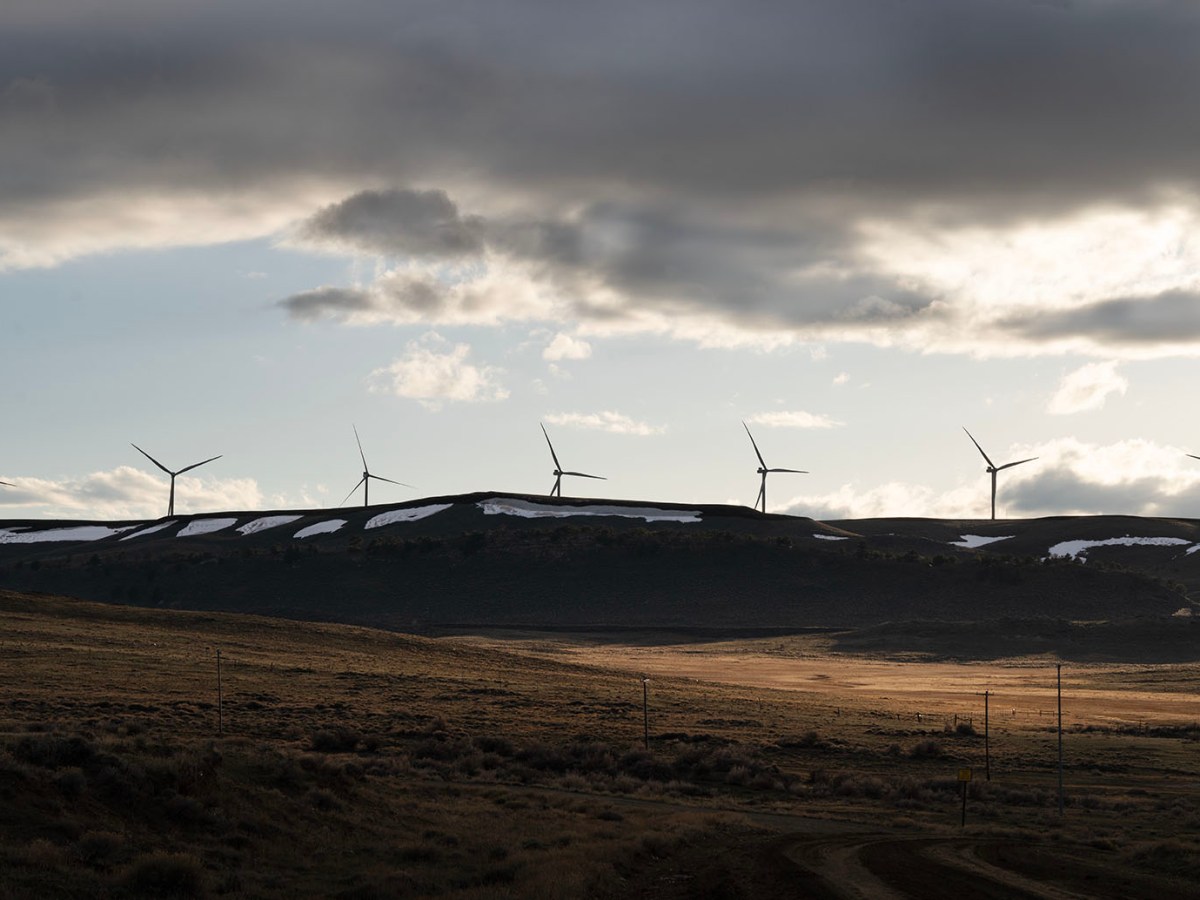
Central and southeast portions of the state are seeing an expanding crop of wind turbines, he noted, underscoring what other speakers had described as an industrial “Wind Wall” that threatens Wyoming’s vistas, ranching heritage, wildlife and tourism.
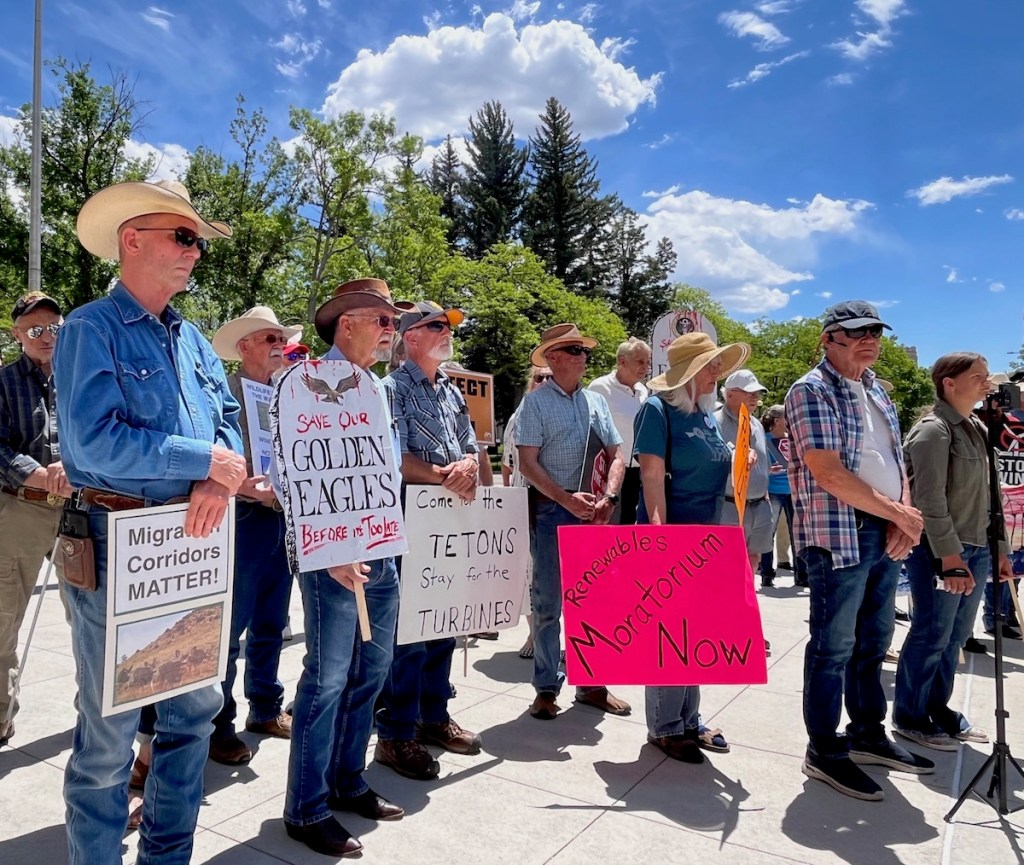
“Wyoming is what America was,” Giesse told the crowd of people holding placards emblazoned with phrases like Save Our Golden Eagles Before It’s Too Late and Renewables Moratorium Now. “The problem is, once it’s gone, it’s gone. And it never comes back.”
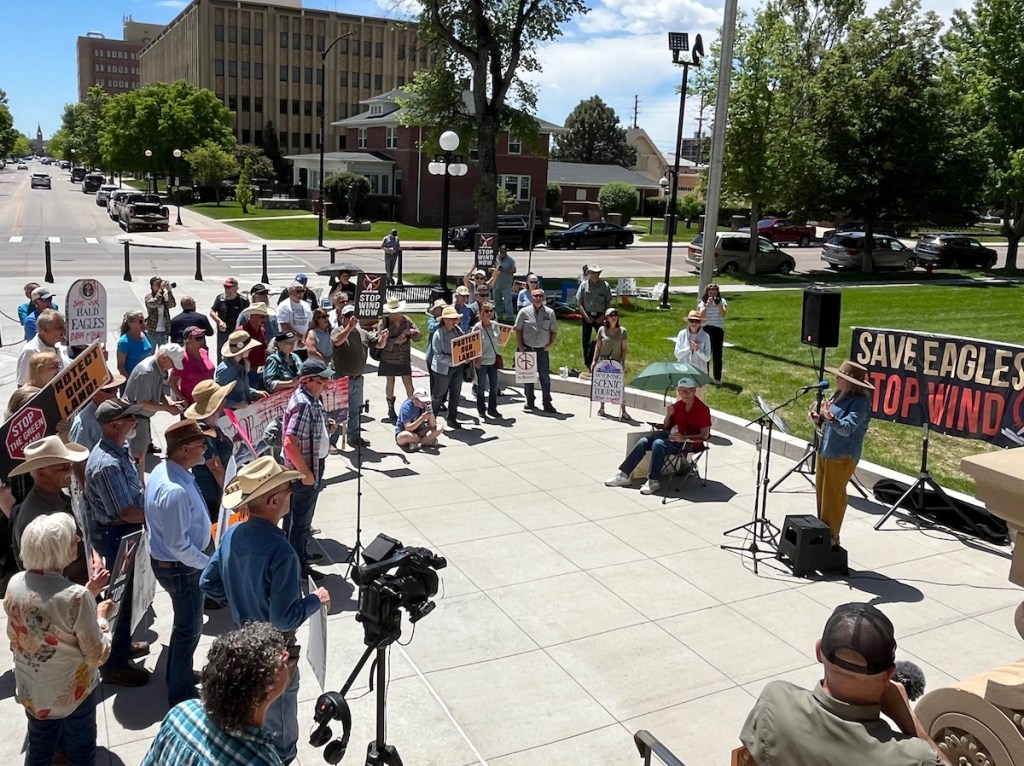
Other speakers at the “Wyoming Wind Wall” rally on Thursday warned wind turbines threaten birds — particularly golden eagles — stress cattle, displace wildlife and potentially pose risks to people via vibrations. To date, there are about 1,927 wind turbines spinning in the state, according to federal data, and at least another 1,000 wind turbines are either being erected or in various stages of permitting and financing.
Rather than take aim at any one particular wind energy project, rally organizers called on decisionmakers to consider the bigger picture: the cumulative impact of converting mostly undeveloped, agricultural landscapes into semi-industrialized zones with wind towers that are regarded by many as a blight on Wyoming’s open spaces.
“Across the Laramie and Snowy Range mountains, industrial wind projects are being approved across hundreds of thousands of acres in the middle of the central flyway, in critical migratory wildlife corridors — without a clear, consistent evaluation of their combined impact,” Albany County Conservancy Executive Director Anne Brande wrote in an email blast ahead of the event. “What is taking shape is NOT a series of individual projects. It is a solid wind wall threatening migratory wildlife and communities.”
Each existing and proposed wind energy project hopscotches through a federal, state and local permitting process where local authorities operate within their own silo of mission-and-authority, critics say. The disjointed regulatory landscape fails to acknowledge that each new wind farm builds upon the other, extending the electrical vine to enable more and more outward industrial growth.
Cheyenne area resident Wendy Volk, who organized the event, has implored state officials to consider individual wind energy projects as part of a larger industrial infrastructure that’s morphing into a corridor of towers, power lines and electrical substations from Medicine Bow to Cheyenne to Douglas.
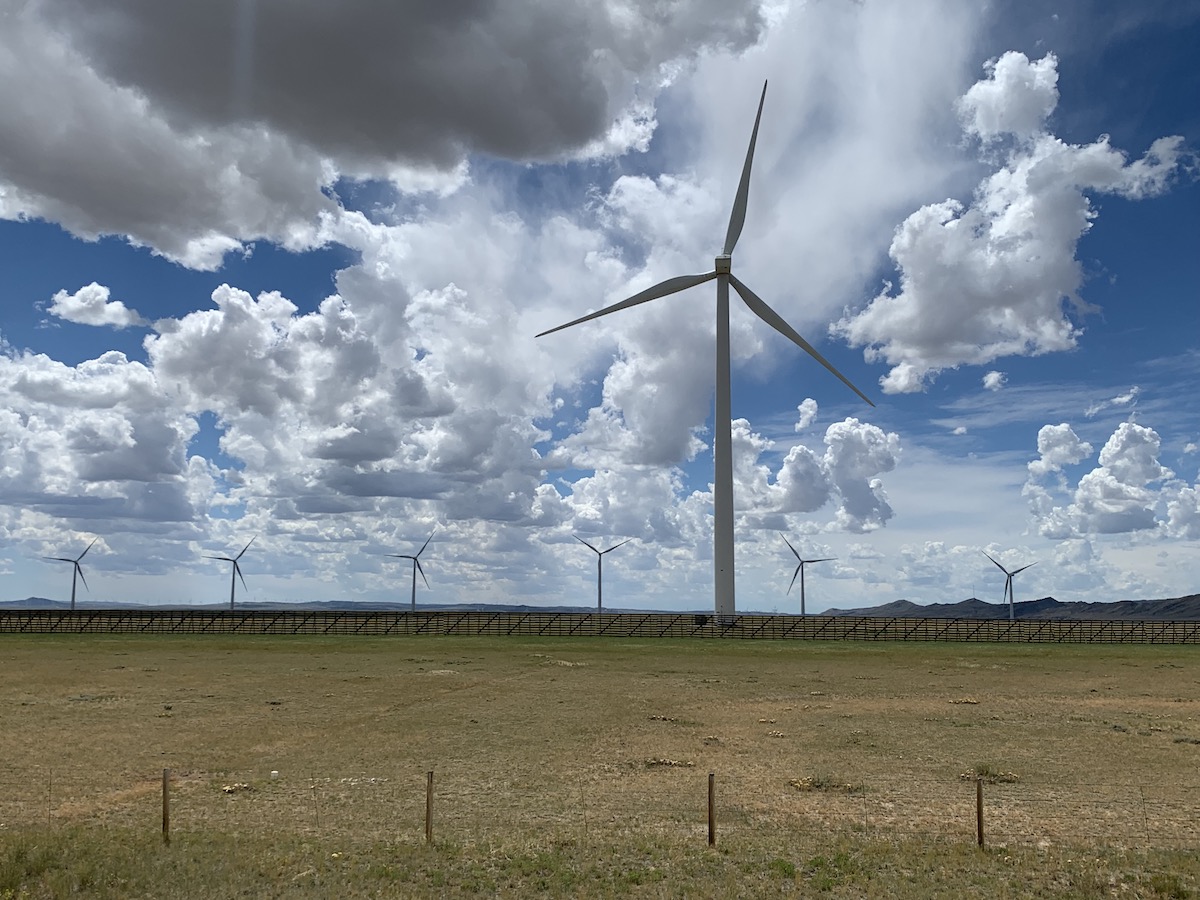
Absent from the rally, however, were Wyoming ranchers and farmers who say, even if they’re not crazy about wind turbines or renewable energy in general, the industry provides an opportunity to earn surface lease rentals. That extra income, several ranchers have told WyoFile, could mean the difference between keeping pastures in production or selling off sections for rural housing and other non-agricultural uses.
Giesse scoffed at the notion when WyoFile asked whether he’d consider such an opportunity.
“They sat at my dining room table and they offered me $47 million over the next 55 years,” Giesse said. “I’m supposed to be blown away.
“I told them,” he continued, “‘What you’re going to do is, you’re going to come in here, you’re going to do the same damn things that some of the oil companies tried pulling. Get paid your subsidies, and you’re going to sell the damn company to a shell LLC who’s going to file bankruptcy and nobody’s going to get anything.'”

Mr. Ronnback, as a Wyoming rancher I would love to educate you as to why “we ranchers” are concerned about such things as the eagles. Our Ranch has been here since 1886 and as such we must and I stress MUST be outstanding as conservationist of our lands or we will find ourselves out of business in very short order. Our Ranch has been in operation continuously, by the same family, for 140 years. We must always be in tune with nature, our environment etc., or as I said we would be out of business in very short order, yet we our still here. Eagles, just like bats or grass and water sheds are all part of our ecosystem and all must be protected…at all costs! Our American Ranchers and Farmers are arguably the finest conservationist and environmentalist this country has to offer and have been the longest practitioners of such concerns of anyone. All in the name of feeding a nation! So you better believe we are concerned…so should you be! Bobby Giesse
I find it hard to believe that Wyoming ranchers are concerned about saving eagles.
Here’s a fact salad to contemplate. The total number of jobs at all of Wyoming’s coalmine operations is currently about 6500. The total number of coal miners in all 50 American states in 2024 was 44,060 , which was down by 1400 from the previous year ( source: US Energy Information Agency ) . The number of people employed in Alternative Energy just in the state of Colorado is 67,000 and climbing. ( Source: Colorado Energy Office). Total US employment in wind , solar , and energy efficiency upgrades ( such as installing heat pumps) is 3.4 million and rising. ( source: US Bureau of Labor Statistics). That is 77 jobs in green energy for every coal mining job nationwide.
In contrast, a century ago, when America had 125 million residents (a third of the population it does today) there were 800,000 coal mining jobs. Not a typo: eight hundred thousand , mostly east of the Mississippi when everything ran on coal , before the Great Depression and mechanization took over. Wyoming should look at the Appalachian saga . The past is prologue.
Meanwhile, to the Luddite livestockers and retrograde farm communities I suggest a field trip to Canada to observe how cattle production , wheat farms, and wind turbine ‘farms’ are compatible. Turbines have dotted the plains of Alberta and Saskatchewan for decades. In a major wind turbine farm , 98 percent of the land remains available for agriculture.Claims that the turbines are destructive, kill birds, ruin soil blah blah blah are wildly exaggerated. Studies show that ranchers and farmers who engage wind turbines are supportive and actually seek out more turbines. That second income stream cannot be overstated.
One of the most exciting areas of innovation in agriculture and green energy these days is the adoption of Agri-Voltaics… elevated solar panels with grazing all around. Sheep love the shade.
But hey! it’s Wyoming. We choose to remain in the past. Luddites live among us…
I find those that obviously voted to wreck the environment by any means necessary are using the laws passed by citizens that cared about the environment to take out wind farms. Somehow these citizens can the dots on the wall of wind, but are okay with letting coal ash* waste destroy our groundwater in Wyoming without a peep?
* Coal Ash tests as a hazardous waste, but is exempt in the law from being a hazardous waste because of the control the energy industry has over our State and Federal legislators. Due to the exemption the coal companies do not put coal ash in lined pits, therefore, the heavy metals emanating from the coal ash percolate to our drinking water.
In addition, these folks now care about wildlife, when they kill every critter that could possibly interfere with their operation including the beaver. If only Wyoming had kept the beaver, we would have far less water storage and groundwater issues due to this engineering marvel, but it was wiped out and these short sighted landowners just keep on killing until their “view” is impacted. When you only care when it impacts you, I would argue you are a selfish citizen and not a good one.
This anti-wind (and solar) movement is destructive to our environment and economy. It’s all part of the MAGA/Trump reactionary agenda. How far will their dishonest go? Their lies are blatant.
My opinion is, I agree, get rid of the wind turbines! We do not want them at least in Wyoming! They destroy so much land just to build them! They are ugly and change our wind patterns! And that changes our weather patterns ! They Kill birds and pollute our land! They bury the blades, instead of sending them back to China where they are made! My nephew used to work on them! So dangerous climbing up so high and only a small perch to work on the motor! Leave our Wyoming land and air free of these unnecessary turbines. We want our open spaces, our birds to fly and our wind to blow how Mother Nature intended! Quit trying to change Wyoming to a dumping grounds, since the other states have lost their land! Look what they are doing to Evanston, Laramie ! All you see when you drive there is wind turbines! And now different destruction to Kemmer! Taking more land and water!!! Wake up Wyoming!! Pretty soon there won’t be anywhere for our cattle, sheep, ride a horse, hunt, or even to take a drive to the Gorge, it will all be gone! Wake up Wyoming!!
I have walked under many windmills, I have yet to see a dead bird. I am not saying they don’t kill birds, I just haven’t seen one yet.
Cowboy Bob’s banner should read “Save Coal Stop Wind”.
Take a drive on I-10 west of Palm Springs California or east of Livermore to se what an abandoned wind farm looks like.
They are a “beneficial” blight on the landscape ~20 years, then become just a blight that the owners apparently don’t have to clean up when they no longer make money from it.
Chad: what about Wyoming’s 8,000 abandoned / orphaned oil and gas wells, and forsaken coalbed methane mass graves? The Husky Oil refinery in Cody was mothballed in 1982 ,and the land around it is contaminated with toxic petroleum pollution and heavy metals. A phenomenal amount of lead leached out of those twenty ancient 200,000 gallon tanks lined with 8 inches of lead. I believe the Husky site should have been declared an EPA Superfund cleanup site, but was only minimally treated and mostly buried in political expedience.
It is not the only example…Wyoming used to have 35 more oil refineries than it does today. The state landscape is also cluttered with the skeletons of long disused oil& gas treaters pumps and compressor stations.
Take off your blinders, Chad.
Interesting
What actual research have any of you completed on wind energy? Living in the Trump bubble does not afford facts but talking points that are untrue. Check this out:
The land-based wind industry supports over 383,000 jobs, including direct, indirect, and induced positions.
Wind energy provides a quarter of the electricity produced in nine states… and growing.
By the end of Q4 2025, there was 25 GW of land-based wind capacity in the clean power pipeline, representing over $50 billion in capital investment.
Wind is America’s largest source of renewable energy.
Benefits of Wind Power
Utility-scale wind energy is the largest source of renewable electricity generation in the United States, providing 10% of the country’s electricity and is continuously growing.
Economic contributions
Land-based wind development has delivered nearly $352 billion of investment across all operational and planned capacity.
Major employment sector
The industry employs over 383,000 Americans across all 50 states from direct, indirect, and induced jobs.
Fast-growing jobs
Wind turbine technician is the fastest growing job in the country, increasing by 50% over the next decade.
Employment for U.S. veterans
The U.S. wind industry employs America’s veterans at a rate (9%) higher than the national average (5%).
Stable tax revenue
Land-based wind projects delivered nearly $2.7 billion in state and local tax payments and land-lease payments last year.
According to Chuck Gray’s TV ads he’s stopped “woke” wind projects. If that’s true, why do those big suckers keep popping up all over the state? Somebody’s not exactly being truthful here…
HAHA He also saved us from China and North Korea.
All are entitled to their own opinion. Would it be possible to obtain the maps of migration routes spoken of so frequently? If so where? While much disfavor is found in new concepts and ways of thinking, It seems that an appraisal of how rural subdivisions effect wildlife, water and riparian areas would be appropriate. Planners and zoners are pretty much bound by their rules and regulations. Example- 4 plot subdivision in flood plain. FEMA is unable to do an assessment of the whole county so some places are not safe So the county issues a flood waiver.
The Wyoming Game and Fish Department website has maps of big game migration corridors and crucial ranges. https://wgfd.wyo.gov/wyoming-wildlife/movement-matters/big-game-migration, https://wyoming-wgfd.opendata.arcgis.com/
Thank you
I’m a lifelong Texan who visits Wyoming for a couple of months annually. My home state has gone for wind power in a huge way. In recent years our governor has turned against it, even telling baldfaced lies about the reliability of non-fossil fuel sources of energy during times of crisis. Without hearing any explanation for this turnabout, I suspect political reasons over any others (so far I have heard none given). It is true that the turbines kill a number of birds and there is a problem with disposal of the giant blades when they are no longer of use. However, when the overall effects to the environment caused by turbines versus oil and coal are considered, it seems to me a slam dunk in favor of wind power. I ask the gentleman above to give evidence as to why he thinks wind power is evil. Something real, please.
The truth about what a complete flop wind energy is has been so well buried by its proponents and the pseudo science crowd that it will be decades before the damage already done comes to light. When it does those responsible will be long gone.
If it has been a complete flop then why are their literally thousands of wind turbines around the world. I would like to know the source of your data please.
Kind of like oil and coal, eh?
I absolutely love the ” Save the Eagles” signs. If there’s one bunch that does not care a whit about eagles (at best), it’s the ranchers. This is from personal experience, btw.
I don’t blame people for not wanting development in what used to be open space, however the ‘save the eagles’ angle is disingenuous as long as Wyoming allows lead ammunition and these same people would fight just as hard against a ban on lead ammunition as they do against wind turbines.
Example please?
You got that right. Maybe the guy with the sign isn’t a rancher. Maybe this is a bi-partisan movement? It’s an odd bunch for sure, look at Bobbie’s hat, he must’ve forgot it was June.
and migration, they don’t care about migration unless it suits their narrative but subsidies that is another story!