
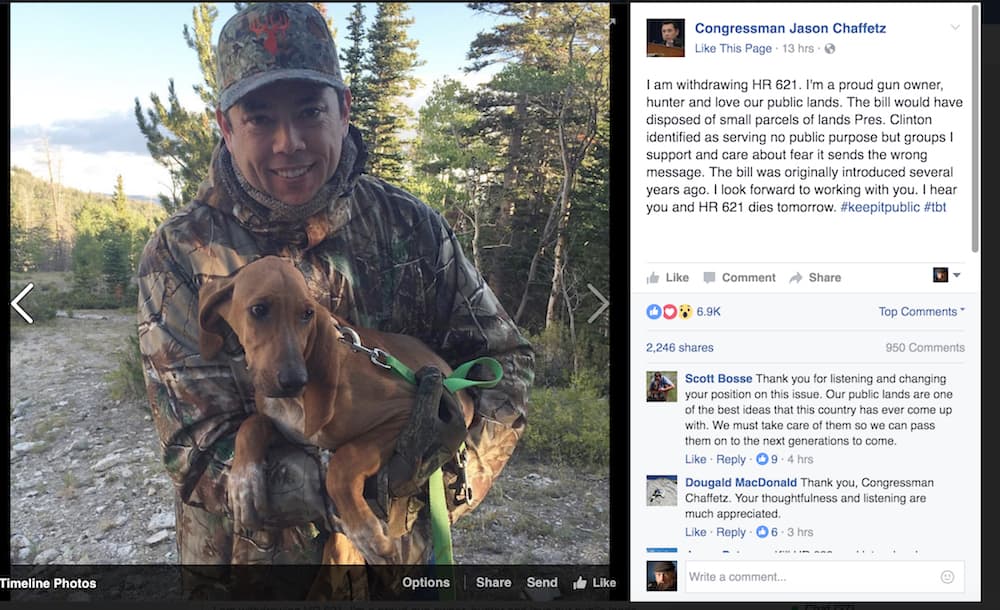
U.S. Rep. Jason Chaffetz used a Facebook post to announce that he was withdrawing a controversial proposal to sell almost 700,000 BLM acres in Wyoming. (Jason Chaffetz/Facebook)

U.S. Rep. Jason Chaffetz of Utah said late Wednesday in a Facebook post he is withdrawing a bill that would have directed the Secretary of the Interior to sell 694,200 acres of public lands in Wyoming.

Chaffetz introduced the bill last week and it was headed to a House committee, according to the bill-tracking website Congress.gov. The language of the bill hadn’t even been posted publicly before Chaffetz pulled it back, saying the measure “sends the wrong message.”

“I am withdrawing HR 621,” the GOP congressman said in his post. “I’m a proud gun owner, hunter and love our public lands.

“…[Groups I support and care about fear it sends the wrong message,” the post said. “I hear you and HR 621 dies tomorrow.”

Withdrawal brought a wave of approval on social media and from conservation, environmental and hunting groups.

“American sportsmen and women know definitively that public lands are the backbone of our sporting traditions,” a manager with the National Wildlife Federation said in a statement.

“That[’s] why sportsmen from across the land flooded Congressman Chaffetz’s office with calls and emails over the last week demanding that he not pursue HR 621,” wrote Aaron Kindle, the groups western sportsmen’s campaign manager. “We appreciate that Mr. Chaffetz listened and withdrew his support for the bill.”

Land Tawney, president of Backcountry Hunters & Anglers agreed. “Representative Chaffetz should never have introduced this ill-conceived bill,” Tawney said in a statement, “but the instant and overwhelming response by sportsmen and women forced him to listen and ultimately abandon H.R. 621.”

Chaffetz wrote that the bill would have “disposed of small parcels of lands Pres. Clinton identified as serving no public purpose.” Chaffetz’s bill was based on a 20-year-old Clinton-era study that identified the acreage referenced in the bill’s title. But the 1997 study didn’t recommend selling the property, nor did it say the land had no public purpose.

Never miss a story — subscribe to WyoFile’s free weekly newsletter

Instead, the 1997 study sought to identify federal lands with “potential for disposal or exchange,” not outright sale.

“…[M]any lands identified appear to have conflicts which may preclude them from being considered,” the 1997 study says. “Conflicts include high disposal costs, critical natural or cultural resources and habitat, mineral claims and leases and hazardous conditions.”

The acreage listed in Wyoming amounted to 4 percent of Bureau of Land Management holdings in the state. Nationwide, the bill called for the sale of more than 3 million acres.

“This loss would have forever robbed the American people of the amazing bounty these and all public lands provide,” Kindle said. “We hope this decision signals that Rep. Chaffetz and his congressional colleagues are starting to understand how important these lands are to Americans and that they’ll cease their efforts to seize them from the public trust.”

Angus M. Thuermer Jr. is the natural resources reporter for WyoFile. He is a veteran Wyoming reporter and editor with more than 35 years experience in Wyoming. Contact him at angus@wyofile.com or (307)...

Join the Conversation

1 Comment

WyoFile's goal is to provide readers with information and ideas that foster constructive conversations about the issues and opportunities our communities face. One small piece of how we do that is by offering a space below each story for readers to share perspectives, experiences and insights. For this to work, we need your help.

What we're looking for: 

  • Your real name — first and last. 
  • Direct responses to the article. Tell us how your experience relates to the story.
  • The truth. Share factual information that adds context to the reporting.
  • Thoughtful answers to questions raised by the reporting or other commenters.
  • Tips that could advance our reporting on the topic.
  • No more than three comments per story, including replies. 

What we block from our comments section, when we see it:

  • Pseudonyms. WyoFile stands behind everything we publish, and we expect commenters to do the same by using their real name.
  • Comments that are not directly relevant to the article. 
  • Demonstrably false claims, what-about-isms, references to debunked lines of rhetoric, professional political talking points or links to sites trafficking in misinformation.
  • Personal attacks, profanity, discriminatory language or threats.
  • Arguments with other commenters.

Other important things to know: 

  • Appearing in WyoFile’s comments section is a privilege, not a right or entitlement. 
  • We’re a small team and our first priority is reporting. Depending on what’s going on, comments may be moderated 24 to 48 hours from when they’re submitted — or even later. If you comment in the evening or on the weekend, please be patient. We’ll get to it when we’re back in the office.
  • We’re not interested in managing squeaky wheels, and even if we wanted to, we don't have time to address every single commenter’s grievance. 
  • Try as we might, we will make mistakes. We’ll fail to catch aliases, mistakenly allow folks to exceed the comment limit and occasionally miss false statements. If that’s going to upset you, it’s probably best to just stick with our journalism and avoid the comments section.
  • We don’t mediate disputes between commenters. If you have concerns about another commenter, please don’t bring them to us.

The bottom line:

If you repeatedly push the boundaries, make unreasonable demands, get caught lying or generally cause trouble, we will stop approving your comments — maybe forever. Such moderation decisions are not negotiable or subject to explanation. If civil and constructive conversation is not your goal, then our comments section is not for you. 

Your email address will not be published. Required fields are marked *