
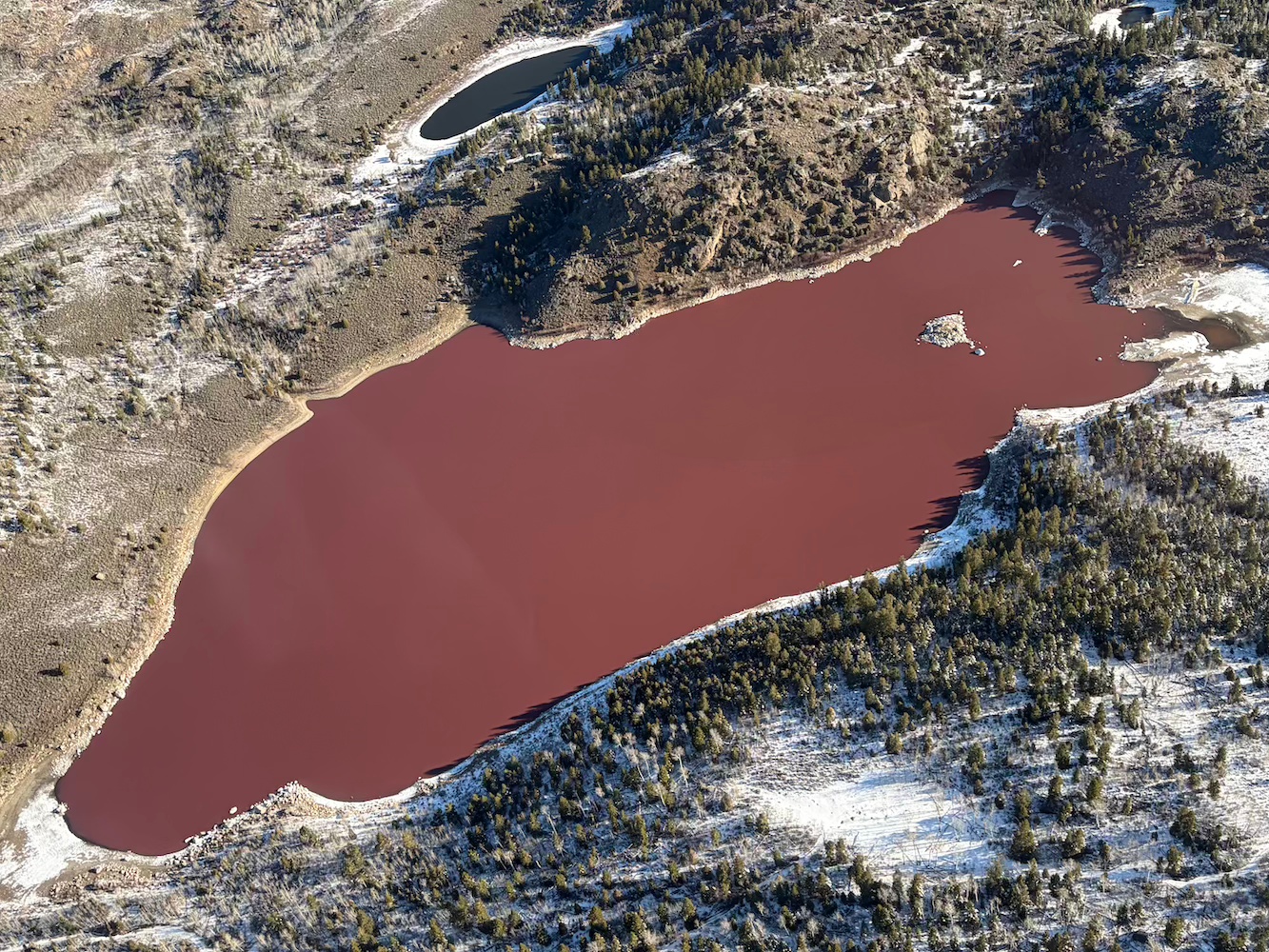

When the ice melted in late March, the striking burnt-red color returned to the fringes of the Wind River Range more pronounced than ever.
This seemingly wine-stained water didn’t reveal itself in a melted-out mine tailings pond. It filled Little Soda Lake, a roughly 50-acre former trout fishing hole perched above Pinedale, just a half mile from Fremont Lake. Now, nearly a year and a half after the once-mysterious shade of water started turning heads in Sublette County, water quality officials say they’ve gained some understanding about what’s going on.
The Wyoming Department of Environmental Quality has ruled out harmful cyanobacteria — which have plagued Little Soda Lake — as the cause of the seldom-seen shade of water.
“The red coloration is due to a different type of algae,” said Eric Hargett, Wyoming DEQ’s water quality standards program supervisor. “Specifically, the algae is rhodomonas.”
That’s a type of nontoxic cryptophyte that’s “most likely” the cause, Hargett said. The native microorganism was found in low densities during 2024 and 2025 testing, and it’s associated with red colorations and brackish water.

“It does have the name Little Soda Lake,” Hargett said, “so it’s been known to be highly alkaline and high in salinity.”
Other Wyoming lakes have turned red as a result of cryptophyte rhodomonas blooms, he said. Hargett recalled one in the Laramie Basin that had similar characteristics to outletless Little Soda Lake, and the other lake also changed color during a period of low water.
Low water’s been a problem in the small Soda Lake watershed. Roughly 50-foot-deep Little Soda Lake’s water level fell by 6-8 feet in recent decades, the Wyoming Game and Fish Department reported in 2024. Nearby and larger Soda Lake dropped even more, by 15 feet. The historically warm winter and sparse snowpack Wyoming just endured will likely only exacerbate those trends.
Harmful cyanobacteria blooms are another part of the troubling water quality changes in the lake, 6 miles north of Pinedale. Little Soda Lake had its first known harmful cyanobacteria bloom in November 2024. The following May, it became the first Wyoming waterbody in 2025 listed on the state agency’s cyanobacteria monitoring website with an advisory. Its water, so far, has not tested positive for related toxins.
Non-toxic, but beware
Although the water is red, there are indications that Little Soda Lake in 2026 is not yet experiencing high densities of cyanobacteria, according to Wyoming DEQ’s harmful cyanobacteria coordinator, Rachel Eyres. Two weeks ago, staff at the Bridger-Teton National Forest, the land manager for the lake, conducted a simple “jar test” and conveyed the results.
“Typically, cyanobacteria will float to the top because they adjust their buoyancy,” Eyres said. “Other phytoplankton, such as algae, will not, and what the [Little Soda] jar test showed is that the top 99% of the water was completely clear. There was just some red organic material in the bottom of the jar.”
Later, official tests will occur. Wyoming DEQ and the Bridger-Teton will test Little Soda’s water for cyanobacteria presence and toxins monthly from July through October, Eyres said.
Little Soda Lake is essentially inaccessible right now because of a winter closure on the Soda Lake Wildlife Habitat Management Area, but that lifts on May 1. Once it does, people recreating should use caution.
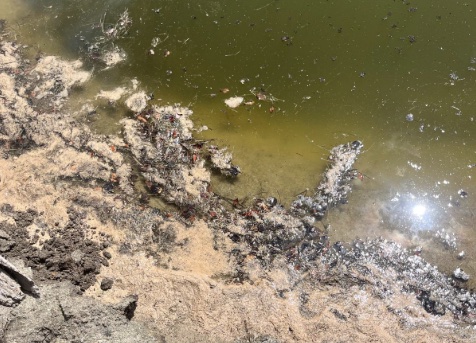
Little Soda’s red color could even mask some of the telltale signs of harmful cyanobacteria, Eyres said. Those include blue-green or pea-colored water that sometimes forms in scums or mats.
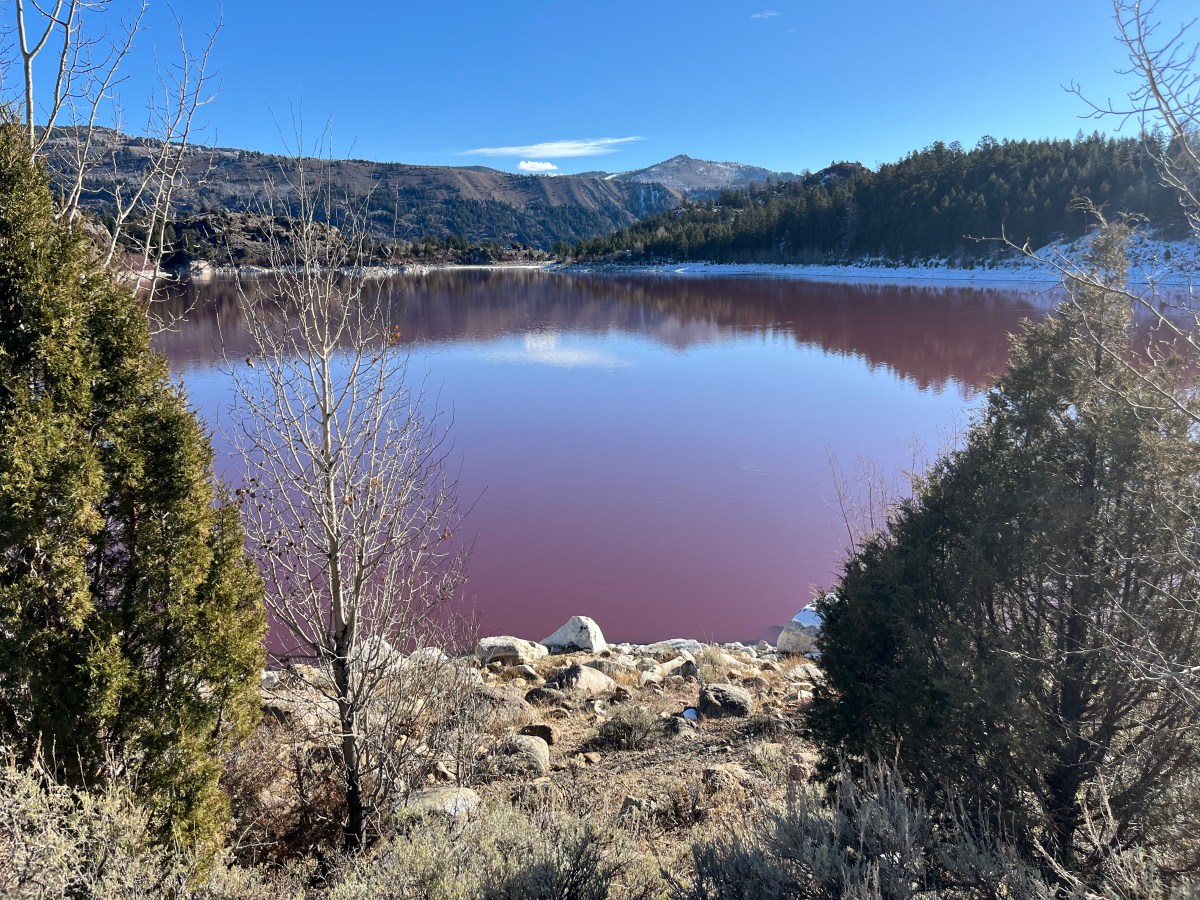
“A [cyanobacteria] bloom can arise at any time, and even before we’re made aware,” Eyres said. “When in doubt, stay out. If you think it looks gross, I would definitely not swim in it and try to keep your dogs out of it.”
Officially, the environmental factors that ultimately enabled the changes in Little Soda Lake remain unknown.
DEQ’s cyanobacteria surveillance has “provided some insight into what the red bloom actually is,” Hargett said. But there’s no broader investigation into the waterbody and it’s not being assessed for a possible “impaired” listing in Wyoming’s biennial Clean Water Act compliance report.
Addressing red water?
Absent an impairment, it’s not DEQ’s role to propose how to address Little Soda Lake.
“It would need to be impaired for us to step in and do any sort of work towards improving a waterbody,” Eyres said.
Some locals have suggestions for next steps.
Joe Meyer is a Pinedale resident and retired University of Wyoming limnologist — that’s a scientist who studies inland aquatic ecosystems. He did his postdoctoral research on eutrophic, nutrient-laden lakes.
A couple years ago, Meyer hiked to Little Soda Lake and walked away with an educated guess about why it was colored like “split pea soup” at the time.
“There were cowpies along the shoreline,” Meyer said. “My first impression was that boy, there’s enough cattle in here to really load up the water with nutrients.”
The following winter, Little Soda Lake first turned red. The color returned in fall 2025, Wyoming Public Radio reported. Aerial photos of the recurrence this spring show perhaps the most stark shade of red yet.
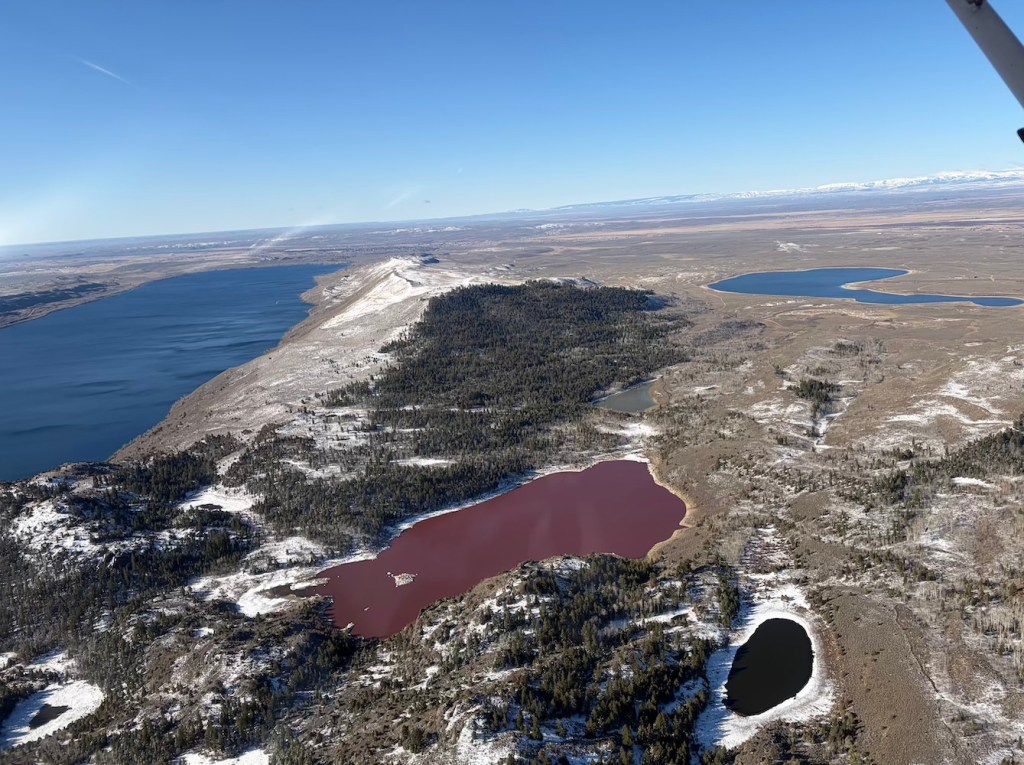
Accumulated nutrients — phosphorus and nitrogen — from cattle feces in Little Soda Lake’s sediment and water are a possible explanation for the bloom that turned the lake red, Meyer said.
“It’s a really nutrient-stressed lake, and this cryptophyte could be a result of that,” Meyer said.
There’s no arguing with tests and data, Meyer said, and cryptophyte rhodomonas sounds like a “plausible” reason why Little Soda Lake’s turned so red. But Wyoming DEQ also can’t rule out oxidized iron or manganese as an explanation without more extensively testing the water, he said.
Those tests could also provide insight about potential underlying causes, like cattle grazing.
“I strongly suggest routine water chemistry [tests],” Meyer said. “They need to know total and dissolved nitrogen and total and dissolved phosphorus concentrations. Those are the minimum things that we’d want to know about a eutrophic lake.”

Is it safe to fish??is the water safe to use?
Thank you. I appreciate you sharing your knowledge and expertise. It’s interesting how much we DO NOT know in a time when we take so much pride in what we think we know 🙂
The Soda lakes also sit on a prominent geologic fault. I wonder if the recently dropping water table has affected the drainage and/or subterranean flows of groundwater in the area, and through these surface waters? A change in groundwater movement could be affecting the recharge rates and chemistry of these lakes. The USFS has groundwater specialists who could also provide important data related to surface water quality. Maybe now would be a good time to include them in the effort to figure this situation out, if it hasn’t been done already.