

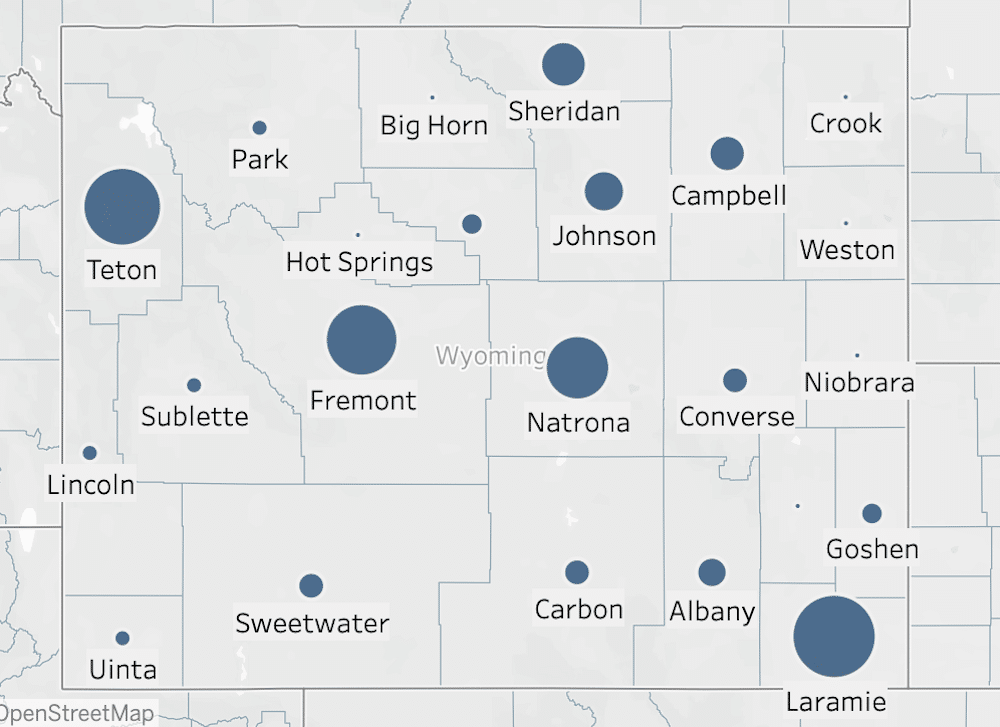
Statistical evidence showed COVID-19 cases in the state continued their sharp rise this week, with little evidence of any curve “flattening” for Wyoming yet.
Confirmed COVID-19 cases in the state more than doubled for the second week in a row despite continued testing limitations. Health experts believe confirmed test results only scratch the surface of the virus’s spread.
Through Friday morning, the Wyoming Department of Health had confirmed 162 cases of the virus through its laboratory and laboratory results from private healthcare providers. Some counties are starting to emerge as hotspots of the disease — though again, a lack of testing makes it difficult to determine whether increased disease or increased testing is driving the disparities.
Today Fremont County, site of the state’s first known case cluster, has 27 cases, the third-highest county count. Half of the state’s 16 documented hospitalized COVID-19 patients are there, Fremont County Public Health Officer Dr. Brian Gee said in a video posted on April 1. More than half of those eight patients were in critical condition and on ventilators at the time the video was posted, Gee said. It is unclear how many patients are hospitalized without yet having received test results
Fremont County officials released numbers this week that suggest a yawning gap between testing numbers and the disease’s spread. Health workers in that county have directed more than 670 people to isolate themselves because they reported symptoms consistent with COVID-19.
The disease isn’t just seriously afflicting elderly patients, Gee said. Three patients under 60 are “seriously or critically ill,” he said.
A second COVID-19 cluster at a medical facility emerged this week. On Friday the Casper Star-Tribune reported that nine cases are linked to the Wyoming Behavioral Institute, a mental health and substance abuse treatment center that takes in patients from all over the state.
Rural towns and Wyoming’s more isolated residents aren’t safe from the virus either, as a story about the first confirmed case in the outpost of Centennial illustrates.
As the confirmed cases count increased, Gov. Mark Gordon resisted a shelter-at-home order. Wyoming remains one of 13 states without one. The governors of Florida and Georgia, who also resisted taking such steps, changed their minds this week after COVID-19 bloomed in their states, according to Axios.
Steep economic impacts to Wyoming continue even without the order. Unemployment claims in the state shot up more than 800% over two weeks, according to the Wyoming Tribune-Eagle.
A third of Wyoming residents responding to a new survey from UW’s Wyoming Survey and Analysis Center say they or an immediate relative lost their job because of COVID-19’s impacts. More than half the respondents said they or immediate family members saw a pay cut or a reduction in work hours.
The survey also showed many more Wyoming residents trust Gordon than President Donald Trump. A little more than 44% of survey respondents don’t trust COVID-19 information given by the president, while only 13.2% distrust information provided by the governor.
Citizens around the state continued to organize. The Wyoming Technology Coronavirus Coalition, a group of volunteers searching for technological responses to the virus’s impact, promoted “medical supply drives” on social media.
An initial effort in Laramie secured “33,930 gloves, 529 N95 masks, 282 other masks, 123 safety glasses/goggles, 118 gowns, and lots of sanitizing products,” according to the group’s website.
Gillette residents planned a drive-by parade for next week to cheer residents of long term care facilities who can no longer receive visitors. The Wyoming News Exchange is documenting acts of charity and kindness around the state, including a Cody-raised businessman who bought four ventilators for the hospital there.

I would expect Teton County to have a large percentage of infected people, especially people with no symptoms. Fremont stands out as a warning sign to all, however. Were the infected folks in Fremont County hanging out at the same place? I saw one was from a nursing home. Which county has the highest infection rate per capita?
Teton County is in the process of trying to raise millions for its working class. Apparently, a large percentage don’t qualify for unemployment insurance, Of course, UI only goes so far in Teton County. Is any other county addressing the economic impact in a serious fashion? Seems like it’s on life support and in need of the same attention, if not more. No rainy-day fund?
Good reporting
I would appreciate a map scaled to population. Please.