


Wyoming’s sage grouse are out of decline and officially on the upswing — at least for now.
Counts in 2022 suggested a slump for the cyclic species was about over. The 2023 lek counts show a 15% increase — a good indication that the population’s soon to soar. There have also been stellar habitat conditions throughout this summer, another factor that gives Wyoming Game and Fish Department sage grouse/sagebrush biologist Nyssa Whitford cause for optimism.
“It was remarkably green for so long this year,” Whitford told WyoFile. “Chicks that hatched this spring had a really great habitat to grow up to mature on, so I expect that we will see another increase next year. We shall see, but I expect the trendline to keep ticking up.”

The numbers are hardly academic. Persistent long-term declines — somewhat separate from shorter-term cycle fluctuations — have sparked worries that the sage grouse would be listed as a threatened or endangered species. Such a listing would have major implications on the fossil fuel and mineral industries, the state’s primary economic engine, which tend to operate in some of the same habitats.
Over the last quarter century, the sage grouse population in the Equality State has run through three cycles. The cycles last on average seven to nine years, Whitford said, though the science explaining why numbers rise and fall when they do is not crystal clear.
Longer-term across the species’ range, the chicken-sized grouse has undergone a marked decline as the habitat it depends on, sagebrush-steppe, has disappeared at a rate of 1.3 million acres per year. A 2021 U.S. Geological Survey report summarizing rangewide sage grouse trends over the past half-century found a bleak 81% decline.
But at least in Wyoming, the short-term trend is more encouraging.
Data relayed by Whitford showed there were increases in males gathered at sage grouse breeding grounds, called leks, in virtually every corner of Wyoming.

The largest swings upwards were recorded at leks monitored by the Southwest Sage Grouse Working Group, with a 28% increase, followed by the Wind River/Sweetwater (20%) and Bates Hole/Shirley Basin (18%) working groups. Counts in the Bighorn Basin were up 15%, and those in Northeast Wyoming rose by 14%.
Sage grouse lek counts increased a modest 5% in southcentral Wyoming and 4% in the Upper Green River area.
Lek counts technically sagged by 12% within Jackson Hole’s smaller, isolated sage grouse population, but Whitford noted a caveat. Some 10% more aggregate males were observed in 2023 than in 2022, she said, but there were also two more active leks that went into the equation, skewing the per-lek numbers year to year.
In general, checking leks was more difficult in 2023 than in a typical spring because of the long-lasting snowpack and muddy conditions that complicated accessing remote areas. Roughly 18,000 male sage grouse were observed on 81% of known, occupied leks, down from the 87% checked the year before.
Higher counts at leks across Wyoming this year speak to how well adapted the species is to severe winters. In places where some species, especially pronghorn and mule deer, were crushed by winter, sage grouse fared OK. They typically have relatively high winter survival, Whitford said, and willingly fly to access exposed sagebrush to feed on.
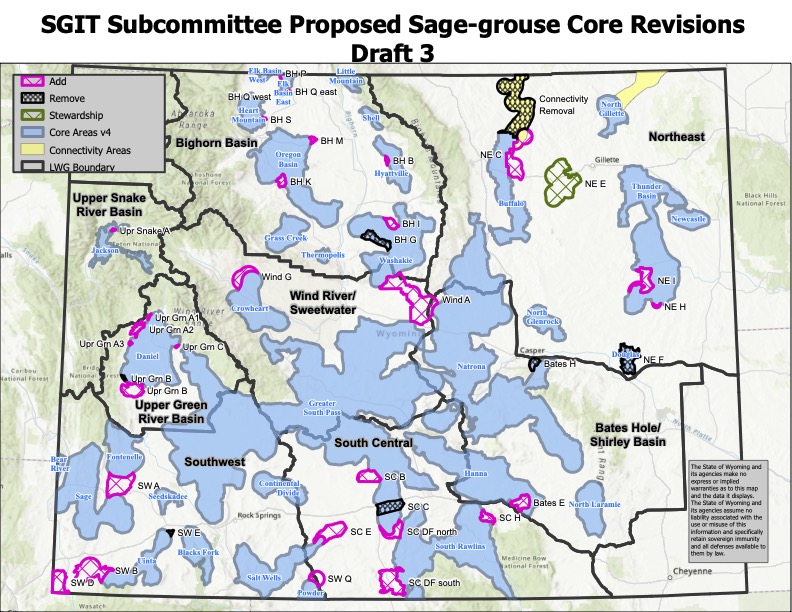
The second consecutive year of modest increases in Wyoming lek counts comes after five straight years of decline. Concurrent with the climb, the state’s Sage Grouse Implementation Team is revising its protective sage grouse core areas in an effort to convince federal wildlife managers that the species doesn’t require a Endangered Species Act classification to succeed. Comments on the core area revisions are due by 5 p.m. Sept. 19. They can be submitted online or emailed to bob.budd@wyo.gov.

I’m not a sage grouse expert but shouldn’t there also be a count of female birds? What does a count of lots of males mean really? How about giving us the ratio of males to females.
Great news in the short term. Beneficial to real people like hunters, but totally ignored by Wyoming landowners and public property absconders, who block hunters altogether, unless those hunters are visiting tourists from other states.