


On top of the largest proposed electric rate hike in Wyoming’s recent history — which threatens both households and businesses already overwhelmed with rising housing costs and inflation — your annual power bill could become much less predictable if Rocky Mountain Power has its way.
It’s up to the Wyoming Public Service Commission to decide if and how to shield the utility’s customers from an increasingly volatile market. The public has an opportunity to weigh in at three upcoming hearings.
Rocky Mountain Power, a division of PacifiCorp and the largest utility in Wyoming, no longer wants to share the risk of unanticipated price spikes for fossil fuels — coal and natural gas to fuel power plants — and open-market power purchases. Instead it wants Wyoming ratepayers held liable for 100% of those cost overruns. Currently, the utility is responsible for covering 20% and its customers in the state — 144,000 households and businesses — are tapped for the rest. Rocky Mountain Power says it should have zero liability and Wyoming ratepayers should pick up the entire tab.
But that “cost-sharing band” ratio — whether it’s 80/20, 70/30, 100/0 or whatever — works both ways. Ratepayers are also owed a rebate when fuel costs come in lower than the estimate baked into their “base rate.”
That’s sometimes the case in Wyoming. But not this year.
Balancing market risk
Based on its last major electric rate update, approved by the Wyoming Public Service Commission in 2020, Rocky Mountain Power’s estimate for fuel and open-market power purchases fell short in 2022 by about $90 million for its operations in the state, according to the company.
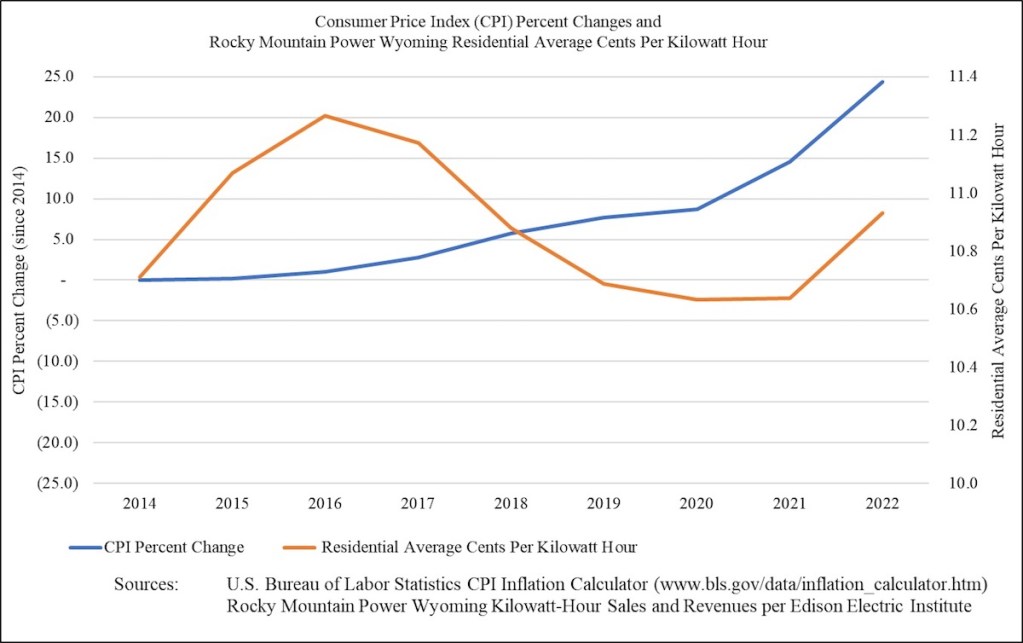
That has resulted in a request by the utility to recover $50.3 million of the fuel cost tab — temporarily boosting rates for its Wyoming customers by 7.6%, part of an overall 29.2% hike now under consideration at the Wyoming Public Service Commission.
Some see Rocky Mountain Power’s 100/0 cost share proposal as a strategy to shift the risk of increasingly volatile fossil fuel markets to the consumer. But because the cost-sharing mechanism is part of a wonky, heavily bureaucratic language within a system that’s mostly opaque to the general public, it’s also often misunderstood.
“It’s a balance,” Wyoming Office of Consumer Advocate Administrator Anthony Ornelas said.
From a consumer advocacy perspective, it’s a good idea to ensure that a utility shares in both the risk and reward of future fuel markets because it incentivizes accurate planning, Ornelas said.
“We believe a sharing band is prudent to put some level of responsibility for [market] forecasting on the utility,” he said. “In the event that we have the good fortune of a [fuel] cost decline, we’ll give up a little bit of that refund for the long-term insurance we think the sharing band provides.”
Without the cost-share mechanism, or if it were adjusted to 100/0, your power bill could change dramatically from year to year — in either direction. Regulated utilities in Wyoming are allowed to true-up those fuel costs — be they in favor of ratepayers or against — on an annual basis.
And unlike some programs among natural gas utilities like Choice Gas, electrical consumers in Wyoming don’t have the option of “locking in” a fixed rate to avoid price swings. Instead, the cost-sharing band attempts to balance that risk, Ornelas said.

One group of Rocky Mountain Power customers in the state that carefully analyzes future fuel costs is the Wyoming Industrial Energy Consumers. The organization includes trona mining and processing facilities, as well as oil refineries and natural gas processing plants. Together, they represent the utility’s largest block of electricity consumption in the state at 70%.
Though they stand to gain the most if fuel costs come in under the forecast, they see an increasing risk. Rather than the current 80/20 split, the group — which is an intervenor in the rate cases — is asking the Public Service Commission to change it back to 70/30, where it was prior to 2021.
“We believe that the sharing mechanism is a very important aspect of Rocky Mountain Power’s rates to ensure that the company has skin in the game and an incentive to keep power costs as low as possible,” Holland and Hart Associate attorney Austin Rueschhoff, who represents the industrial group, testified to lawmakers in August.
Ornelas, the consumer advocate, will ask the Public Service Commission to maintain the current 80/20 split, he said. He might support a 70/30 split if there’s enough support among consumers, he added.
Market volatility
Some parties that are challenging Rocky Mountain Power’s rate hike requests note that, historically, the utility has done a good job of forecasting fuel prices, sometimes resulting in a rebate to its customers.
But fuel markets are reacting to numerous pressures, including a shift from fossil fuels to renewable energy and, increasingly, disruptions from extreme weather events and human-caused climate change.
“If the company feels confident that investing in more gas infrastructure will make economic sense for ratepayers, then it should have some skin in the game as well.”
Rose Monahan, Sierra Club
Heat waves last summer and, in particular, an extreme cold snap in December and January spiked demand for electrical power, which in turn temporarily drove the price of natural gas upward by a factor of 10. That’s the primary basis for Rocky Mountain Power’s “energy cost adjustment” request now before the Public Service Commission.
By far, fuel costs — for coal and, especially for natural gas — are among the primary drivers behind Rocky Mountain Power’s historic rate increase request, according to the company. “Since 2021, natural gas fuel prices have risen 89%, the company’s coal fuel prices have increased 38%, while open market power costs have increased 199%,” Rocky Mountain Power spokesman David Eskelsen told WyoFile in July.
For its part, Rocky Mountain Power and its parent company PacifiCorp are participating in the Western Energy Imbalance Market, which coordinates among some 20 electric power utilities across the West to more efficiently “balance” fluctuations in power demand across the region. The utility claims that its participation in the program has avoided some $591 million in wholesale power purchases for customers throughout PacifiCorp’s six-state operating region.
But hedging against wild market price swings for the raw coal and natural gas used to generate electricity is a separate challenge. It’s one reason why PacifiCorp plans to ditch fossil fuels in its electric generation portfolio — decommissioning most of its coal-fired units by 2030, and exiting natural gas-fired generation by 2040, according to the company’s most recent Integrated Resource Plan.

Meantime, the utility’s exposure to natural gas markets is likely to increase. For example, the company plans to convert four coal-burning units to natural gas — two at its Naughton power plant by 2026, and two units at its Jim Bridger plant by 2030.
Rocky Mountain Power declined to provide specific estimates about how much more natural gas it might require with those coal-to-natural gas conversions. The Sierra Club, also an intervenor in the rate cases, worries about that potential growing exposure to the natural gas market.
“If PacifiCorp wants to place its bet on more gas generation, it should be willing to put its money where its mouth is, so to speak,” Sierra Club staff attorney Rose Monahan said. “In other words, if the company feels confident that investing in more gas infrastructure will make economic sense for ratepayers, then it should have some skin in the game as well.”
Currently, Wyoming’s cost-sharing band is applied no matter the magnitude of fuel cost overruns, Monahan noted. The Wyoming Public Service Commission could consider modifying the program to take into account particularly large spikes and place more of that responsibility on the utility, she said. Or, the commission could even place the total burden of fuel cost overruns on the utility and maintain the 80/20 cost-sharing ratio for when fuel costs come in lower.
“The reason being that customers do not have a say in whether a utility decides to rely on gas or coal-fueled resources,” Monahan said.
Public participation
The Wyoming Public Service Commission has scheduled three more meetings to hear public comment regarding Rocky Mountain Power’s $50.3 million energy cost adjustment and its $140.2 million general rate case.
° Monday, September 18, 2023, in Riverton at the Central Wyoming College’s Health and Science Building (Room No. 100) located at 2660 Peck Avenue, from 5:30 p.m. to 8:00 p.m.
° Monday, September 25, 2023, in Laramie at the Laramie Municipal Operations Center located at 4373 N. 3rd St., North Platte Conference Room, from 5:30 p.m. to 7:30 p.m.
° Thursday, October 12, 2023, in Casper at the Thyra Thomson State Office Building located at 444 W. Collins Dr., Roundhouse Conference Room # 3024, from 5:30 p.m. to 7:30 p.m.
The meetings may also be accessed via Zoom at https://us02web.zoom.us/j/9933449233, or by telephone by dialing 1-669-900-9128 or 1-253-215-8782 (Meeting ID: 993 344 9233).
Comments regarding Rocky Mountain Power’s proposed rate cases can be submitted via email at wpsc_comments@wyo.gov, or mailed to 2515 Warren Ave., Suite 300, Cheyenne, WY 82002.

I have two commercial buildings with solar arrays. One with High Plains Power that the PSC has just sided with the power company on regarding net metering. This change will make my power cost much higher next year on that building. The other with Rocky Mt. Power is limited to 25KW due to net metering rules from the legislature. I could use more power capacity but I cannot due to these rules. I am not interested in being paid for any excess power I may generate. I am just trying to avoid the rising cost of power. Looks like the PSC is ready to vote against the citizen customer again.
RMP is wanting to raise our rates by $140MM for renewable energy and transmission out of state. It’s not in the utility bill now, but it in their PSC filing. Is that as good enough source for you Frank?
https://www.rockymountainpower.net/content/dam/pcorp/documents/en/rockymountainpower/rates-regulation/wyoming/filings/docket-20000-___-er-23/3-1-23-application—direct-testimony/1_Cover_Letter,_Application_and_Petition_for_Confidential_Treatment.pdf
Very discouraging that the Wyoming Legislature feels obligated to protect a highly profitable business from the real marketplace dynamics. (This might be related to the utilities contributions to the legislators.) Monthly ratepayers will get a VERY big surprise in their last bill if the rate they negotiated does not cover their actual bill in these variances. The utility will be able to charge a very high last bill in order to even the ledger. Read your utility billing notices very carefully. All ratepayers must come out even with this variable set of costs if this bill stands (costs that only vary to charge more, never varies to charge less).
Renewable energy also appears to be having higher volatility due to rising costs.
https://www.eenews.net/articles/rising-power-costs-spark-fears-of-clean-energy-slowdown/
Tom, read your utility bill that explains your costs. No renewable effect is listed at all, as the utilities PROFIT from renewables. Their annual reports also say that renewable gain more revenue than their related costs. The utility companies themselves are telling you that your post is wrong. Get better sources.
you can put your utility bill on a monthly payment plan.
this will protect you from high usage times in the winter.
The billing statement tells you on the utility bill that if this legislature Bill passes, they will charge more if variances do apply. Note that neither utility company has ever had lower cost variances, only higher ones. Your end-of-year bill will be a LOT higher to balance those variances.