

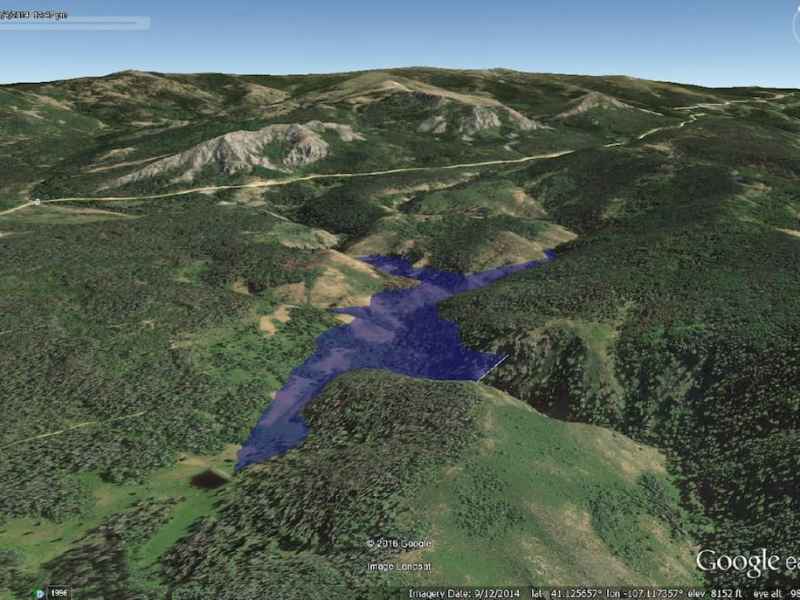
Wyoming’s plan to construct the West Fork Dam in the Medicine Bow National Forest “does not align well” with federal policy and management plans, a forest official wrote in a 2022 brief intended for U.S. Secretary of Agriculture Tom Vilsack.
The Medicine Bow environmental policy analyst who evaluated the state’s plan for the 264-foot high dam also said the proposal might not meet a U.S. Forest Service public-interest standard necessary for a land swap that would enable dam construction.
The critical assessment was penned as Medicine Bow staff prepared a briefing paper on Wyoming’s plan to construct the dam and its 130-acre reservoir in Carbon County to serve fewer than 100 irrigators who want more late-season water. Forest officials sought staffers’ input on the proposed development above the Little Snake River.
Medicine Bow officials were preparing the late-2022 briefing for regional and Washington D.C. officials, unnamed VIPs and Secretary Vilsack, according to documents obtained by WyoFile through a records request.
“The Forest is concerned that the State’s current preferred concept … may not be in the public interest, and is likely to be highly controversial…”
Medicine Bow environmental specialist Matt Schweich
In an internal Medicine Bow email, forest environmental policy analyst Matt Schweich asked that the briefing paper state that “[t]he Forest is concerned that the State’s current preferred concept does not align well with Forest Service policy and the Forest plan, that it may not be in the public interest, and is likely to be highly controversial with the public.”
Ninety-six percent of comments on the plan opposed the project, a WyoFile tally of submissions showed. Criticism ranged from the project’s environmental impacts to Wyoming’s rosy analysis of public benefits and the state’s willingness to fund the bulk of the project for the benefit of private irrigators.
An ongoing environmental review necessary to advance the Wyoming project will determine whether the dam plan meets federal policies and the Medicine Bow management plan. A federal-state land exchange necessary for construction must be found to be in the public interest. An environmental impact statement and associated reviews of the proposal have been delayed once, and their completion date remains uncertain.
A Medicine Bow spokesman said Schweich’s opinion does not reflect the official position of the agency, which will only be revealed through the environmental impact statement.
Last puzzle piece
The Forest Service, U.S. Natural Resources Conservation Service and U.S. Army Corps of Engineers are working to complete the EIS in a process largely obscured from public view. The emails, however, provide another peek into the thinking of Forest Service specialists regarding the merits of the controversial project.
In another internal discussion previously reported by WyoFile, a Medicine Bow hydrologist expressed worry that the dam proposal wasn’t being thoroughly vetted. Medicine Bow spokesman Aaron Voos dismissed that worry last year, characterizing the criticism as healthy agency discussion.
Schweich added his newly revealed assessment of the dam plan in a Sept. 26, 2022 email exchange as Medicine Bow staffers were preparing a “Hot topic” report for leadership, including Vilsack. Fully four years before that, Wyoming water developers had settled on the size of the dam, the capacity and size of the reservoir and the site of the complex. Wyoming has not deviated significantly from those plans.

A month before Schweich wrote his 2022 assessment, Wyoming had provided the last piece of the puzzle, telling Medicine Bow officials the state would seek 1,762 acres of forest land in an exchange that would enable construction of the dam and reservoir. Jenifer Scoggin, director of the Wyoming Office of State Lands and Investments, provided that land-swap information to Medicine Bow officials in August 2022, according to a letter she wrote later that year.
Medicine Bow officials appeared to have known the size of the dam and reservoir, their location and the federal acreage Wyoming sought when the officials asked Schweich for his assessment.
A month after Schweich responded, Wyoming submitted its formal proposal to the Medicine Bow for a land exchange and dam construction.
Regardless how well-informed Schweich was when he made his 2022 assessment, spokesman Voos said it was unclear at that time exactly what the state intended.
“[T]he internal, draft email of Hot Topics updates [to which Schweich contributed] is prior to receipt of any formal land exchange proposal from the State,” Voos wrote WyoFile. “At the time, multiple informal discussions were taking place surrounding conceptual ideas.
“Since it was unclear what the State’s future use of any current National Forest System land might have been at that time,” Voos wrote, “then yes, there was the possibility for misalignment with our policy and Plan.”
WyoFile obtained the emails through a Freedom of Information Act request. Although the environmental impact statement is being written largely out of public view, the public had an opportunity to weigh in on the issue before the analysis began. People will be able to comment on the review when it is completed.

Does not align well with federal policy OR public opinion.
Somehow this will still get pushed through though. Gotta keep the welfare ranchers happy.
Yep, getting government money to feed hungry kids? =welfare
Building a reservoir for less than 100 people, on lands owned by all of us?= necessary
Thanks again Angus: ” the EIS is being written largely out of public view “. I wonder if NEPA requires the USFS to offer State and County agencies ” cooperating agency ” status at this time – in other words, is this the actual scoping phase of a significant Federal action requiring local input from elected officials and State agencies such as Wyoming Game and Fish. Maybe the state and county agencies are already participating – if they are, their meeting minutes would show them appointing a representative to sit in on the scoping meetings. What’s up???
another round of public money to benefit a few private individuals!
what is your definition of socialism?
wasn’t this project a benefit to only 60 +/- farmers at a cost to the state of $80+ Million? Nothing but a pure freebie subsidy to those rugged individualists paid for by the taxpayers
The dam would help a small number of ranchers with late season water supply. What is the projected additional income this water would provide these ranchers compared to the cost of the dam construction and project upkeep. Did the state analyse whether it would be cheaper to pay the ranchers the difference vs the cost of the dam. Wyoming (we) need to subsidize ranchers while refusing to help other Wyoming groups most often reasoning they would not know what this additional aid would cost the state, even though it would help a larger number of Wyoming citizens.
At this time the projected dam has no other uses. with all additional water being passed to other downstate users.
If the state was in the business of caring whether or not ranching was profitable, they would have quit handing out money decades ago.
Maybe the governor could appoint a task force heavily weighted toward special interests. They could meet behind closed doors. And the Freedom Caucus could start a bunch of unfounded rumors. Then Hageman could threaten Congressional action, and the legislature could appropriate $50 million for lawsuits. But I digress!
Scarily true Earl. Well put.
Scarily true Earl.
Thanks Earl, that was beautiful….I would love to hear what the bag man from Baggs or should I say the thick-headed hick, has to say about this turn of events?
If you do not own a cow in Wyoming, you should be voting for a Democrat.
Kind of nice to hear this viewpoint from the people that LIVE there! I dont – but I agree completely – for what its worth.
I hope things turn out better when this is “settled”!
The damage that livestock grazing does to the land & riparian areas AND sadly to so much wildlife is disturbing to say the least.