

Some Medicaid patients seeking gender-affirming care in Wyoming could feel the impact of a budget change passed this week in the House and Senate.
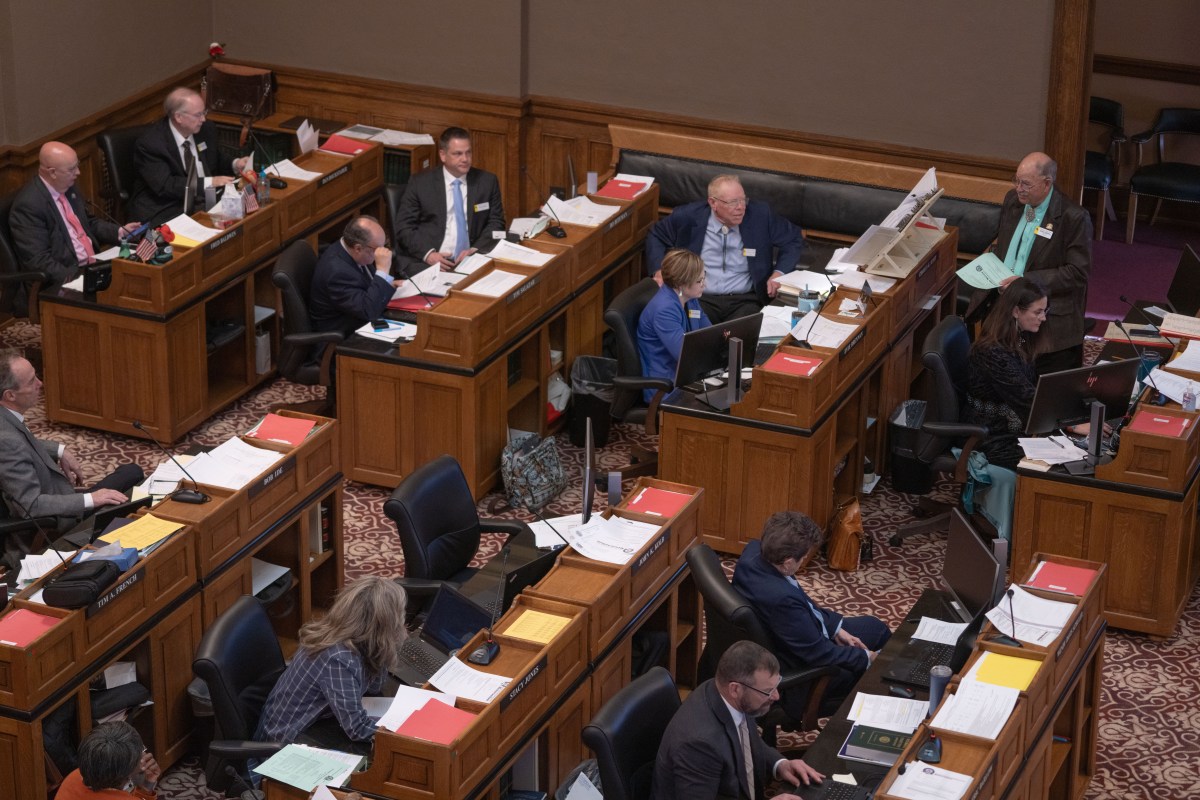
Lawmakers in both chambers adopted identical budget amendments Monday and Wednesday that would bar state funds from being used to pay for gender-affirming treatments in Wyoming.
The proposed change — sponsored in the House by Reps. Sarah Penn (R-Lander), Pepper Ottman (R-Riverton), Ken Pendergraft (R-Sheridan) and Jeanette Ward (R-Casper) and in the Senate by Sen. Lynn Hutchings (R-Cheyenne) — would bar state funds from being used for gender reassignment surgeries or the administration of puberty blockers, testosterone and estrogen, with exceptions for people “born with a medically verifiable genetic disorder of sex development.”

Lawmakers who supported the proposal said gender-affirming care is elective treatment, and that the state shouldn’t pay for it. Opponents were concerned that the change could go against best medical practice in some cases. They also took issue with addressing gender-affirming care through the budget rather than through legislation — and by controlling the purse strings of the Wyoming Department of Health.
“My problem with this is we shouldn’t limit how an agency works by their funds,” Rep. Lloyd Larsen (R-Lander) told lawmakers Monday.
“Let’s continue to develop policy, particularly on how the state approaches gender reassignment.”
The proposal would also block state funds from being used to pay for abortions in Wyoming, with some exceptions. But the Wyoming Department of Health already follows a federal provision that prevents it from paying for abortions except in cases of rape or incest, or if the mother’s life is in danger.
The proposal to bar state funding for gender-affirming care can’t be negotiated further in the Legislature since lawmakers in both chambers approved of the change. But Gov. Mark Gordon still has the power to veto specific items in the budget after lawmakers pass the entire budget bill. (The portion addressing abortion could still be negotiated since lawmakers in the House added more exception language Wednesday in their version of the amendment. But the compromise would still have to be within the bounds of the House and Senate versions.)
If the provision does remain in the budget, it would be the first time the Wyoming Legislature has successfully curbed access to some gender-affirming care in Wyoming. The move is part of a growing trend among Republican-controlled legislatures, which have passed dozens of bills this year aimed at transgender people.
In the past, Wyoming lawmakers have attempted to push bills that would put up barriers to gender-affirming care for minors. Those attempts have so far been unsuccessful. Lawmakers are trying again this year.
Medicaid reimbursements
It’s not entirely clear how these budget amendments could impact gender-affirming treatment access in Wyoming. The Wyoming Department of Health doesn’t provide direct funding for facilities in Wyoming that offer gender-affirming care, Kim Deti, the agency’s spokesperson, told WyoFile.
The amendment, however, could affect Medicaid reimbursements for such treatments.
“The biggest role really that our department plays in health care in Wyoming is through Wyoming Medicaid,” Deti said.
In Wyoming, the pool of people who qualify for Medicaid coverage is very limited. Lawmakers here have rebuffed attempts to adopt Medicaid expansion for more than a decade, and the state’s Medicaid program limits eligibility to low-income people who also fall under a certain age or in particular physical health categories — low-income children and those on supplemental security income, for example.
Medicaid can only cover gender-affirming treatments that are considered “medically necessary” under the department’s administrative rules.
The department, Deti said, has never used any of its funds to pay for gender reassignment surgeries — procedures that lawmakers are attempting to outlaw for minors in Wyoming, though there’s no evidence such surgeries are performed on children in the state.
“We have no plans to allow coverage of that procedure, and our administrative rules would prohibit coverage of such a surgery,” Deti said.
The health department’s programs sometimes cover “limited” gender-affirming care when it’s deemed medically necessary. Deti said this is “a pretty rare situation.”
Between 2018 and roughly mid-2023, Deti estimated the department spent less than $150,000 on gender-affirming service reimbursements. (WyoFile submitted a records request for the exact amount but wasn’t yet in receipt of the record by press time.) To put that in context, the department spent hundreds of millions of dollars annually on total Medicaid expenditures in Wyoming over a similar period, according to the 2022 Wyoming Medicaid report.
Impacted providers
Julie Burkhart, founder of the Casper Wellspring Health Access clinic, which provides gender-affirming care, told WyoFile on Tuesday that the clinic does serve some Medicaid patients seeking gender-affirming treatments. (The clinic is also the only facility in the state that provides abortions.)
“If we’re talking about the withdrawal of Medicaid funding for these types of health care visits, then there would be some impact on some of our patient population,” Burkhart told WyoFile.
That being said, Burkhart wasn’t sure what portion of these treatments qualified for Medicaid reimbursements or exactly how many of their patients could be affected.
“Now that it’s here, we’ll be looking into it further, because the last thing we want to do is to be in violation of insurance requirements and reimbursement parameters,” Burkhart said of the amendment. “Even though we want to be able to provide care for folks and also to use their insurance, we don’t want to get sideways with the state or any other insurance company.”

The budget amendment brings into question how the clinic and its patients will afford these treatments in states that are “inhospitable” to this kind of medical care.
“At the end of the day, that’s an important question,” Burkhart said.
“As in abortion care, we have to go out and cobble funding together from different entities in order to make ends meet, and now it can be that same exact situation,” she said of funding gender-affirming care at the clinic.
The University of Wyoming Family Medicine facilities have also served Medicaid patients seeking gender-affirming care, UW spokesperson Chad Baldwin relayed in a Thursday email to WyoFile. Some of these treatments have qualified for reimbursement under Medicaid, he said.
The budget amendment could hamper UW Family Medicine’s ability to offer gender-affirming treatments, according to Baldwin. Since UW Family Medicine is a federally qualified health center, it’s required to care for patients regardless of the patient’s ability to pay. The facilities have resources to offset some costs, but not all of them, so the clinics would have to absorb them as uncompensated care.
But the “bigger barrier,” Baldwin relayed, would be for patients and their ability to afford care that the clinics might not be able to absorb.
Another of Penn’s budget amendments related to gender-affirming care also won lawmakers’ approval Monday, but was later deleted by an amendment brought Wednesday by Rep. Bob Nicholas (R-Cheyenne). This proposal would have stripped the UW family medicine residency program of $100,000 if the program offered or performed gender-affirming treatments through its facilities. Hutchings brought the same amendment in the Senate but ultimately withdrew the proposal.
Legislation
Lawmakers brought at least 10 bills to the session related to transgender people, gender-affirming care, pronouns, obscenity and school programming. Now, only three remain.
Two of those bills address gender-affirming care in Wyoming.
One bill would allow minors who received “gender transition services” to sue a doctor over that treatment until the age of 21. Another is similar to a bill that failed during last year’s session, minus a section about health insurance. The legislation would outlaw gender-affirming treatments for minors in Wyoming, including surgeries, hormones or puberty blockers. (Again, there’s no evidence that gender-affirming surgeries are performed on minors in Wyoming.)

Update: This story has been updated to include information about the University of Wyoming Family Medicine facilities. —Ed.
Correction: This article has been updated to correct that lawmakers can still negotiate differences in the abortion provision of the amendment. —Ed.
For more legislative coverage click here.

Gender confusion seems to be the current fad among a tiny group of our population. Next year, we’ll probably have people claiming to be unicorns or Klingons.
If done the Feds should just pull all the funds from the state and let Wyoming fund the programs.
What is there, like maybe a few hundred of us in this whole state? They could just leave people alone. That could be a ring they could do. Maybe concentrate on helping low income people instead of attacking one of the largest minority groups around. Equality state, what a joke! But i expect nothing less from a group of people that refuse to even learn about gender dysphoria or how transitioning is a necessity for us. Whatever I guess, they also think climate change isn’t real so it’s kind of a lost cause to try to get through to them.
Wyoming should change its nickname from “equality state” to “bringing back the dark ages”.