

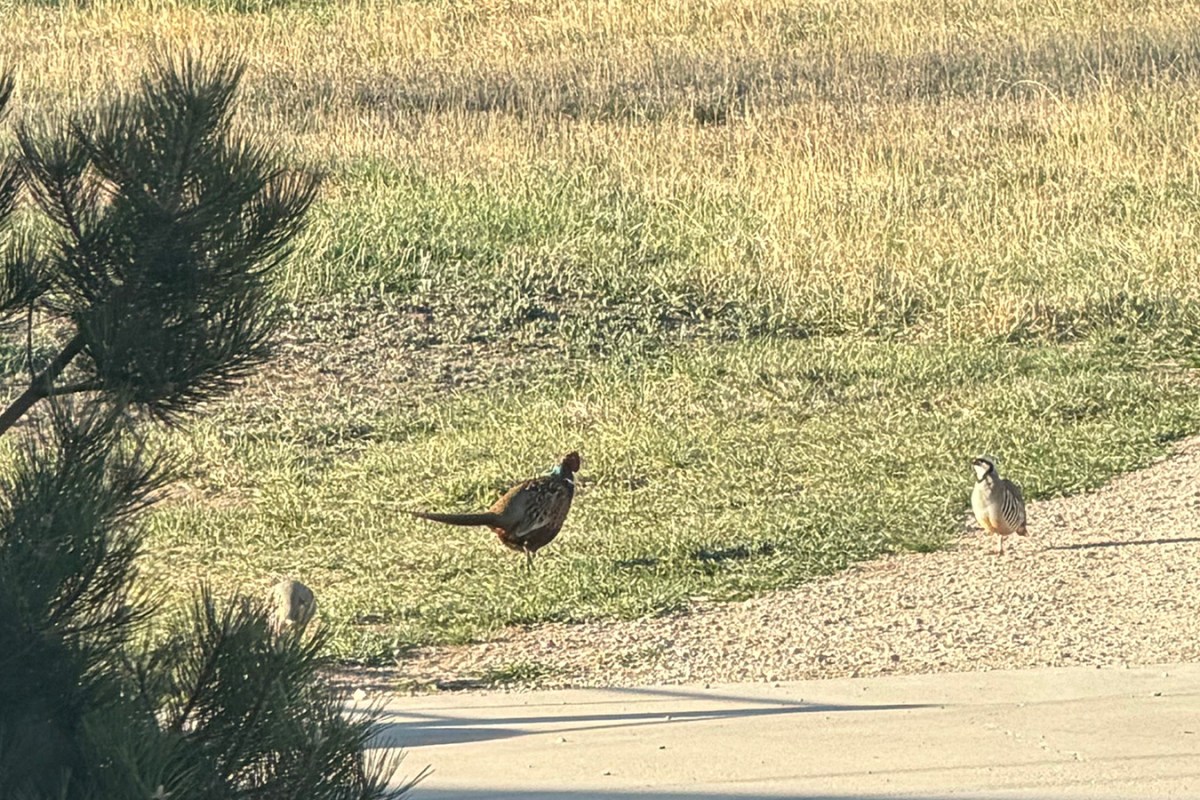
Chukar and pheasant have plenty in common.
They’re related, part of the ground-dwelling Phasianidae bird family. And they’re both Eurasian upland bird species that thrived in their respective habitat niches after being introduced to North America: Chukar have taken to the arid, rocky West, while pheasant have proliferated in riparian zones and agricultural country that stretches from the mid-Atlantic to the California coast.
Distribution maps show that, broadly, they do overlap.
But typically, the two species aren’t comrades in the way that George Barlow and Liz Brimmer recently documented in their rural Lander-area driveway.
A chukar pair that had taken a liking to Barlow and Brimmer’s yard for weeks was joined by an inquisitive, or perhaps indifferent, rooster pheasant. The three colorful Old World birds were basically hanging out, feeding in circles around each other, “for quite a while.”
“They were just comfortable in each other’s presence,” Barlow recalled of the sighting. “Everybody was doing their own thing and marching around. It was fascinating.”

Mmmmm chukar.