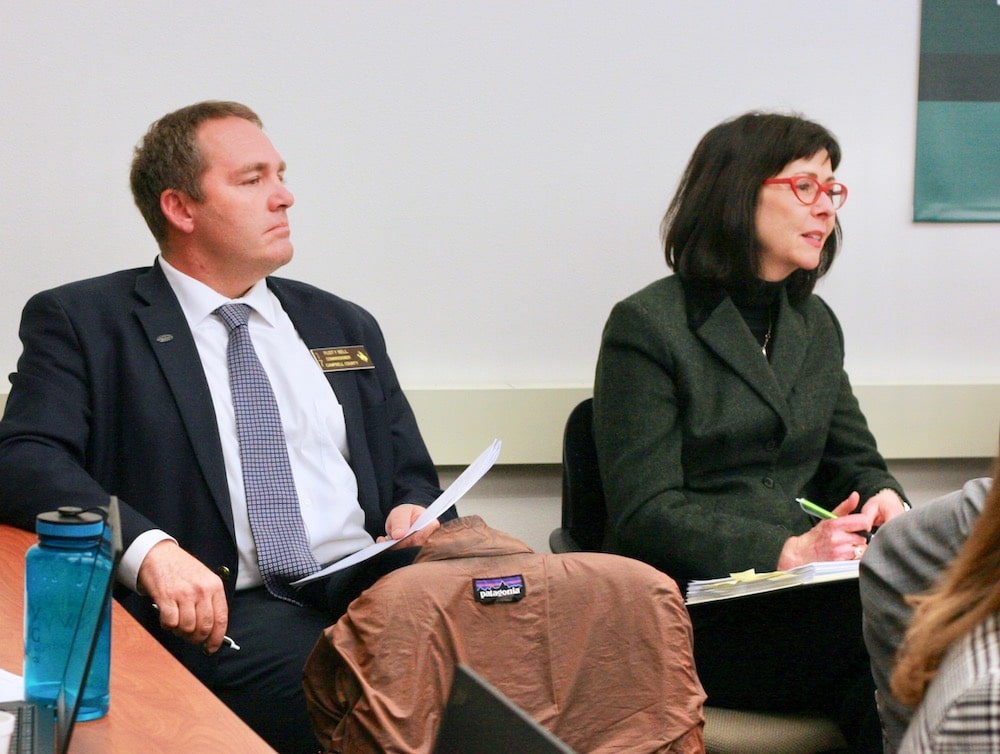
Lawmakers on the Select Coal/Mineral Bankruptcy committee have advanced a bill to give the Wyoming Attorney General’s office the authority to represent counties in pursuit of state taxes during energy company bankruptcies.
The draft bill came after a representative of the AG’s office told the committee his office didn’t currently have the authority to enter the cases and that such involvement could be ill-advised.
That prompted lawmakers to pass a motion for a draft bill that would give the AG clear authority to represent counties in bankruptcy court. Though it would not necessitate the AG’s involvement, under the measure the agency could no longer say it didn’t have the authority.
“They’re not required or obligated but at least we don’t have to hear that answer again,” Senate Minority Floor Leader Chris Rothfuss (D-Laramie) said. “I’d settle for that as a good start.”

County attorneys and commissioners have noted throughout the course of recent bankruptcies that they’ve gotten little help from the state. Campbell County in particular sought state help at several key inflection points over the years, only to be rebuffed by the executive branch.
Even with the Legislature’s sudden attention to the issue, the AG’s office has continued to resist working with county attorneys. Deputy Attorney General James Kaste wrote a three-page memo in response to previous committee questions stating his office did not have the authority to work for counties in most bankruptcies and did not see any great benefit in changing statute to give them that authority.
“This letter is very disappointing to the counties,” Johnson County Commissioner Bill Novotny told the lawmakers. “We don’t feel the attorney general’s office has the back of the counties.”
The state of Wyoming filing court claims alongside counties can add far more weight to tax collections efforts in the eyes of the judge, Novotny and other county officials present said.
The bigger issue for Wyoming counties, however, is actually the structuring of statute that governs the tax claim, Kaste wrote in the letter. The involvement of the state in bankruptcy proceedings won’t change matters, he argued. The committee is working on other efforts to lessen the risks to mineral ad valorem taxes from bankruptcies.
“The priority of any claim filed by a Wyoming county in bankruptcy and, thus, the probability of recovery on the claim, will not change based on whether the Attorney General’s Office or the county attorney pursues the claim,” Kaste wrote.
“Moreover, regardless of who pursues the county’s claim, the cost to employ local bankruptcy counsel in the jurisdiction where the case has been filed will be the same,” Kaste said. “Thus, neither the results nor the costs are likely to change if the Attorney General were to pursue bankruptcy claims on behalf of the counties.”

Officials from Campbell County have spent more than $1 million on outside legal counsel and spent time and energy pursuing tax debts into the high-level legal quagmire of bankruptcy courts. They’ve done so in pursuit of ad valorem taxes that are collected at the county level but mostly go to fund statewide public education, commission chairman Rusty Bell told lawmakers. Ultimately, Campbell and other counties have ended up negotiating tax payments with bankrupt companies or companies buying mineral properties out of bankruptcy.
“Our thought was that we are all on the same team,” Bell said. “For the most part most of our tax is your tax so I don’t see why we shouldn’t be as much on the same team as we could be.”
Though the counties are reimbursed for the money they spend on legal counsel, that money comes from the back taxes collected. But once it’s spent on counsel, that money that is no longer available for public schools statewide. Lawmakers considered creating a new position within the AG’s office for an attorney with bankruptcy court expertise, but did not take action on that idea.
In an email Monday morning, AG Bridget Hill said she welcomed the statute change. “I welcome the Legislature’s efforts to find solutions that will address the detrimental impacts of coal company bankruptcies on the state, the counties, and the employees of these companies,” Hill wrote.
Support WyoFile reporting with a tax-deductible donation today
During the Blackjewel bankruptcy, her office was engaged in negotiations with the companies to collect unpaid taxes, she wrote. “My office will continue to consult and cooperate with counties facing these difficult issues,” she wrote.