


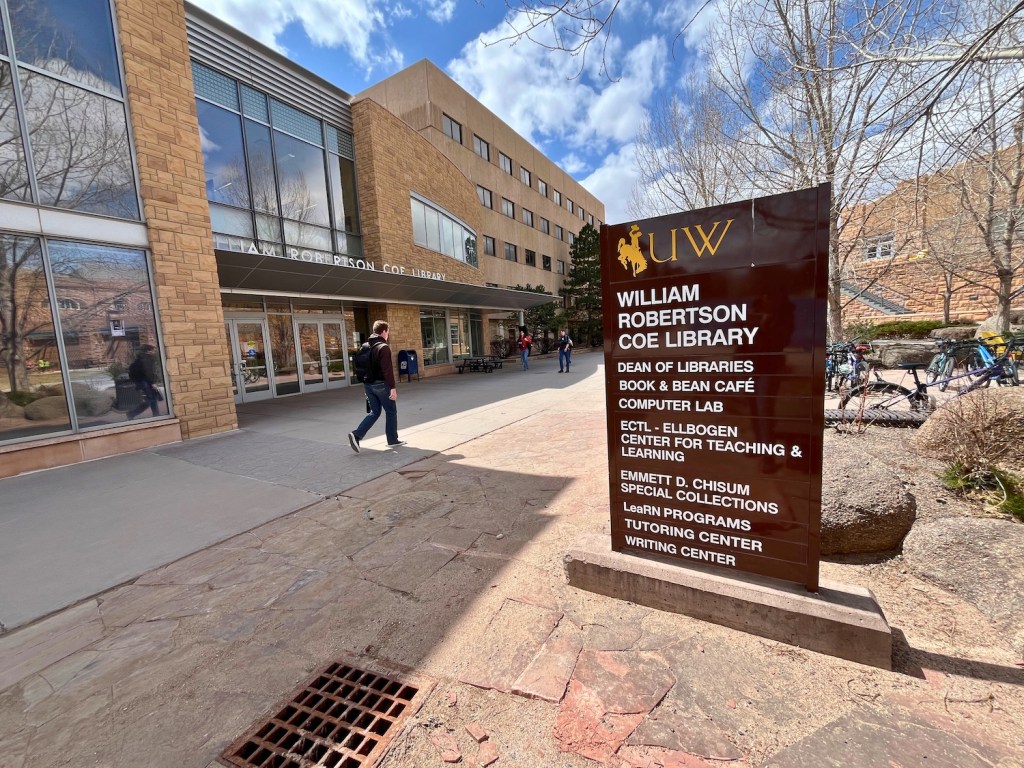
The University of Wyoming is a land grant university, meaning revenue from lands the federal government gave to Wyoming helped generate the school’s endowment. The United States seized vast swaths of those lands from tribes — sometimes for little or no money — and gifted them to the new state to benefit public education. UW still receives the funds generated from leasing those lands.
That is one reason Wyoming’s Northern Arapaho and Eastern Shoshone tribes say the university should help defray college costs for tribal students, including with tuition waivers.
Advocates have been pushing the effort for years. Now, UW is advancing a framework to give financial help to members of the Eastern Shoshone and Northern Arapaho tribes who graduate from Wyoming high schools.
Rather than a tuition waiver — which aims to alleviate tuition costs for Indigenous students — the UW plan would set up what’s called a commitment structure, university representatives told the Legislature’s Select Committee on Tribal Relations last week.
The commitment structure would be a four-year renewable scholarship that would equal tuition and mandatory fees until a first bachelor’s degree is earned, UW Vice President for Budget and Finance Alex Kean said.
“You would have to be an enrolled member of the Northern Arapaho or Eastern Shoshone tribe, graduate from a Wyoming high school, complete [a federal aid application] on an annual basis, and in order to maintain that moving forward, be enrolled as a full time student or complete a minimum of 12 credit hours per semester,” Kean told lawmakers.
The university’s board of trustees has considered a draft plan and asked for amendments, Kean said. “But conceptually, I think there was an indication that we’re working towards something that is achievable.”
However, tribal members had a different take. Tribal advocates feel the university has been punting the issue by asking them repeatedly for new data, Eastern Shoshone Education Director Harmony Spoonhunter said.
“It’s kind of like we’re getting pushed in circles,” Spoonhunter said. “I started in 2011 and we’ve been working on this for a really long time.”
In the meantime, she said, she’s watched states like Colorado and Montana enact native tuition waivers. “And so I would like to see that here.”
Taking the lead
UW President Ed Seidel in September 2024 pledged to spearhead an effort to define what Native student tuition waivers could look like for the school’s undergraduates.
He made the commitment after a “circular” conversation between UW trustees and state lawmakers about which entity is responsible for initiating such a plan. Education leaders and lawmakers have batted the concept around for years.
Advocates say a waiver would lower barriers and encourage more Native American students to enroll in higher education, where their participation and graduation rates lag. Others say universities that have benefited financially from ancestral tribal lands, like UW, have ethical obligations to the state’s Native American residents.
Alyson White Eagle, a research assistant, student in the UW College of Law and Northern Arapaho tribal member, zeroed in on Native tuition waivers for a research project she presented to the legislative committee a year ago.

White Eagle pointed to the acquisition of lands. “UW has made a return on revenue generated from the sale of these lands from the Morrill Act at a rate of 321 times,” she said. “Despite this considerable revenue generation, UW’s Native student population, native faculty [and] staff population is pretty low.”
Less than 1% of the UW student body reports being Native American or Alaskan Native, compared to 4% of the state population holding tribal affiliations, according to her report. Retention and graduation rates among Indigenous students also lag behind the general student population.
The University of Wyoming currently offers aid to Indigenous students through roughly 17 different endowed funds, UW Foundation President and CEO John Stark told the committee last week.
But this new commitment structure concept would be specifically focused on giving Native students a leg up.
Headway
The proposal would be funded by a new endowment structure, Kean said. The UW board of trustees has asked to review a complete endowment agreement “so that they know what it is exactly that they’re approving.”
Once that is in place, he continued, “then we would begin the discussion of how to fund this.” The estimate is that $6 million would be needed to fund current enrollment levels, he said.
The proposal is subject to final approval by the board. “But I think we’re making some headway,” Stark said.
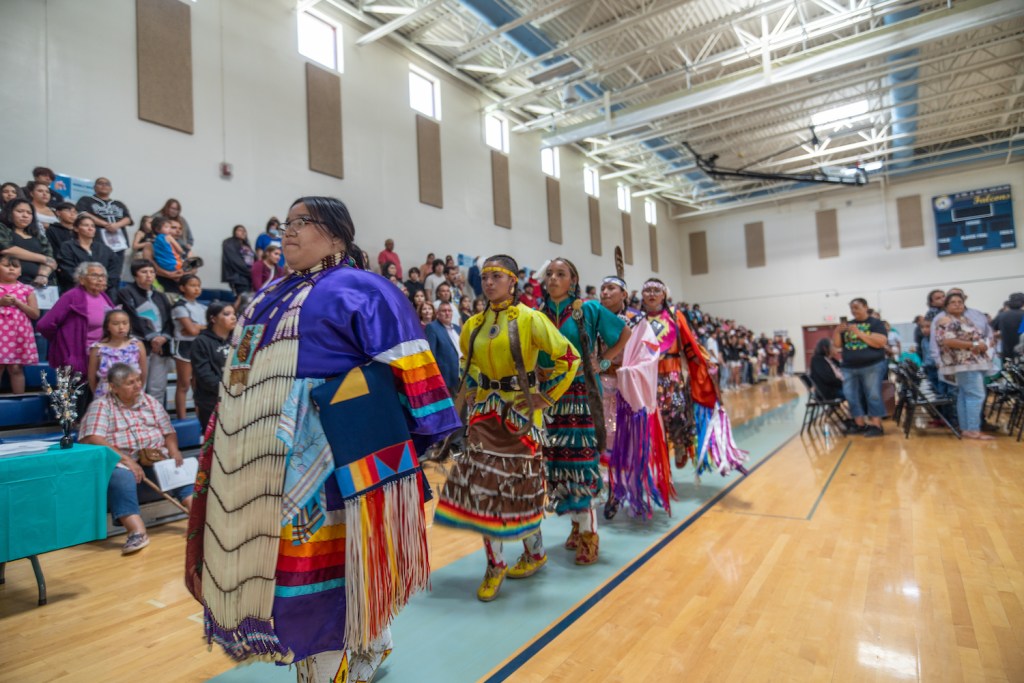
Tribal representatives, however, told the committee that it’s already taken too long. UW continues to ask for data in a way that’s delaying the issue, Eastern Shoshone Business Council Chairman Wayland Large said. UW representatives also suggested that Spoonhunter start her own endowment, Northern Arapaho Business Council Chairman Keenan Groesbeck said, which was disrespectful.
“So all in all, the good old boy club at UW needs to deal with us, they need to give us the time to hear us out on these matters,” Groesbeck said. “And we’re here. We’re not going nowhere.”

Hello All. This happened about 5, 6 years ago at UW.
A group of graduating students from St. Stephen’s, on the Wind River Reservation, went to visit UW for a senior trip, with the possibility of applying and attending. There happened to be a football game that day, so the senior students wanted to attend the game, there was something about “get a banner or flag at campus Bookstore and get in free, or something like that. Aboutv5 Boys went to the bookstore, BOUGHT rhe flags or whatever it was. They were stopped by security before they left the bookstore, accused of theft. The boys were all under the age of 18, were held there at the bookstore for about an hour, they were illegally searched, they’re backpacks were illegally searched, and were asked over and over and over, “where it is”? Not having a clue if what the adults at the UW Bookstore was talking about, the St. Stephen’s School Native students answer was all rhe same.. “what”? “What are you looking for”?. After about an hour of accusing and asking the same questions, the adults/employees at UW Bookstore didn’t find anything for what they were accusing minor indian boys of stealing, the boys were released. The parents complaints fell on Institutional Deaf ears, nothing has been done about it. This story has a longer version, but I told you the point of the story. THAT PART OF AMERICA NEEDS TO CHANGE. We always tell our children, our young people, “You are our future leaders, be good to PEOPLE. Be Firm but Fair. Be the bigger person”.
Thanks again, Katie. You give us another well-rounded article! This time you present tribal leaders holding UW’s “feet to the fire”! BIG thanks.
Just a reminder—-Education and health services are treaty rights—-“the supreme laws of the land”. Please remind us of that fact since 1868 every chance you get.