

WyoFile now provides audio versions of all articles. Feel free to send feedback to casey@wyofile.com
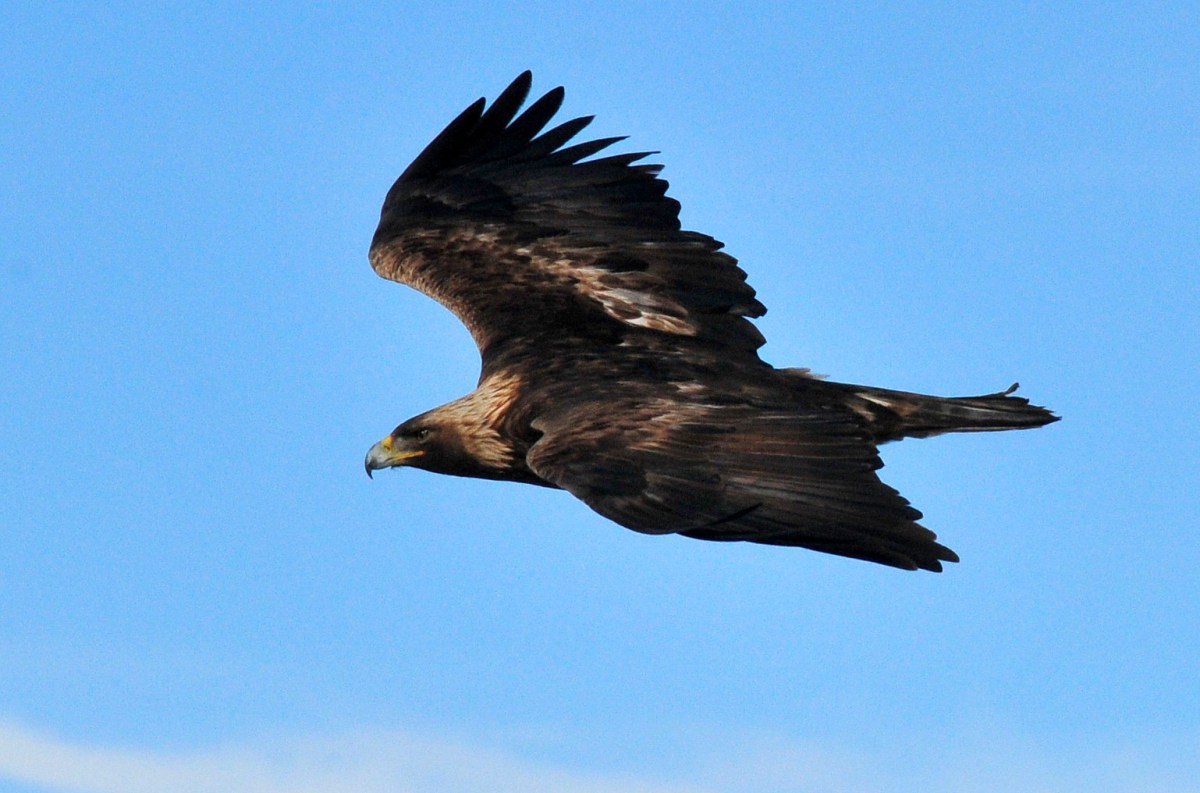
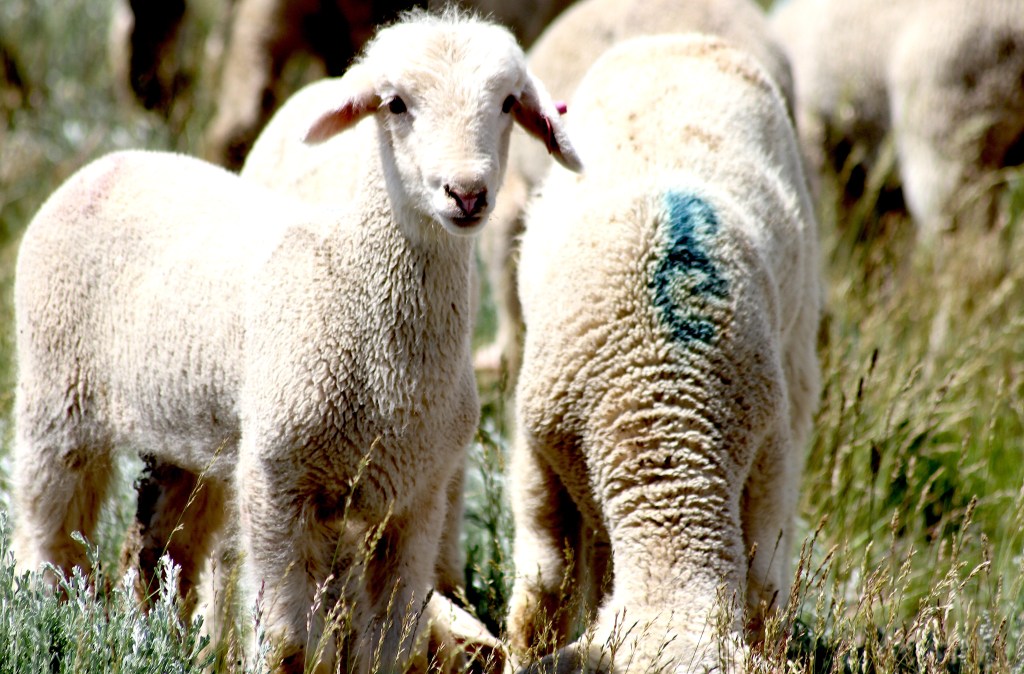
CASPER—Chronic clashes between an apex raptor and domestic lambs grazing Wyoming rangelands reached cabinet-level officials at two branches of the United States government early this year.
U.S. Department of Agriculture research biologist Lindsey Perry briefed Wyoming officials about the status of her golden eagle work on Wednesday morning at a meeting of the state’s Animal Damage Management Board.
“Word came down from the Secretary of Ag and Secretary of the Interior that they wanted immediate action this lambing season to alleviate some of the depredation that was happening,” said Perry, who works at the National Wildlife Research Center. “They asked us to try to do something.”
By the time U.S. Department of the Interior Secretary Doug Burgum and U.S. Department of Agriculture Secretary Brooke Rollins’ directive trickled down to Perry in February, the marching orders were to capture golden eagles in areas used by lambing domestic sheep and move them elsewhere. The intent was to “disrupt their focus on the lambs and alleviate that pressure,” she said.
Because of manpower limitations, the eagle-moving efforts effectively delayed a National Wildlife Research Center project geared toward studying and identifying a cost-effective deterrent to golden eagle depredation in Wyoming, the research biologist said. Testing of nonlethal deterrents is now slated to take place in 2028 and 2029. And because of the directive, the focus in 2026 and 2027 is changing to moving eagles.

The question of where to bring Wyoming golden eagles is complicated by their predilection for returning, especially if they’re not moved long distances.
“They often come back to the same location,” Perry said. “But it does take some time. A year. Sometimes it’s a little bit faster.”
The goal for 2026 has been to move the large birds of prey toward the Pacific Coast, to put some mountains between the translocated birds and their native ranges. But so far, no other states that meet wildlife managers’ criteria have been willing to take an influx of golden eagles. Animal Damage Management Board member Sharon O’Toole guessed why there have been no takers.
“If I was a livestock producer in that area,” O’Toole said, “I wouldn’t want the eagles turned loose.”
Perry affirmed the hunch.
“Exactly,” she said.
“Basically, they were concerned about us relocating eagles into livestock production lands in their states,” Perry said. “They said, ‘We don’t want to do this right now. We’re going to give it a little bit more time.’”
Addressing livestock conflict with golden eagles is complicated by federal laws that address the native avian predators. They’re protected from most possession and killing by the Bald Eagle Protection Act, which was amended in 1962 to also protect golden eagles.
Golden eagles also are not doing well from a population standpoint. Facing stressors like habitat loss, lead poisoning and wind turbine strikes, numbers in Wyoming have declined by nearly a third over the past 20 years, according to Teton Raptor Center conservation director Bryan Bedrosian.
That is especially worrisome for the species.
“Wyoming is to golden eagles as Wyoming is to sage grouse,” Bedrosian told the Wyoming Game and Fish Commission last October. “We have a quarter of the breeding population of golden eagles in the western United States. We host roughly half of the migrants that come down from Alaska and Canada.”
Yet concurrently, conflict with golden eagles has also been on the upswing. The branch of USDA that addresses conflict, Wildlife Services, reported no hazing of golden eagles in the period from 2016-18. But by 2020, some 19 eagles were hazed, according to an environmental assessment covering bird damage management in Wyoming.

Woolgrowers in places like Johnson County have experienced chronic depredation issues, the Buffalo Bulletin has reported.
Wyoming sheep producers reportedly lost $700,000 worth of lambs related to eagle depredation in 2025, according to the Animal Damage Management Board’s latest annual report.
It’s unclear when the U.S. Department of the Interior and Agriculture-directed translocation efforts will offer relief.
“What’s next?” Perry said. “We’re going to be working with the states and trying to come up with a plan for translocation to try and move some of the eagles.”

This problem is nothing new, I was the district supervisor for Wildlife Services for many years out of Rock Springs. The problem is the migrating juveniles that are passing through during lambing season. They find lambing ranges, and stay much longer than normal because of the food base of new born lambs. In some places there can be dozens of golden eagles praying on these new born. Also, the raven issue is a problem by picking the eyes out and the umbilical cord, both of these avian predators are a serious problem and has been this way for decades. The adult eagles are very territorial and will defend their home range, so most the problem with eagles are the juveniles passing through, but will stop when the food source is abundant. These baby lambs are about the size of jackrabbits, perfect size for them to pray on.
I have decades of experience as an expert on many raptors, including golden eagles.
Relocating golden eagles is highly unlikely to be effective. These are animals of vast ranges, that know exactly how to find home similar to homing pigeons.
Mike Koshmrl’s important golden eagle article in today’s WyoFile is troubling in many ways. I am connected to this story by an included photograph, and associated link to another 2022 WyoFile article regarding satellite telemetry studies of wind energy impacts on golden eagles. However, my connection runs deeper. Golden eagle studies have been a part of my life since 1972, when taken under the wing of a wonderful U.S. Fish and Wildlife Service (FWS) research biologist, I started trapping and tagging golden eagles for undergraduate and graduate projects in far W. TX. That part of TX, and an adjoining area of SE NM, had a long prior history of conflict between sheep and goat raising interests and golden eagles; and, witnessed intensive, widespread eagle trapping, shooting, poisoning and highly effective aerial gunning. Walter Spofford published a monograph in 1964, where he estimated that some 20,000 golden eagles had likely been killed over the history of persecution in that area. Today population estimates of golden eagles in the U.S. (including AK) are 40,000 and declining. Wyoming has had its own history of golden eagle/livestock conflicts including use of the thallium sulfate poisoning and helicopter shooting in the early 1970s which killed hundreds of golden eagles.
My university trapping efforts proved successful, and in 1975, I was “emergency hired” by FWS to train field technicians to trap golden eagles on a problematic eagle/sheep depredation area near Dillon, MT. Here, USDA and FWS collaborated on a massive live-relocation project to remove golden eagles from the lambing areas. That temporary job led to a 33-yr career with FWS, which also included off and on golden eagle research and other related conservation work. And today, I am still emersed in golden eagle wind turbine collision studies here in WY.
This new round of proposals to relocate golden eagles away from lambing grounds in WY is a hollow, political solution with little merit and higher potential for further harm on what is now a rapidly declining WY golden eagle population. Yes, golden eagles can and do take lambs! Newborn lambs are little more than jack-rabbit sized animals with none of the inherent jackrabbit instincts/abilities to avoid being eaten by eagles. But wildly absurd claims of livestock level losses and golden eagle sheep/goat killing efficiencies by some sheep ranchers over past years has done little to support their cause. And while I am sympathetic to ranchers’ true losses of revenue from golden eagle depredation, I don’t think it’s the government’s job to bail out ranchers at such enormous public cost when direct operator benefits would be questionable at best, and impacts to golden eagles could be very real. The Dillon project removed over 140 golden eagles in 1975 alone (a number of which died in the process), but as I recall, the involved ranchers still sustained considerable lambing loss (perhaps not all related to eagles as it took place on open, windswept hills with little protection against spring weather).
The telemetry data we’ve obtained on 162 golden eagles, satellite-tagged in WY between 2014 and today, show population biology characteristics which suggest that distant relocation of WY golden eagles could have an additive impact on a population now in jeopardy. But first, it is important to understand the key role industrial wind energy development is having on the population decline of golden eagles here in WY, and elsewhere. There are a higher number of tagged golden eagles whose fate could not be determined after tag telemetry signals fell silent. But, of 32 tagged golden eagles that died and their cause of death could be factually determined (necropsies and other site indicators), 84.4 percent of all deaths were human caused, and 51.8 percent of those human-caused deaths were the result of wind turbine strikes (more than all other human mortality factors combined—vehicle collisions, electrocutions, shooting, etc.). Given the proliferation and wide distribution of wind farms across essential golden eagle habitats from the Canada to Mexico, wind energy is now having an unprecedented level of impact on golden eagles that decades of trapping, shooting, poisoning and aerial gunning couldn’t match.
But if golden eagles trapped in WY are relocated to distant states, it could result in added displacement and permanent loss of breeding, or potential future breeding eagles critically important to restoring and maintaining golden eagle populations in WY. I am all for trying to develop more realistic, effective measures to reduce potential golden eagle depredation on lambing grounds—better cover and protection for newborn lambs for example—but a heavy-handed, costly, and likely ineffective approach at taxpayer and golden eagle expense is a poor solution.
Mike Lockhart
Laramie
This might sound crazy, but put harnesses with spikes on the lambs. These are used on little dogs to protect them against coyotes.
They kill them while the ewe is giving birth.. It normally kills the ewe too. So short of constantly pulling guard duty, what’s the next brilliant idea?
To those who say the predation is exaggerated–I would say, you don’t live where you have to make a living on sheep. Speak to the sheep ranchers with lambing ewes finding the faces of the lambs coming out of the ewes’ uteruses that have been eaten by eagles. One rancher lost nearly 75% of his first year ewe’s lamb crop last year.
I have lived in Wyoming my entire life and have watched the increased numbers of goldens come into central Johnson county over the past 20 years. In addition to lamb predation, there is the additional predation on the Wyoming sage grouse population. These birds are virtually helpless when it comes to the attacks by eagles.
These are magnificent birds to watch fly and they are beautiful to look at but the financial and environmental toll they are taking in the areas where their population has increased has reached an imbalance to the total use of the lands. Their range is huge (as the eagle experts will tell you) but they return to the areas where the “pickings are easy.”
Not a sheep rancher, just an observer, and land owner.
Your heading certainly does point directly towards liberal democrats doesn’t it? While the Secretary of agriculture and interior are under the Trump administration and trying resolve a complex problem, it is beautiful how you make it look directly like Trump himself is attacking Golden Eagles. Nice reporting.
Actually, the heading points to rightwing goofballs.
Leave the eagles be, they were here first. Sheep, like cattle, are invasive species. They should be removed from public lands.
Myself I prefer lamb chops and beef steak over eagle drumsticks.
No worries, the wind turbines will take them out.
This problem is a real dilemma. Moving birds who have acquired the habit of killing or maiming lambs and calves only makes one think that it is possible that transplanted birds will teach the resident eagles of the area the same techniques. Who is going to want that? Ravens and crows have some nasty behavior techniques toward newborn livestock also.
Personally, I do not believe the Sheep Barons claim that eagles take over 3,000 lambs from Wyoming in a year. We know ranchers exaggerate losses , or are compensated for actual livestock losses with a guaranteed multiplier that presumes for every lamb or calf taken by a predator there must be X-number more taken without a trace, then get paid for those phantom corpses. Such a deal.
Having said that, Wyoming grazes about 300,000 domestic sheep. By the Stockgrowers reckoning, eagles are taking one percent of them. Thing is, losses to all causes are a cost of doing business, and in any given year around 45,000 sheep are lost to predators , weather, disease, theft, poison , birthing gone wrong, and even just rolling over on their backs and not being able to get back on all fours. Yup.
The top predator on sheep is our old friend, the Coyote, which should be named the Wyoming State Dog. For every sheep taken by a golden or bald eagle, Wile E. Coyote takes five. We know how well coyote control works. Eliminate one and two will take its place. And I don’t hear the Interior Sec and Ag Sec and the stockgrowers yammering about deporting ravens, foxes, bears, cougars and naughty domestic dogs to other states. Just the eagles ? Get real.
Who can forget the exalted Sheep King of Wyoming back in the 1970’s, the late Herman Werner. He hated eagles so much he hired helicopters from Utah and local Cessnas with sharpshooters to chase down eagles and shot them out of the sky, Aerial warfare.
Werner got caught. Using brand new infrared imaging technology developed for the Vietnam War to locate Viet Cong in the night, US Fish and Wildlife agents flew Werner’s ranch holding. He had buried the carcasses of so many eagles in one spot that they showed up on infrared as heat sources. Herman got busted by science. His eagle graveyard was radiating heat as the birds decomposed. Agents estimated the mass grave contained over a thousand eagles.
That’s how Wyoming sheep ranchers used to deal with eagles, left to their own devices and dogma. This was all immortalized in a fine country rock stomper by former Byrds guitarist Stephen Stills ( how ironic!) when his Manassas band performed the song ” Fallen Eagle ” inspired by the Herman Werner debacle.
Bottom Line: relocating eagles to other states to save 1% of sheep is ridiculous
Licensed, master falconers from all over the country would love the opportunity to trap a golden eagle for the purposes of falconry. As of now the only state that allows any eagle take is Wyoming and they are only allowed to issue 6 permits maximum. This is out of over 100 falconers all over the country that apply every single year. It would be great if other states could also issue a take and Wyoming could decide on their own how many they would allow falconers to trap. We see this as much more preferable to eagles being chopped up by wind turbines, electrocuted, or shot.
Beyond absurd. The ghosts Randy Graham and Dick Strom are with us yet.
https://www.hcn.org/wp-content/uploads/1991/10/1991_10_21_rfs.pdf
Ah, $700,000 depredation of lambs during 2025 is what percent of lamb production? The figure is meaningless. So, sheep have been lambing and golden eagles are not a new invasive species to this area…….just sayin’ The cost to capture and “relocate” golden eagles will cost infinitely more than paying out depredation charges.
I’d much rather see eagles in the air compared to sheep on public lands.
The welfare ranching lobbyists are a cancer.
Thank you Chuck!