

Last month, Radiant Industries abandoned plans to build a first-of-its-kind nuclear manufacturing facility in Wyoming, choosing Tennessee instead. Wyoming law would have prevented the company from storing nuclear waste at the site, and the regulatory uncertainty killed the plan.
Opinion
This move spotlights a watershed moment for Wyoming.
Up until now, conversations around nuclear energy in Wyoming have happened on a case-by-case basis. When a new project is proposed, lawmakers scramble to decide whether to make exceptions to state laws to accommodate the plan. As Radiant’s glow fades from Wyoming, we have a chance to get ahead of the curve and develop a comprehensive statewide policy for future nuclear proposals.
The piecemeal nature of nuclear planning has come into sharp focus in recent years. In 2021, when TerraPower proposed a nuclear power plant in Kemmerer, state lawmakers opted to allow the company to store its nuclear waste at the facility despite a statewide ban. This paved the way for the project to move forward.
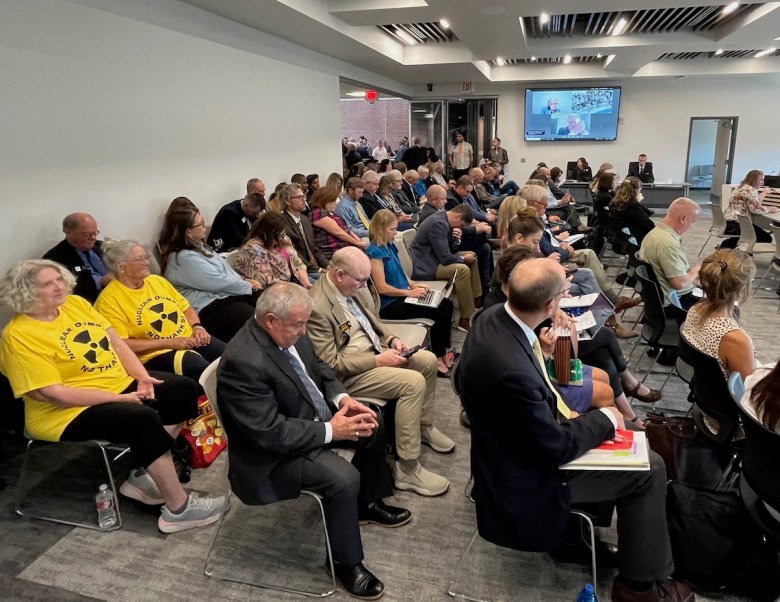
A few years later, with a proposed “nuclear manufacturing” facility on the table in Bar Nunn, the Joint Minerals, Business and Economic Development Committee tabled a measure to legalize nuclear waste storage. That, along with vocal community opposition, prompted Radiant to pull out of Wyoming.
Interest in nuclear technology is not going away any time soon. Future companies will doubtless come begging for more exemptions. Now is the time for Wyoming leaders to step up and have the conversations we should have been having all along about how to regulate this industry.
Granting every new company its own exemption is not the way to roll out a responsible nuclear policy. The conversation we need to have is much larger than Radiant or the wish-list of any single firm. With new nuclear technologies emerging, we are not just talking about storing radioactive waste. We are also talking about building new and untested reactors, transporting these reactors and waste across our highways and through our communities, and navigating new federal rules designed to expedite construction, which could end up leaving communities and the state on the hook for missteps. All of this needs to be taken into consideration as Wyoming leaders decide how to regulate future nuclear projects.
As the conversation unfolds, it is essential that our leaders listen to the questions and concerns expressed by Wyoming communities and acknowledge the lived experiences of those impacted by the nuclear industry. Gov. Mark Gordon has criticized those who are hesitant about nuclear, calling them “Club No.” But hesitation is healthy when the stakes are high and the issue complex. There is a lot to unpack and digest about this industry, and the skepticism voiced by community members, local leaders, and tribes has been warranted.
Is nuclear right for Wyoming? The answer depends on careful consideration of opportunity and risk. We need to consider whether nuclear power is a reasonable and economically viable way to power our grid and reduce emissions. We need to weigh the impacts of increased mining. We need to evaluate whether there are sufficient safeguards to protect Wyomingites from catastrophic health impacts like the ones we saw in the 1960s, when a radioactive plume from the Susquehanna-Western uranium mill led to cancer clusters on the Wind River Reservation.
These calculations might look different for different communities. The outcome may well benefit the next iteration of Radiant. It should, at the very least, provide clarity for both industry and Wyoming’s communities about the types of projects we are willing to host. Communities deserve time. Industry deserves certainty. People deserve leadership over politics. Wyoming’s leaders should seize Radiant’s departure as an opportunity to take the lead in crafting clear, proactive and comprehensive policy surrounding nuclear energy — rather than doing things piecemeal, whenever a new project pops up. Taking the time necessary to thoroughly address an issue that will have impacts for tens of thousands of years is not only worthwhile — it is essential for the long-term success of our communities, our economy and our way of life.


Nuclear wasn’t acceptable for the “common good”\citizens of this nation. It should not be acceptable for data centers to digitally enslave that same citizenry.