

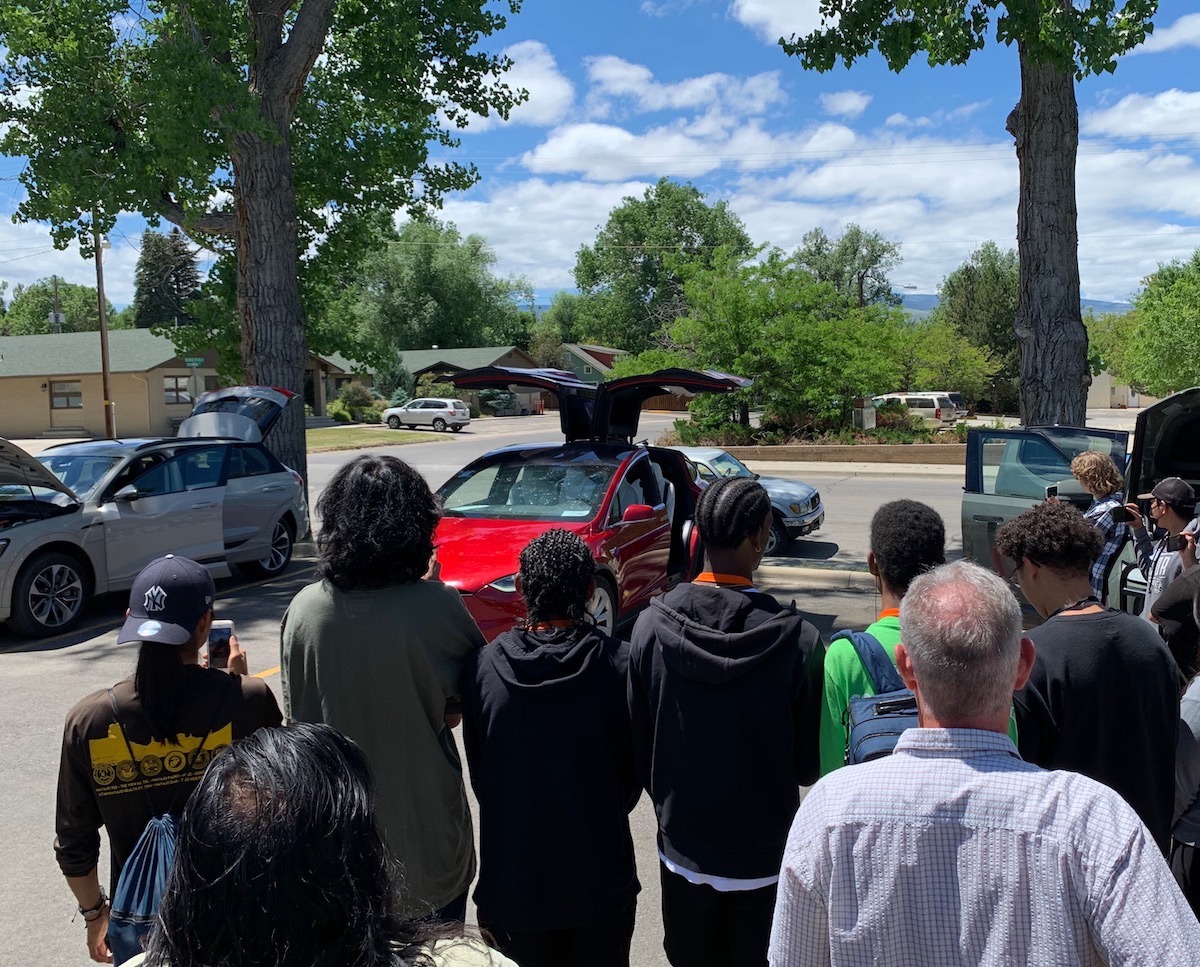
Several electric vehicle charging stations across Wyoming unplugged their units late last year when the state applied its alternative fuels tax at EV charging stations, inadvertently imposing “triple” taxation on residential EV drivers and creating a conundrum for some charging stations.
Now, a bill is cruising through the Legislature that proponents say will equalize what’s out of whack between residential EV and petrol automobile owners, as well as an administrative headache for some EV charging stations and state revenue collectors.

House Bill 145, “Removing triple taxation for resident EV drivers,” saw little opposition as it cruised through the lower chamber during the Legislature’s budget session. It was similarly regarded as a practical “clean up” measure Thursday as it advanced out of the Senate Transportation, Highways and Military Affairs Committee on a 4-1 vote.
The smooth sailing, according to testimony on the bill, might be attributed to the fact that lawmakers, for the past several years, have contemplated how to better adapt Wyoming’s fuel tax system to drivers who get their fuel by pumping electrons rather than gasoline. EV drivers, such as Converse County resident Maria Katherman, say they just want to contribute to Wyoming road maintenance the same as all other drivers.
“We are very happy to pay this tax,” Katherman told the committee. “I think that we should contribute to the maintenance of the roads.”
Nobody spoke in opposition to the bill during the committee hearing Thursday. The bill is scheduled to be heard for the first time on the Senate floor today.
The problem
To help fund road maintenance, Wyoming imposes a per-gallon tax of 24 cents. But how do you apply that to EVs?
Many states have developed methods to calculate an equal rate for kilowatt consumers, but Wyoming started out with a guess, of sorts. Rather than come up with a gasoline-kilowatt conversion rate at electric charging stations, it imposed a $50 annual registration fee on residential EV owners — eventually ratcheting it up to $200 — guessing that’s about what a traditional car-owner might pay at the pump in a year.
Though the state has had an alternative fuels tax law on the books to equalize rates for biodiesel, propane and even electricity, it held off imposing it at EV charging stations. Meanwhile, charging stations kept popping up — some “level 2” stations that provide a slow “trickle” of electricity, and some “level 3,” or fast-charging stations.
“We are very happy to pay this tax. I think that we should contribute to the maintenance of the roads.”
Maria Katherman, EV owner
While residential EV drivers were contributing to Wyoming road maintenance via the annual $200 EV “decal” fee, Wyoming was missing out on revenue from out-of-state EV drivers.
That changed when the Wyoming Department of Transportation sent out a notice last year that the state would begin collecting the EV-gasoline-equivalency rate at all EV charging stations. That meant that out-of-state EV drivers would finally chip in at the electrical pump. But, it also meant that residential EV drivers would now pay the annual $200 registration fee, the fuel tax at the charging station, plus a sales tax on electricity.
That’s triple taxation, many lawmakers have agreed, and it needs fixing. It’s been a committee topic for the past two years.
Enter HB 145.
The potential fix
“So the goal here is that we kind of align residents to be on a similar amount of fuel-tax payment that they’re paying with their EV, and we also make sure that all the people that drive through the state properly pay for how much they’re driving [on Wyoming roads],” HB 145 sponsor Democratic Jackson Rep. Mike Yin told the Transportation Committee.

Yin is also president of OtterSpace, a company that operates fast-charging EV stations in Dubois, Lander and Pinedale, and a slow-charging station in Laramie. If passed, HB 145 will likely increase tax payments from the company, he said.
The bill removes the electricity sales tax at EV charging stations, bringing those kilowatts in line with petrol, which is also exempt from sales tax. It also mandates that only fast-charging EV stations impose the fuel tax, and allows residential EV drivers to apply for a refund on their annual $200 fee using their fast-charging station receipts.
Level 2, or trickle-charge EV stations, would be exempt from imposing the tax under HB 145. That’s because, according to Yin and other bill proponents, the volume of electricity used at those facilities is small and hardly worth the accounting and reporting expense. WYDOT and Wyoming Department of Revenue officials told lawmakers they generally agreed with the strategy, noting that tax collection at fast-charging stations brings EV and petrol drivers into parity.
Katherman, the EV owner from Converse County, noted the ancillary advantages of level 2 charging stations and why they shouldn’t be folded into the state’s fuel tax program.
While some privately owned slow-charging stations impose a nominal fee — some of those by-the-minute instead of measuring actual kilowatts — a handful of towns and many businesses provide the service as an amenity, like complementary coffee. Because it’s a slow charge, EV drivers are tempted to spend hours downtown shopping, for example, Katherman said. It’s a strategy to encourage more commerce at Wyoming storefronts.
“Sometimes it’s happened to me before, that I end up spending a couple of hours and more dollars than I had hoped to,” she told the legislative panel. “So it can be a big advantage for the state.”
For more legislative coverage, click here.

Efficiency comparisons BMW x3 (gasoline) BMW iX3 (EV)
The smart money is on EV’s for a lot of reasons. Number one being your pocketbook.
EVs like the BMW iX3 use energy far more efficiently than gas vehicles like the BMW X3, turning most input energy into motion instead of wasting it as heat. The BMW X3 gets 29 mpg combined per EPA ratings, while the iX3 is estimated at around 100 MPGe—over 3 times better on an energy basis.
EPA Efficiency Ratings
EPA measures gas cars in miles per gallon (mpg) and EVs in miles per gallon equivalent (MPGe), using 33.7 kWh of electricity as equal to one gallon of gas energy.
• BMW X3 30 xDrive: 27 city / 33 highway / 29 combined mpg.
• BMW iX3 (est.): ~100 MPGe combined, based on ~15 kWh/100 km consumption and 400-mile range with 112 kWh battery.
This means for the same energy input, the iX3 goes about 3.4 times farther.
Energy to Wheels Breakdown
Think of efficiency as “how much energy from the tank/battery actually pushes the wheels vs. gets wasted.”
• Gas X3 (ICE): Only 20-30% of gasoline energy reaches the wheels; 70-80% wasted as engine heat, exhaust, and friction.
• Electric iX3 (EV): 85-90%+ of battery energy reaches the wheels; just 10-15% lost to heat or drag (regen braking recovers some).
Real-World Example
Driving 100 miles: X3 uses ~3.4 gallons (386 kWh equivalent), wasting ~290 kWh as heat. iX3 uses ~34 kWh from battery, wasting ~4 kWh—over 10 times less waste. Gas engines are like campfires (lots of smoke/heat, little push); EVs are like efficient fans (direct airflow)
Source data upon request
So how do we compensate EV drivers for the climate change mitigation they foster through their use of cleaner and more efficient use of energy? How about a further tax on gasoline for climate impacts. That would be true taxation parity. The Wyoming legislature is wrong again on this topic. No surprise, they are often wrong on a whole host of things. The harm done by internal combustion engines to the environment is huge compared to the paltry revenue being generated here. Tax the polluters and reward the clean vehicles…. That’s the smart thing to do but hey, we don’t expect anything smart out of Cheyenne.
Hmmmm, “Lander”????????
I’ve always been puzzled when seeing Teslas in Wyoming in subzero Temps. Are the occupants in Everest expedition weight clothing.
Summer, no problem. Electric heat, EXTREMELY inefficient. Range probably half or less in 0 degrees F.
You’ve obviously never owned an electric vehicle. People continue to quote the myths. The fact is I’ve driven nothing but EV’s for 5 years now. Never been cold in my car. Is there range degradation, yes. But these days with efficient heat pumps providing for cabin environmental controls and battery management needs it is greatly reduced. Internal combustion engines also suffer significant efficiency degradation in cold weather. We can have the conversation about EV’s but at least lets have it base on facts, not Greek mythology
They obviously know something about the EV their driving that you don’t!
So you might have to charge an extra time. EV owners can plan for that. EV’s like any other vehicle have cabin heaters and heated seats. Stop insulting EV owners if you don’t know the facts. In very cold weather (like -30) the range may be down but EV’s will continue to run when other vehicles have fuel freezing issues. ICE vehicles have a place and EV’s have a place.
In the above, “residential” should be “resident.”
good catch