


It seemed inevitable that the dwindling Colorado River would be divvied up by the federal Bureau of Reclamation. On June 14, BuRec gave the seven states in the Colorado River compact just 60 days to find a way to cut their total water usage by up to 4 million acre-feet. No plans emerged.
Opinion
But surprisingly, BuRec’s Aug. 16 press release imposed no new cuts on states, instead affirming cuts mandated under 2007 and 2019 agreements. Nevada and Mexico took minor losses and Arizona emerged as the first big loser.
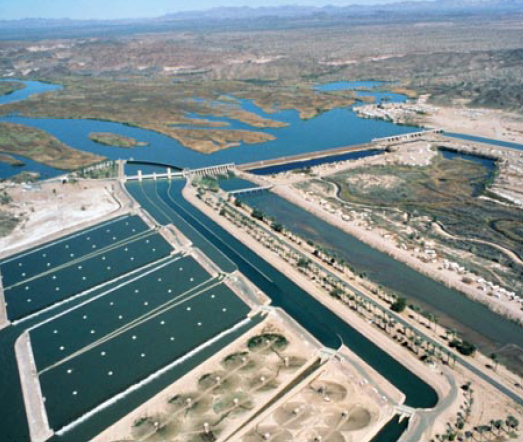
BuRec said Arizona must cut 592,000 acre-feet “because of the concession it made back in 1968 to California to get the Central Arizona Project online,” says University of Wyoming law professor Jason Robison. That concession meant the 1.4 million acre-feet capacity of the Central Arizona Project has junior water rights. In a shortage — like now — the Central Arizona Project, except for tribal water rights, could be cut to zero, a blow to cities and agriculture.
Here’s a question the Upper Basin states seem inclined to ask: If the 1922 Colorado River Compact parceling out the river’s water is the law, shouldn’t California face major cuts? After all, California’s huge allotment of 4.4 million acre-feet lately equals the entire consumption of the four Upper Basin states, and its allotment is also junior to almost 1 million acre-feet of tribal water.
Thanks to a 1931 seven-party agreement, California established a pecking order of priority for each of its water users. Massive districts such as Palo Verde and the Imperial Valley Irrigation District have priority over the Metropolitan Water District, which brings drinking water to 19 million people in Los Angeles and Southern California. The state has a structure, but no plan for serious savings.
For the Upper Basin states, says Robison, “It’s more nuanced. But there’s significant federal authority to run those (BuRec) Upper Basin reservoirs,” though none are very large.
Where might other water cuts be found? Colorado’s 1876 constitution ranked municipal water over agriculture, making it tough to dry up cities like Colorado Springs or Aurora, even though their water rights are junior. But residents might see incentives for tearing out lawns, along with programs for water reuse and much higher water rates.
In rural Colorado, there isn’t much water available to conserve. The largest irrigation district in the Upper Basin, the 500,000 acre-feet Uncompahgre Valley Water Users Association, already took a 150,000 acre-feet cut this year because of a light snowpack.
“The runoff just isn’t there,” says General Manager Steve Pope.
Pope, as well as many others in agriculture, views a desert city like Phoenix — which grew on the false promises of reliable water — as an existential threat to farming communities.
“Are we going to water a field that produces some sort of a crop, or do we water a golf course or a median?” asks Pope. “What’s the benefit of a lawn?”
What the federal government can’t touch for now is any Upper Basin irrigation project created before the signing of the Colorado River Compact in 1922. In Colorado, a spreadsheet compiled by the state’s Division of Water Resources tells what projects, by date, risk losing water. Some Western slope irrigators are vulnerable because the water rights they’re using were bought by municipalities only recently, intending them for future growth.
Many Colorado irrigators on private ditches are lucky to have so-called “perfected” rights dating from the late 1800s. To snag water from these irrigators, it’s likely to be all carrot and no stick. But rather than taking payments for not irrigating, says Pope, “we would be more concerned with system efficiency and improvements.”
The Inflation Reduction Act provides $4 billion to Colorado River water users for just this kind of conservation. Meanwhile, Colorado is the only Upper Basin state that seriously tested paying irrigators to fallow their land or reduce irrigation by half. But ceasing to irrigate farms involves risks. After a couple of dry years hay fields can bounce back, landowners report, but anything more than that leaves bare dirt and dust in the air.
For now, BuRec seems to be following its plans and hoping for the best, which means emergency cuts might be drastic. As John Weisheit of Utah-based Living Rivers sees it, BuRec made a mistake when it told the seven Basin states of the Colorado River to find 2 to 4 million acre-feet to do without.
“The cuts,” he says, “should go even deeper, up to 6 million acre-feet. The need is to that point.”
This piece was originally published by Writers on the Range, a nonprofit dedicated to spurring lively conversation about Western issues, and reprinted here with permission.

California is a bully. Period.
The authoritarian mindset says they can do whatever they want. They won’t stop wasting. They will blame others and grandstand. They should have the most modern conservation system and strict rationing. Instead they open the floodgates of immigration and let water run in the gutters. Maybe with all the intelligent people leaving in droves they will just devolve and go the way of the Dodo. Frankly the states cannot resolve this. There is not enough water. Expect threats. That is how California does things.
“Here’s a question the Upper Basin states seem inclined to ask: If the 1922 Colorado River Compact parceling out the river’s water is the law, shouldn’t California face major cuts? After all, California’s huge allotment of 4.4 million acre-feet lately equals the entire consumption of the four Upper Basin states, and its allotment is also junior to almost 1 million acre-feet of tribal water.”
California has over 800 miles of COASTLINE. Has no one ever told them about desalination? End of debate.
colorado overbuilt their state for an increase in population & increase in taxes.
now that water is in short supply the political class in colorado is blaming the suppliers up stream for the lack of more conservation.
california is in the same boat.
before you know it wyoming will be told by the cut back in water usage even though wyoming has the least percentage of population per square mile than any other state.except alaska!
UNBELIEVABLE !
Just kick the old can down the road.