

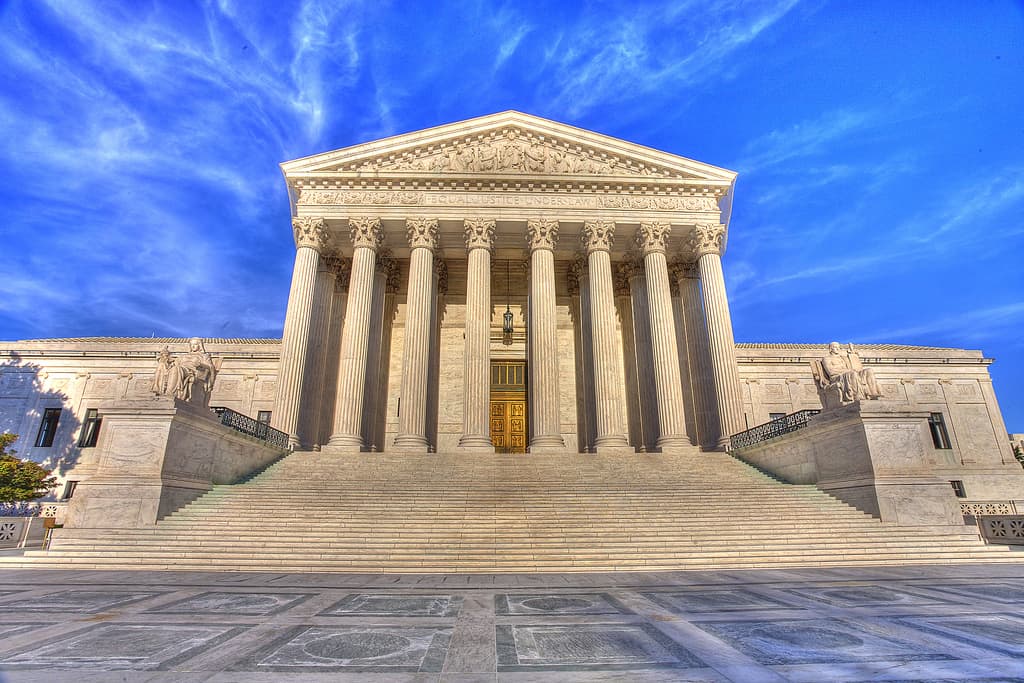
Gov. Mark Gordon was right to applaud the recent U.S. Supreme Court decision that hammered the final nail in the coffin of what was known as the “Chevron deference.” For states and their rights to govern closest to the people, it is indeed a victory.
Opinion
“Chevron deference,” coined from a 1984 Supreme Court decision, had already suffered several legal blows in the past decade, but its final death last week should be seen as a necessary win in the battle to strengthen our country’s sacred separation of powers, a vital component to the system of government our Framers created.
And it’s a victory for those who believe Congress needs to wake up and start doing its job properly, while the executive branch needs to follow laws judiciously, regardless of who’s in the White House. This 40-year-old idea of punting to unelected officials in federal agencies has created four decades of enforcing far too many incorrect interpretations, giving agencies unimaginable powers to create ossified rules with no accountability to the people ruled by them. That is now gone for good.
Gordon said in a statement last week, “For years, unelected bureaucrats running federal agencies in Washington D.C. have used ‘deference’ as an excuse to target certain industries based on politics. Wyoming has experienced that firsthand. Limiting their power to overreach is cause for celebration, and this ruling begins that process.”
How exactly were agencies able to achieve overreach under Chevron? Through agency actions bolstered by a Supreme Court decision that created an unchallengeable diktat. Quite simply, where laws, as (poorly) written by Congress, were vague or ambiguous, the 1984 ruling set up a two-step process for papering over the murky depths. “Is Congress’ intent clear? If not, is the executive interpretation reasonable?” These were the questions asked and answered under Chevron. “Reasonable” became the only standard.
So, any “reasonable” interpretation of murky congressional law was cleared up by agency rulemaking — and not by congressional or judiciary action. And that was that. Those harmed by the “reasonable” interpretation in Washington had little recourse going forward. Not a great way to govern.
The Chevron decision came in the same week Gordon rolled out his initiative to highlight his administration’s years-long efforts, through numerous state agencies, to push back against federal overreach and give Wyoming a stronger say in the federal politics that affect our citizens daily. The similarities between these two events can’t be missed.
The fall of the ”Chevron deference” only days after Gordon spent time showcasing the state’s costly work against the federal government’s overreach (often using the same kinds of rulemaking-as-law tactics) was timing kissed by the political gods. Something most governors aren’t so lucky to receive, but perfect for pointing out why federal actions often come at the expense of states’ rights.
The overturning of Chevron, coupled with recent examples showcased by the governor of Wyomingites fighting the federal government on a host of issues, punctuates the continual tensions between the federal state and our state. And it’s a tension that isn’t ever going to end, but one that needs to be constantly tended to, as Gordon (and many past Wyoming governors) have done throughout their administrations.

“The court has essentially removed the fox from the hen house,” Gordon said regarding the Chevron decision. “This decision ensures that agencies can no longer unilaterally expand their authority beyond the letter of the law. It rejects the strategy of attacking a state’s industries through rules and regulations like those advanced by the Biden Administration.”
When Gordon discussed the state’s myriad lawsuits against the federal government, he brought along several agency heads. They included Wyoming Department of Environmental Quality Director Todd Parfitt, who spoke about the unfair, debilitating tactics being used by — in this instance — the Environmental Protection Agency. The governor’s office said Wyoming was contending with at least 125 rules and regulations issued by the EPA alone, with another 98 proposed.
“These new rules have moved forward with little to no engagement with the state’s DEQ, which implements most of these programs impacted by these new rules,” Parfitt said. “These federal agencies appear to be more interested in the quantity of regulations versus the quality of regulations. Equally concerning is that these agencies have historically demonstrated that they are incapable of keeping up with implementing rules already in place, leading to increased litigation.”
It’s clear “quantity over quality” will be the unflattering legacy of the Chevron deference.
Federal rule-making to advance oftentimes unpopular policies harms the proper functioning of government. It only further erodes trust in government and cultivates deeper divisions among peoples, creating a kind of constant tit-for-tat that is dangerous for our country and our state.
It is simply the worst way to govern or be governed. And for that, Chevron’s death is a welcome victory.
I’ll end by asking a question sparked by something I read because I think it speaks to the conflicts that created Chevron deference in the first place: How do we act together when we don’t think alike?
The answer, as outlined in Yuval Levin’s excellent and highly recommended book, “American Covenant: How the Constitution Unified Our Nation — and Could Again,” is that the Constitution is our guide, for in it the Founders created the system of representation, competition and argumentation that allows us to deal with one another and find common actions. This system of government of ours isn’t perfect, but it’s pretty darned close, if we care to keep it.
Nowhere in the Constitution did our Founders suggest that rules (like taxes) made by far-off unelected entitles were a proper way to govern or be governed.
I believe we can act together best when we find agreement locally, with elected representatives closest to the people, hammering out a compromise, held accountable by those who must live with the agreement. That’s the answer. So, bye, bye, Chevron!


Google : “SCOTUS Chevron ruling impact on Healthcare”
Google: “SCOTUS Chevron ruling impact on OSHA”
Google: “SCOTUS Chevron ruling impact on EPA”
Google: “SCOTUS Chevron ruling impact on Tribal issues”
Pick other search criteria… No more protections!
Sent the same info to Sen. Barrasso – this is his reply!
Thank you for taking the time to contact me. It is good to hear from you.
I appreciate hearing your thoughts on the U.S. Supreme Court’s decision to overturn the Chevron Doctrine. For too long unelected, unaccountable Washington bureaucrats have gone unchecked. They abused the rulemaking process for decades. They ballooned the size of government and imposed on us a costly maze of burdensome political regulations. This ruling rightly curbs the power of rogue federal bureaucrats and puts it back into the hands of the American people.
Government should not do for people what they can do for themselves and government should not put obstacles in the way of people pursuing their American dream. I will always stand up for Wyoming values, protect our freedom, and uphold the foundation of our country.
Thanks again for sharing your views with me. I value your input.
Bad deal. Are you really suggesting that unelected officials are less capable than elected officials. I fail to see that anything will be gained by shifting the decision making to politicians. Amy, for cryin’ out loud, these people can’t get a federal budget passed until 9 months after it’s due. They spend more time finger pointing across the aisle than they do in actual decision making. And, while I’m on the subject, you don’t actually believe that our esteemed elected officials come up with these bills on their own, do you? All research and writing is done by “unelected” individuals, either staff members or lobbyists . This is true at all levels of government. Let’s just bog everything down more, so that even less gets done…..
Ah, the liberals with their ad hominem attacks and their airs of superiority are out in force.
Did it ever occur to you that if Congress can no longer rely on federal agencies to do their work for them because of sloppy law-making, they will either be forced to be more careful with their pens or will be more hesitant to exercise their penchant for writing legislation where it doesn’t belong?
Both of those are good things, btw, in case you didn’t know.
Let us not forget that, in the original Chevron case, SCOTUS allowed the Reagan EPA to WEAKEN environmental rules and REDUCE regulation. And more recently, Chevron was cited by the FCC as it both regulated AND deregulated the Internet, multiple times. So, the doctrine cut both ways depending upon who appointed the regulators. And that was the problem. It let bureaucrats, often politically appointed and motivated ones, make law. It’s repeal is a good thing.
This is a bad decision by the Supreme Court! It will make it more difficult for the federal government to act to address our myriad of problems. We will wallow in judicial limbo while Rome burns around us.
So I use to work for the federal government and if you think it’s going to be better now you will be sadly mistaken. The government will still render its decisions as they need to based on their regulations and the laws and expertise. What won’t happen is these decisions will be stuck in the court system for years and good, bad, or indifference it will crush the system. I’m sure the MAGA crowd will be happy but the really user of our federal lands and the like will be hurt including the industries that use the land. So good luck with it and I will in a weird Masochistic way enjoy seeing the train wreck that will follow.
This decision will force congress to do their job. Read the book The Permission Society by Timothy Sandefur to see how the power of of unaccountable bureaucrats has taken over the duties of the people we have elected to make decisions for us. This is not a partisan issue in any way, shape or form. This is about making governance accountable.
Bob Melrose, I disagree your analysis. I think the bureaucrats are doing what our elected officials have neglected to do or have been unable to do because some refuse to cooperate in legislating reasonable laws intending to cause problems and devision.
Amy, Amy, Amy. As a former legislator, you certainly must know that the agencies you loathe so much were created by the United States Congress under the powers of the Constitution. The will of the people, as it were.
Labeling congress as “far off” is simple-minded misinformation that interferes with public safety. Please stop doing that.
At least Chevron allowed agency’s with staff all over the country that could provide local and educated information, input, and context to laws made by elected bureaucrats in a far off place called Congress where only 3 out 535 people are from Wyoming. I wouldn’t exactly say that those law makers have Wyoming’s best interests at heart, in fact, I’d say the lobbyist have a lot more say than any agency.
Far more important than the separation of powers is the separation of church and state.
Gordon Townsend. There is no such thing in the Constitution. It says in the first amendment ” Congress shall make no law respecting an establishment of religion, or prohibiting the free exercise thereof; …….”. What you want is all religion to be abolished. I suggest you read the Constitution.
I suggest you re-read the comment you are replying to. Nothing was said about abolishing religion.
Freedom of religion also means freedom FROM religion. It’s not a hard concept to reconcile, is it?
I suggest you read what the founders thought.
Instead the rule making will now fall to unelected judges.
So, how do we distinguish between unelected bureaucrats who happen to know what they’re talking about and elected idiots at all levels of government who revel in their ignorance, as do Republicans?
Knowledge and experience isn’t necessary with the repubs. The claims of “I done did my own research” is the new gullible ol’ party rallying cry…
Unfortunately, this nonsense is only the beginning..