
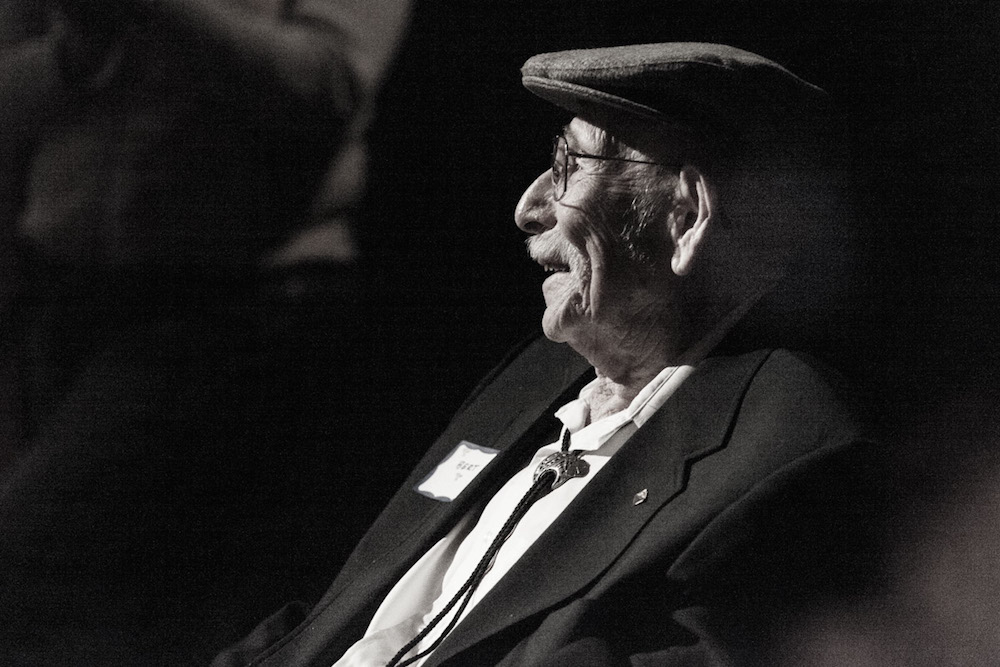
Bert Raynes, author, columnist, birder, wildlife advocate and proponent of citizen science, reacts to the audience during the 2015 premiere of a film about his and his late wife Meg's dedication to observations of nature. Bert Raynes won the 2018 Murie Spirit of Conservation Award from the Murie Ranch of the Teton Science Schools. (David Swift)

The Murie Ranch of the Teton Science Schools gave the 2018 Murie Spirit of Conservation Award to a newspaper columnist who writes a lot about birds.

Recipient Bert Raynes, a keen observer of nature who’s in his 9th decade on the planet, has penned “Far Afield” for the weekly Jackson Hole News and Jackson Hole News&Guide for decades and still writes it today. He’s also authored several books, but his witty column about observations of nature is likely responsible for propelling his gentle personality beyond the bird-club circle.

After commenting on things as diverse as hummingbirds and the Hubble telescope, Raynes routinely includes a section reporting observations of others who call him to report wildlife sightings. From this journalistic democracy grew Nature Mapping Jackson Hole, a citizen-scientist accounting and census of wildlife in the Yellowstone ecosystem.

Biologist Franz Camenzind called Raynes “the Mr. Rogers of our neighborhood,” adding that “the natural world is his neighborhood.”

Raynes had his late wife Meg as his muse and the couple launched the Meg and Bert Raynes Wildlife Fund that supports nature mapping and other conservation efforts.

The Murie family, including Olaus and Mardy, Adolph and Louise, established the Murie Ranch in what became Grand Teton National Park. The ranch became an educational center following their deaths. Mardy, a wilderness activist who was by President Lyndon Johnson’s side when he signed the Wilderness Act in 1964, called wilderness “the basis of all our civilization.

Never miss a Photo — subscribe to WyoFile’s free weekly newsletter

“I wonder,” she said, “if we have enough reverence for life to concede to wilderness the right to live on? I hope that the United States of America is not so rich that she can afford to let these wildernesses pass by. Or so poor that she cannot afford to keep them.”

David Swift, a Jackson photographer who worked in the valley for some 40 years before his death in January, photographed Raynes in 2015 at the premiere of a film about his life.


Angus M. Thuermer Jr. is the natural resources reporter for WyoFile. He is a veteran Wyoming reporter and editor with more than 35 years experience in Wyoming. Contact him at angus@wyofile.com or (307)...

Join the Conversation

2 Comments

WyoFile's goal is to provide readers with information and ideas that foster constructive conversations about the issues and opportunities our communities face. One small piece of how we do that is by offering a space below each story for readers to share perspectives, experiences and insights. For this to work, we need your help.

What we're looking for: 

  • Your real name — first and last. 
  • Direct responses to the article. Tell us how your experience relates to the story.
  • The truth. Share factual information that adds context to the reporting.
  • Thoughtful answers to questions raised by the reporting or other commenters.
  • Tips that could advance our reporting on the topic.
  • No more than three comments per story, including replies. 

What we block from our comments section, when we see it:

  • Pseudonyms. WyoFile stands behind everything we publish, and we expect commenters to do the same by using their real name.
  • Comments that are not directly relevant to the article. 
  • Demonstrably false claims, what-about-isms, references to debunked lines of rhetoric, professional political talking points or links to sites trafficking in misinformation.
  • Personal attacks, profanity, discriminatory language or threats.
  • Arguments with other commenters.

Other important things to know: 

  • Appearing in WyoFile’s comments section is a privilege, not a right or entitlement. 
  • We’re a small team and our first priority is reporting. Depending on what’s going on, comments may be moderated 24 to 48 hours from when they’re submitted — or even later. If you comment in the evening or on the weekend, please be patient. We’ll get to it when we’re back in the office.
  • We’re not interested in managing squeaky wheels, and even if we wanted to, we don't have time to address every single commenter’s grievance. 
  • Try as we might, we will make mistakes. We’ll fail to catch aliases, mistakenly allow folks to exceed the comment limit and occasionally miss false statements. If that’s going to upset you, it’s probably best to just stick with our journalism and avoid the comments section.
  • We don’t mediate disputes between commenters. If you have concerns about another commenter, please don’t bring them to us.

The bottom line:

If you repeatedly push the boundaries, make unreasonable demands, get caught lying or generally cause trouble, we will stop approving your comments — maybe forever. Such moderation decisions are not negotiable or subject to explanation. If civil and constructive conversation is not your goal, then our comments section is not for you. 

Your email address will not be published. Required fields are marked *

  1. Thank Angus! for a wonderful tribute to Bert Raynes, the Muries, and all of our leaders in Conservation, yourself included, who bring our history into the sunlight! Chuck