

A federal judge has ruled in favor of PacifiCorp and its subsidiary Rocky Mountain Power in a case that could tap the electric utility’s Wyoming customers for yet more money.
For how much is unclear, and one party involved in the case told WyoFile an appeal is under consideration.
The lawsuit, which PacifiCorp launched against the Wyoming Public Service Commission last year, strikes at the heart of a long simmering suspicion among state leaders that the utility giant is trying to shift too much of its rising costs to maintain a regional power system to its Cowboy State customers.
That’s not necessarily the case, at least when it comes to a particular calculation and modeling tool related to Rocky Mountain Power’s 2023 rate hike, according to an order handed down Wednesday by U.S. District Judge Kelly H. Rankin.
As a result of the 2023 rate case, which spurred contentious public meetings, the utility’s Wyoming customers saw a 5.5% general rate hike increase in January 2024, in addition to a pair of temporary upward fuel cost adjustments. Earlier this year, the commission accepted a settlement agreement struck between Rocky Mountain Power and the Wyoming Office of Consumer Advocate to increase rates by about $85.5 million, or 10.2%.
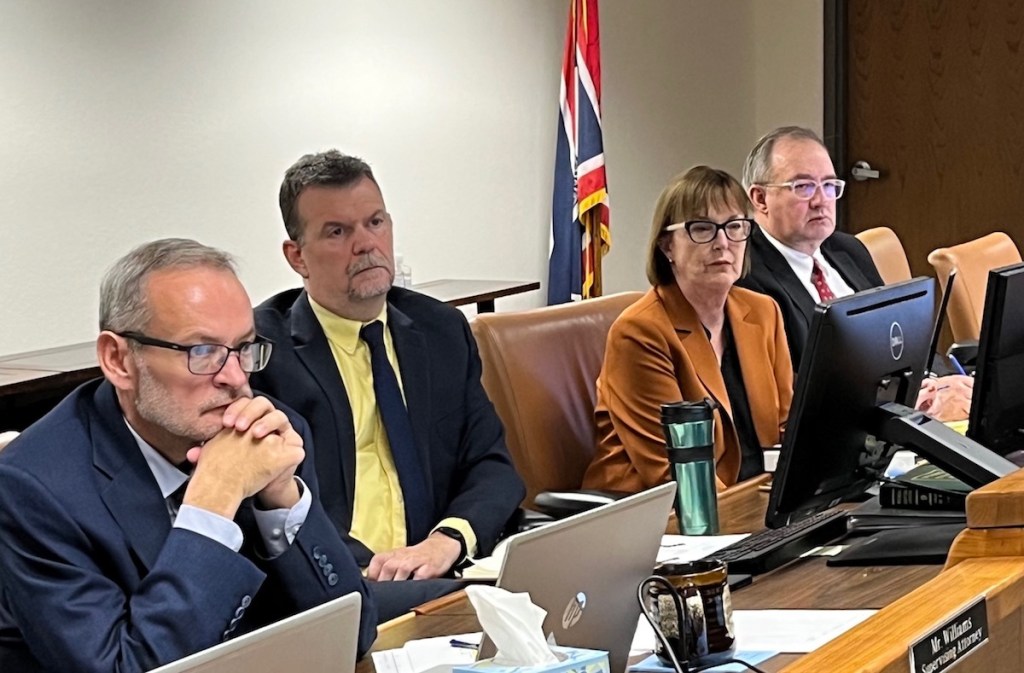
The Oregon company, which is the largest utility operating in Wyoming, named Wyoming Public Service Commissioners Mary Throne (who has since left the commission), Christopher Petrie and Michael Robinson as defendants, according to its complaint. And it gets wonky.
The lawsuit centers on the Federal Energy Regulatory Commission’s authority to require utilities with multistate electric transmission (powerlines) to “hold a certain portion of their energy generating capacity in reserve.” It’s part of a requirement to allow third-party access to interstate transmission lines, and it’s intended to maintain reliable electric service via multiple parties, according to FERC.
That comes at a cost for a utility subject to the federal regulations, according to PacifiCorp.
To estimate and forecast the cost — the portion that is “just and reasonable” to pass on to ratepayers in a particular state — PacifiCorp and Rocky Mountain Power used an Aurora modeling tool. But the Wyoming Public Service Commission has repeatedly objected to that particular modeling, and reduced how much it allowed the utility to raise its rates in the company’s 2023 rate hike case, based on its objection.
When the commission devalued the utility’s calculation, it unfairly reduced how much PacifiCorp and Rocky Mountain Power was legally allowed to recover, according to this week’s court order.
“Further, it is quite clear from the parties’ filings that the issue regarding trapped costs will continue to rear its head,” Rankin wrote.
Rankin’s order denied a request by the defendants to dismiss, and granted PacifiCorp’s request for a summary judgement, asserting the facts of the case are not in dispute.
The order may be appealed.


Well this is bs. They shut down power producing plants and other forms of energy in their state. Then come to us saying oh you owe us money? Who is this judge were does he live who paid him? Think Wyoming about to get short changed.
Thank you Dustin and WyoFile for continuing to cover this story, as well as the many other utility and energy stories you cover so well. Although these issues are, or can be, quite technical, you explain them so the lay public can understand their impact. I appreciate your continued excellent coverage of significant issues in Wyoming and the region.
I think something needs to be said that is lost on the people of Wyoming. Almost everyone in this state is served by a for profit electric service provider. If wind wasn’t profitable why would they be investing in it ? Rocky Mountain Power exists to make a profit. A bunch of maintenance intensive dilapidated coal plants are not the reliable “baseline” power source that Wyoming politicians hark about. It is the dams in the Pacific Northwest that are isochronous, the coal plants as well as the wind turbines are in droop. If you are interested in the electrical grid and do not know those terms, please read up on them.
Oh so thankful I get my power from a co-op out of Montana.
Data centers will continue to increase their footprint on the power landscape. We get to foot the bill.
Kaputalism in action!