

Opinion
My friends in New Mexico call it the Llano del Norte, the Northern Plains. For their Spanish ancestors, it was the “Northern Mystery” — the land far beyond the rivers and the missions. It was too vast, too cold and forbidding. The native people were fierce and the gold the Spaniards sought was too elusive. The Comanche, the Cheyenne and the Arapaho soon convinced them that it was in their best interest to return to the thick adobe walls and the warm pinon fires of Santa Fe. It was a good decision.
We live on the very western edge of the llano, in the basin between the Laramie Range on the east and the Medicine Bow mountains on the west. Native people hunted here, passed through here on their way to someplace else. The Laramie Plains were too high, too cold and too windy to stay very long. It was a good place for bison, not so much for human beings. It is the westernmost outpost of the great American grassland, an afterthought of creation in the image of the shortgrass country to the east. It is a hard place.
But like that shortgrass country off east, it was a small province in an empire of grass. From horizon to horizon, the greatest expanse of grassland on earth. From the Assiniboine in the north to the Rio Grande in the south, from the Father of All Waters to the Shining Mountains, the Great Plains dominated the face of America six centuries ago. Bison, antelope, elk, wolves and grizzly bears. Whooping cranes and prairie chickens. Tallgrass to midgrass to shortgrass from east to west, it was a wilderness of incomprehensible proportions. A wilderness of grass.
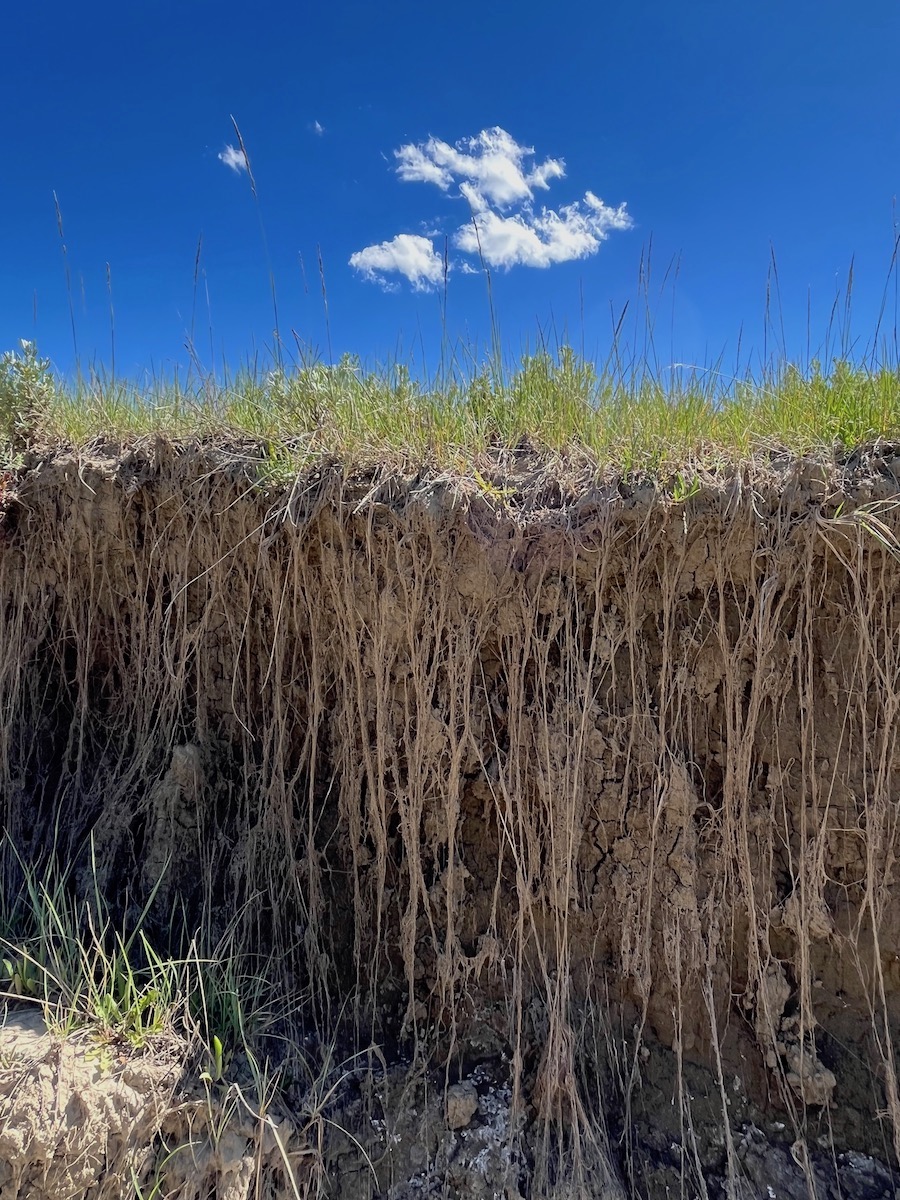
It’s a funny thing about grass — you can only see a small portion of the plant above ground. Most of it is hidden beneath the surface. The buffalo grass and blue grama that grew on the flanks of the Laramie Range where the Cheyenne camped still grows here today. It’s scrubby looking stuff, seldom more than four inches tall. But it’s thrifty. It doesn’t need much water. It can grow in these cold, hard places because it has deep roots. Those roots sink down through the decomposed granite and limestone soil to find the water and nutrients the plant needs to survive. Despite the short growing season and the ever-present wind, it thrives.
So it’s been with the people who came to the plains country. They too needed deep roots to survive, clinging to the cold, dry, windy edge of the American heartland. Some tried to put down roots here but failed. You can still see the forgotten cabins of the miners and the collapsed remains of the sod homes built by homesteaders in our corner of Wyoming. Long-forgotten people gave their names to the creeks, then died in obscurity. But others stuck. The Swedes came to work in the timber. The Irish came to work on the railroad. The Texans came north with the herds on the old Bozeman Trail. The Mexicans came to work the sugar beet fields. They came from all over the world, from different cultures and different backgrounds. But they stayed and against the odds they thrived, through good times and bad.
They thrived because they put down roots — deep roots, like the tough prairie grasses that were here when they came. They put down roots of family, with a love of this wide open country and a pride in their own brand. They put down roots of community, where they might ride all day to help a neighbor brand his calves or take a meal to a friend. They put down roots of faith, simple faith that brought families together to give thanks for rain or a new colt or a real house of their own. These are our roots, the fibers of our being that sink into this hard place and sustain us all.
Those deep roots come with time. It’s not an overnight thing, and we shouldn’t try to make it one. A hat from Murdoch’s or a new pickup truck won’t help. You can’t buy your roots. But you can begin to grow them. If you’re new in the country, here are a few gentle suggestions, based on things we do:
- We wave. When you meet a neighbor on the road or street, it’s expected that you will wave. It’s not a big production — just a minimalist greeting. Maybe just a finger (no, not that finger!) raised in greeting. If you don’t do it, we think you’re stuck up. If you overdo it, we think you’re weird. Just do it.
- We help. If I’m stuck in the snow and you just drive right past, I’m going to remember that to my dying day. Stop and ask if I need help. I’ll probably say, “Nah, I got this.” But at least ask. I’ll do the same for you.
- We like some things that might or might not be a big deal where you came from. University of Wyoming sports, the Buffalo Bills, hunting and fishing and the outdoors in general, rodeo and the smell of rain. Just kinda feel your way along with this. You’ll be fine.
- We don’t like some things, too. Politics, religion, how much you make or how much your home or car or cosmetic surgery cost are all on that list. Just listen and smile and don’t say too much.
But all that said, welcome. We all started out new in the country. We hope you like it here on the northern plains. It isn’t for everyone, but we think it’s a good place to live and work and raise a family. It isn’t an easy place, but that’s ok. Most things worth having aren’t easy. They never were. And if you’ve been here a while, maybe next summer, after what we fervently hope will be a long, very snowy winter, it might be good to walk out on the prairie early some morning and give thanks for a place that requires deep roots.
