


A district court judge in Teton County wants the Wyoming Supreme Court to answer key constitutional questions posed by the state’s two abortion bans. It’s not her first time asking.
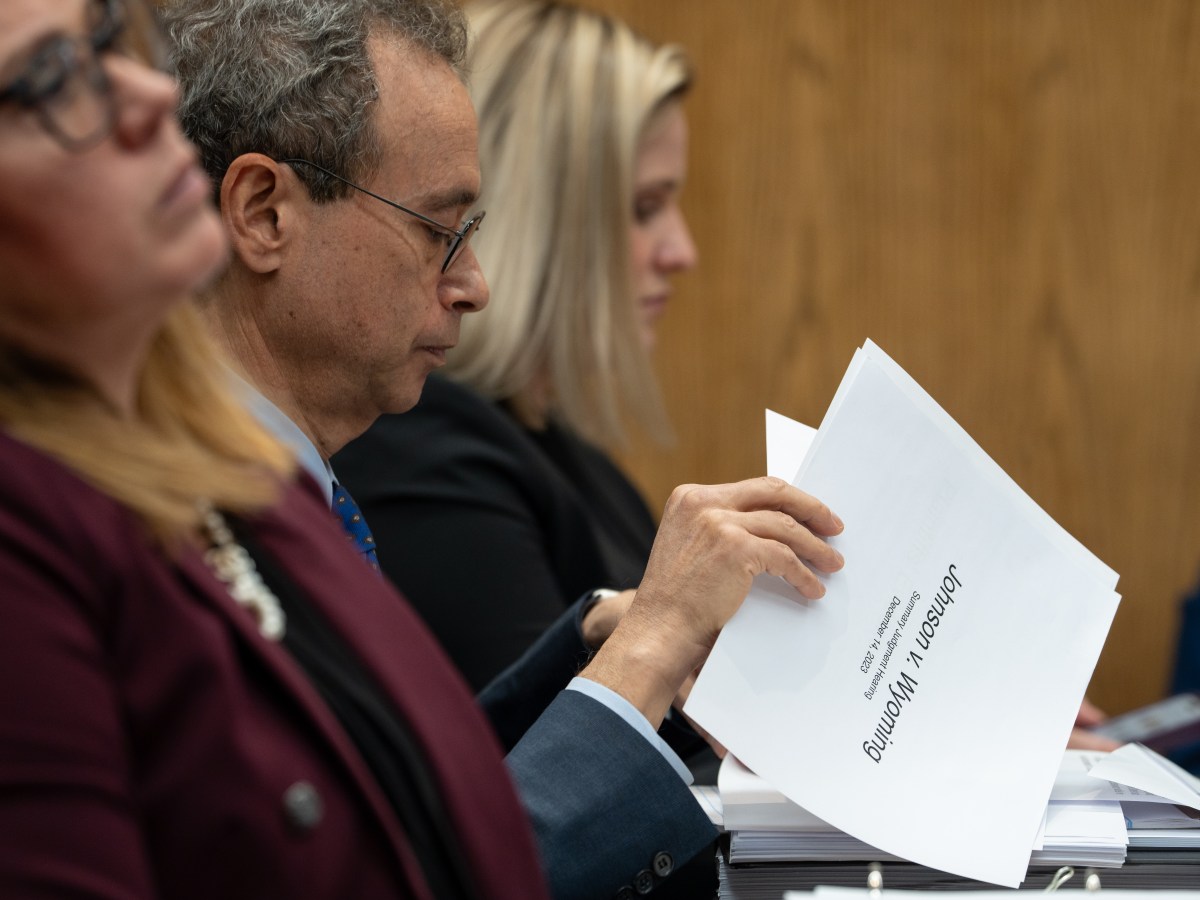
Ninth District Court Judge Melissa Owens heard arguments in December from abortion rights plaintiffs and the state over whether she should rule in their favor over two abortion bans.
The bans, passed last year, include a near-total prohibition and a medication abortion ban. Owens put their enforcement on hold, leaving most abortions legal in the state pending a decision.
Since late last year, there’s been very little word on when — or whether — she’d decide on their constitutionality, but now she’s asking the high court to answer the constitutional quandaries at the heart of this case.
This tactic isn’t new. Owens asked the Wyoming Supreme Court to take up the case over Wyoming’s first abortion ban — a “trigger” ban, which went into effect after Roe v. Wade was overturned — including a dozen key questions in late 2022.
At that time, the justices denied her request, stating, “This Court does not believe it can answer all twelve certified questions on the limited factual record provided.”
This time, there are far more filings and court records to work with, but will it be enough to convince the high court to make these major decisions before Owens rules?
Owens thinks so.
“The Court having reviewed the file and being otherwise fully advised in the premises finds that the record in this matter is fully developed and issues before the Court involve questions of law that are determinative to this action in which there does not appear to be any controlling precedent in the decisions of the Wyoming Supreme Court,” she wrote in her filing this week.
The Supreme Court will have 30 days to decide whether to take up these questions once they receive a hard copy of this request, which they hadn’t as of Tuesday afternoon.
The questions
The first, and likely most substantial, question Owens is asking the justices to consider is whether the two bans violate Article 1, Section 38 of the state constitution.
The vast majority of voters opted to add that section to the Wyoming Constitution in 2012 in the wake of Congress passing the Affordable Care Act. Conservative lawmakers at the time were worried the health care law would encroach on a person’s medical choices.
“Each competent adult shall have the right to make his or her own health care decisions,” the amendment states. “The legislature may determine reasonable and necessary restrictions on the rights granted under this section to protect the health and general welfare of the people or to accomplish the other purposes set forth in the Wyoming Constitution. The state of Wyoming shall act to preserve these rights from undue governmental infringement.”
If the bans do not violate that statute, Owens asks the Wyoming Supreme Court to certify whether it violates 11 other parts of the state constitution.
Beyond that, Owens asks whether the bans are unconstitutionally vague or violate Wyomingites’ right to privacy.
The plaintiffs and defendants
Plaintiffs in this case include women, doctors, an advocacy organization and Wyoming’s sole clinic offering elective abortions.
Meanwhile, the defense includes the state, governor, attorney general, Teton County Sheriff and the Jackson chief of police.
Anti-abortion lawmakers and Right to Life of Wyoming tried to intervene in the case to argue in support of the bans, but they were denied at both the district and state supreme court levels.
Most recently, plaintiffs asked Owens to add a new study examining the effects of abortion bans on OB-GYNs to the case record, including more written testimony. However, Owens denied that request Monday, stating it would be an “unjust” addition after all the proceedings and highlighting plaintiffs’ failure to cite “any legal authority to support their Request.”
Context
The court case is proceeding as the public waits on Gov. Mark Gordon’s decision over new abortion regulations the Legislature has put on his desk.
House Bill 148 – Regulation of surgical abortions includes more requirements for non-hospital clinics providing multiple abortions, which could force the closure of the state’s only clinic offering election abortions — Wellspring Health Access in Casper.
House Bill 148 also requires women to get an ultrasound at least 48 hours before being allowed to get any kind of abortion. Early on in pregnancy, this would likely require transvaginal ultrasounds. There are no exceptions for victims of rape or incest.
Proponents say the bill will make women safer, but opponents argue that there’s no medical reason for the requirements and it’s effectively meant to ban abortion via regulation.
If the state’s near-total abortion ban is found to be constitutional and goes into effect, HB 148 would yield to it.
Many observers suspect this legislation could end up in court like the other abortion bans, facing similar constitutional questions.
Gordon has until Saturday to make a decision.



Once again, I deserve to make the choice myself, not all the others rallying behind their belief/s. Let me remind all that out that a belief is only that, a belief, not a fact, no matter loudly or how many times one says.
It boils down to which is most important, the life of a human being or convenience for the parents of that human. What will be next when abortion is so common as to not be controversial? Eliminating handicapped and old people????
The life of a human being? Like the life of the pregnant women? I would suppose if we value life, then we wouldn’t support the death penalty. How do we feel about a family being forced to keep a brain-dead (but still alive) person on life support facing astronomical medical bills and the likelihood that the patient never wakes up? Should we be legally required to donate a kidney to keep another person alive? Is human life really important or have we just been indoctrinated by an out-of-date religion that’s been hi-jacked by religious extremists?
It’s kind of telling how you all have to keep conflating a fetus with living, breathing people. There’s a reason your billboards always have infants and toddlers on them, rather than clumps of cells.