

Earlier this year, the Legislature, driven by the Wyoming Freedom Caucus, proposed up to $60 million in cuts to the state’s lone four-year university. Though the Legislature ultimately restored the University of Wyoming’s full funding following a sustained public pressure campaign, the question on many Wyomingites’ minds was: Why? Wyoming Freedom Caucus members, who proposed the cuts, said the reason was to “get UW’s attention.” They certainly did that, and in doing so recalled an anti-intellectual strain in western political culture sometimes hostile to academia, expertise and critical inquiry.
Opinion
But given that UW is the state’s only four-year public higher-ed institution and enrollment is down since COVID, it was an unusual posture for the Legislature to take.
I think one of the West’s most beloved adopted sons would agree if he were alive today: Theodore Roosevelt.
Roosevelt was a scholar who penned several volumes of U.S. naval history, Western history and biographies. Born and raised an Easterner in New York City, Roosevelt cut his teeth in the West after the tragic losses of his wife and mother within hours of each other. Seeking to escape his demons, Roosevelt set off for his ranch in what is today’s North Dakota. “Black care rarely sits behind the rider whose pace is fast enough,” he wrote.
The time Roosevelt spent in the West was transformative. He adopted traits and habits characteristic of the emerging Western identity he described as “the strenuous life.” He gained an appreciation for people whose backgrounds, motivations and perspectives were radically different from the privileged life he led. His tailored buckskin and Harvard degree were hardly the credentials required to ingratiate himself with the cowboys of the Badlands; it was his raw determination that won their esteem.
Though Roosevelt did recognize the value of this social diversity, it was predominantly among white people. As president, he was an imperialist, nationalist, exclusionist and chauvinist. His views on race and gender ultimately restricted who he thought was fit for U.S. citizenship and should be the beneficiary of a U.S. education: predominantly Anglo-Saxon males.
Roosevelt’s remarks at the Indian School in Albuquerque, New Mexico, mirrored these racial assumptions when he said, “I am glad to see the Indian children being educated as these are educated so as to come more and more into the body of American citizenship, to fit themselves for work in the home, work in the fields, for leading decent, clean lives, for making themselves self-supporting, for being good providers and good housekeepers; in other words, for becoming American citizens just like other American citizens.”
The implication was that Indigenous peoples must assimilate into Anglo-American cultural identities to be considered good citizens, not that Anglo-American cultures should accept and tolerate Indigenous peoples as they are.
The principle, even if Roosevelt applied it imperfectly, has since been claimed by a larger circle of Americans — and it is that broader inheritance Wyoming risks abandoning.
Roosevelt’s hardscrabble experience in the West later crystallized his commitment to rugged labor and what he described as a “practical” education — not an education grounded in curricula, but one rooted in toil, industry and skill-building. Indeed, the Fargo Forum even reported in 1910 that Roosevelt referred to his time in North Dakota as his “post-graduate course.”
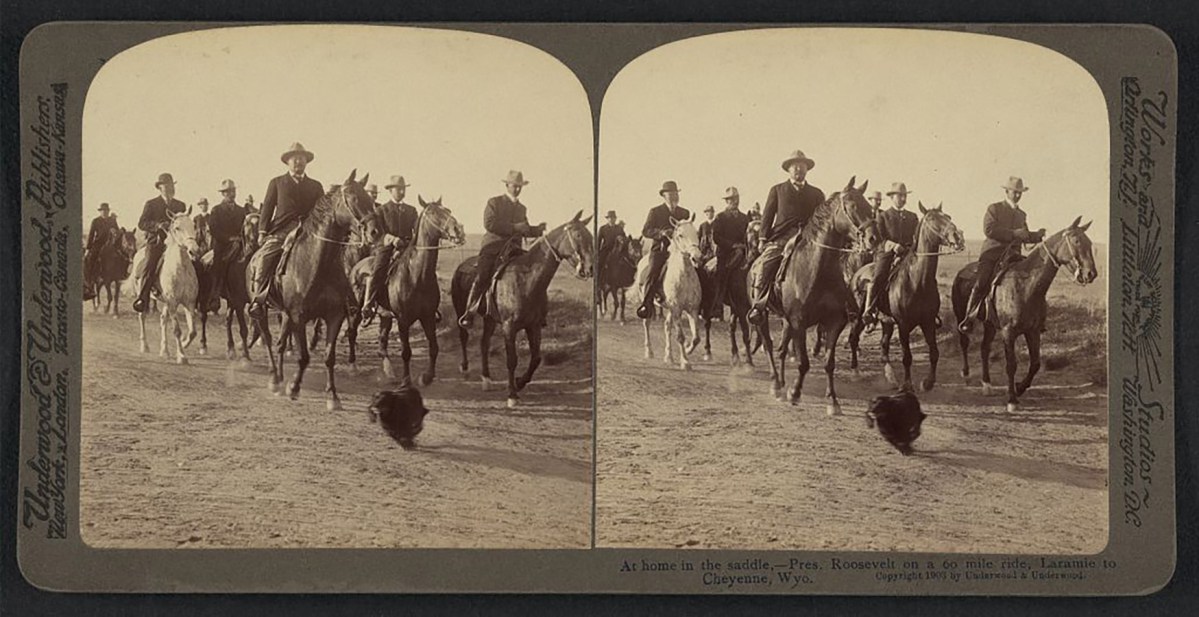
In 1903, Roosevelt embarked on a sweeping eight-week, 14,000-mile tour of the West to espouse the dual importance of education and civic engagement. (It was also an opportunity for him to promote the 1902 Reclamation Act, and champion national parks, national forests and resource conservation.) To Roosevelt, an educated American and a good citizen were one and the same.
On April 2, 1903, Roosevelt launched his tour at Northwestern University, where he set the tone for his speeches linking education and citizenship. The best thing colleges and universities could instill in their students, he said, was “character, a fine and high type of citizenship. That is what we must strive to produce in our universities.” In Roosevelt’s view, schools didn’t provide education so students could merely gain and retain knowledge; they offered students the direction to apply that knowledge on behalf of their countrymen.
Roosevelt spoke of these same ideals from the steps of Old Main at UW on May 30 of that year. As beneficiaries of a state-funded education, he told students in attendance, they owed it to themselves and their fellow Americans to pay it forward. By investing educational resources in its students, the state of Wyoming entered into a compact with them. In return, he proposed, students would offer Wyoming “the service of a good citizen.” And he warned Americans not to feel entitled to the privileges of citizenship. Rather, they should contribute a service to the country to exercise the privileges of citizenship.
Just as Roosevelt bridged the cultural divide between East and West, his belief in the bond between education and citizenship bridged generations. In fact, it evoked the founding of the nation.
In the early stages of the American Revolution, colonial patriots modeled the prototypical American citizen as the antithesis of the typical British subject. A government of the people, by the people, could only function if its citizenry was informed of history and current events, and took active and energetic participation in government. Alexis de Tocqueville witnessed this American cultural aspect during his visit to the U.S. in 1831; using New England’s form of local government, the town meeting, as an example, he observed that “institutions are to liberty what elementary schools are to knowledge; they bring it within the reach of the people.” Roosevelt’s 1903 speeches on education reflected this tradition, fusing together the tenets of education and civic responsibility.
Almost 100 years after de Tocqueville, Roosevelt’s niece, Eleanor, made this same observation. In April 1930, Eleanor published an essay in Pictorial Review titled “Good Citizenship: The Purpose of Education.” In it, she argued that education and citizenship were inseparable, much like her uncle Theodore did during his 1903 tour of the West. Citing “Theodore Roosevelt’s example,” Eleanor supported the idea that “‘a service’ was owed to the country in peace, and that this could only be rendered satisfactorily when every citizen took an interest in good government.”
If Wyoming’s leaders believe, as Roosevelt did, that education forms the backbone of democratic citizenship, then disinvestment was not a pragmatic consideration. Instead, it stood in contrast to the enduring Western civic tradition that braids together education with citizenship, and has since been extended to a wider swath of Americans.
I agree with Roosevelt when he told the crowd gathered at UW: “People of Wyoming, I believe in you and in your future.”
It’s not clear that the Wyoming Legislature does.

Wow, Nick DeLuca reaches way back in time to judge President Roosevelt by DeLuca’s 2026 standards.
“His views on race and gender ultimately restricted who he thought was fit for U.S. citizenship and should be the beneficiary of a U.S. education: predominantly Anglo-Saxon males”.
And yet, President T. Roosevelt presented the first Medal of Honor for a person born in Wyoming to a Black Man. Edward Lee Baker Jr in 1902.
https://www.cmohs.org/recipients/edward-l-baker-jr
He judges the house leadership who wanted to lower the state appropriations to the University of Wyoming.
“They certainly did that, and in doing so recalled an anti-intellectual strain in western political culture sometimes hostile to academia, expertise and critical inquiry”.
Heck of an accusation! Perhaps the house was looking at the state finances as that is the purpose of a budget session. The university has known of an impending enrollment “cliff” for at least 17 years. Since 2018, the enrollment has been decreasing nearly every year. Why? Because they have not tried to raise quality and attract more student with areas of excellence. It is hard for institutions to breed excellence when they have all their wants met. They have no necessity for them to innovate for and they are not hungry at the University.
Here is the data:
CSU: https://www.ir.colostate.edu/wp-content/uploads/sites/21/2025/11/BOG_FA25_Report.pdf
UW: https://www.uwyo.edu/oia/_files/enrollment/hist-sp26off.pdf
CSU trending up for the most part and UW trending down for the most part.
They clearly are not flocking in for our low tuition versus the closest Land Grant university to the South. Overfunding leads to complacency.
You would think the Alumni Association would be constantly communicating with alumni. I have a masters degree from UW and a bachelors degree from CSU. I have not heard from UW’s alumni for a decade. I get stuff from CSU about once a quarter.
I do agree with the sentiments of President Roosevelt. But if he were looking at the appropriations to UW and the number of voters, he would be astounded to see well over $1000 per voter per year. Not counting Hathaway, not counting grants and contracts from state government agencies.
It is a lot of money for an institution that does not return to the taxpayer.
The legislature could have been better at communicating… but they did get UW’s attention… now start a real conversation on higher education.
While I am know there is good home schooling taking place, the indocrination of children with parental prejudices and cult beliefs is not quality.
I have observed public education for years. The inhibiting factor is lack of desire from students, “you can lead a horse to water, but you can’t make it drink.” And equally important is positive involvement and support from parents.
When parents have to micromanage every moment of their childs day with a cell phone, when can education take place?
There are dedicated professionals in the public schools. Let them do their job.
Barbara, a parent has the right to indoctrinate “with parental prejudices and cult beiliefs” their child anyway they see fit.
That is literally nature. I’m sure you did it with your children if you had any.
Teachers are supposed to simply teach yet they indoctrinate students in many instances just as much, and THAT is not their job.
“Teachers are supposed to simply teach yet they indoctrinate students in many instances just as much, and THAT is not their job.” Just curious, Chad. What specific evidence do you have backing up this claim? Please explain in more detail about this “indoctrination”.
Yes, heaven forbid any child getting a different perspective on live from anyone but their parents. Dave Gustafson
Laughable, continually eroding of QUALITY public education over the past 50 years has turned the USA into Idiocracy.
Any parent that wants their child to have a quality education has 3 options. Private school, Responsible homeschooling, or find an extremely rare community with good public schools, (good luck on the last one).