

Even before President Donald Trump’s Department of Government Efficiency carved away at land management agencies’ budgets, they struggled to meet mounting demands in Wyoming and elsewhere. That problem will only grow more acute, according to a regional U.S. Forest Service director, underscoring the need for partner organizations.
“Everything we do in the Forest Service, we are reliant on partners, particularly in recreation spaces,” Tyler Ashcroft, the deputy director of recreation for the U.S. Forest Service’s Intermountain Region, told the audience during an Outdoor Recreation Summit panel in Laramie last week. “And so, quite literally, partners have filled a gap that we could not fill ourselves.”
Partners — such as counties, state government agencies and nonprofit organizations — are already bracing to step up efforts to buttress agencies that have shed thousands of federal jobs and seen other expenses frozen.
Friends of the Bridger-Teton, a nonprofit that helps the Bridger-Teton National Forest manage growing crowds with everything from donated fire rings to volunteer ambassadors, is hiring a five-person “Forest Corps” this summer for the first time. The team will consist of former USFS employees who will help the agency on trail projects, Executive Director Scott Kosiba told WyoFile.
“We’ve gotten requests from all six districts on the forest for projects that they need support with,” Kosiba said.
He is glad his organization can fill growing needs, he said, but emphasized that his Friends group offers support to regional agencies at a level few nonprofits can provide.
“We really grappled with how we could help the forest without playing into this narrative that these services can be done by the private sector or nonprofits,” Kosiba said. “We could never replace these civil servants.”
In a state where nearly half of the land is public and outdoor recreation is on the rise, federal agencies in Wyoming and their partners are expected to be stretched thin this summer as they work to do more with less. Amid a federal downsizing process that’s been defined by uncertainty, it’s still too early to fully understand the impacts on agencies, Ashcroft told the audience gathered for a panel titled “Supporting Public Land Management Agencies through Partnerships.”
“I think everyone in the room recognizes we’re going through a period of change,” Ashcroft said. “Quite honestly, we don’t know what our organization is going to look like.”
Right now, he noted, federal employees still have an opportunity to accept or reject a deferred resignation program offered. “So when I say we don’t fully have a picture as to what the impacts are, we truly do not at this point in time,” he said.
With sentiments like this, Ashcroft and his fellow panelists offered a rare glimpse into the angst federal employees are experiencing amid the tumult created by DOGE efforts to slash federal spending.
Less with more
Doing more with less is not a new theme for the Forest Service, said Ashcroft, who is stationed in Utah but oversees a region that includes Wyoming. The agency oversees more than 9 million acres in Wyoming, making it a major land manager here.
“Yes, we’re facing new challenges right now as an agency, but capacity has been an issue that we’ve been dealing with for a long time,” Ashcroft said. He used firefighting as an example.
In 1985, the Forest Service’s fire suppression costs were $111 million, Ashcroft said. In 1994, that amount jumped to $757 million — the first time it exceeded half a million dollars. It topped $1 billion in 2000, went over $2 billion in 2017 and zoomed across the $3 billion mark in 2021.
“So the costs of fire have taken a greater portion of the agency’s budget, and as we’ve had to build our fire workforce, it’s resulted in cuts to our non-fire workforce,” Ashcroft said. “Simultaneously with that, we’ve seen an elevation in recreation use all across the West, all across national-forest-system lands. So we’re dealing with two challenges: a significant rise in the increase of people that want to use public lands, and then a decrease in the amount of resources that we have to manage those resources.”

The panel was part of the Wyoming Outdoor Recreation Summit, which gathered businesses, agencies and recreationists in Laramie to talk about issues like access and economic opportunities. Though Ashcroft and his fellow panelists discussed longstanding challenges, participants were keen to hear about recent DOGE impacts on Interior Department agencies like the U.S. Forest Service, Park Service and Bureau of Land Management.
“Is there going to be a hair-on-fire moment when the bathrooms aren’t getting cleaned and maybe the campgrounds are getting closed?” asked Wyoming Office of Outdoor Recreation Manager Mark Tesoro, who moderated the panel.
“One forest may have lost their entire special uses program, which impacts guiding and outfitters, where another forest may be whole in that region,” Ashcroft said. “So it truly is varying by district to district, forest to forest, that you’re going to see impacts.”
Regardless, he said, “the agency’s priority is to keep sites open, and so we are going to prioritize that to the extent possible.” Sites may, however, not be open at the same level of service that users have enjoyed in the past.
“There could be sites that historically had running water, that may not have running water,” he said. “There could be sites that had trash collection that may not have trash collection this year.”
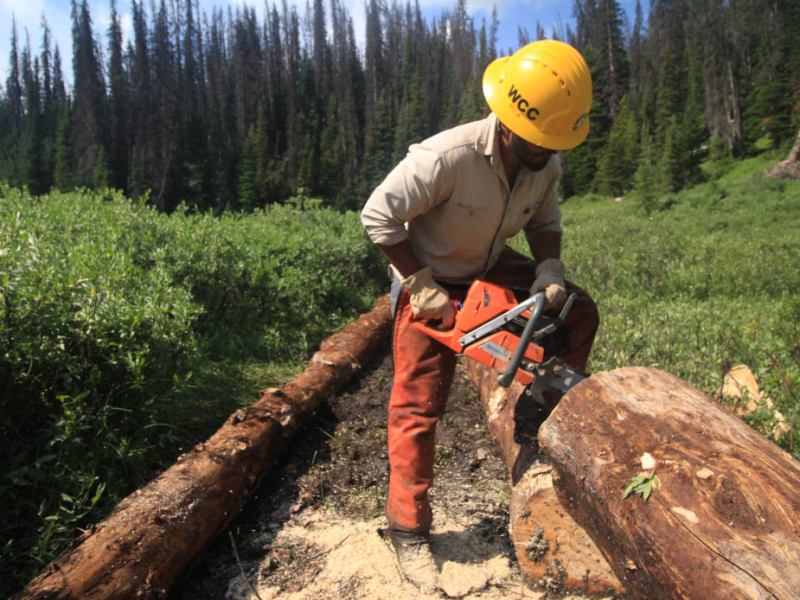
Trail maintenance will be a big challenge, Ashcroft added, so users could encounter more debris or downed trees.
Agency leadership wants to keep decision-making as local as possible, Ashcroft said, and has identified safety, fire, timber and recreation as priorities. “I see us trying to focus what we have on those priorities, recreation being one of those priorities.”
Prioritizing recreation
Deputy Director of Recreation for the U.S. Forest Service’s Rocky Mountain Region Chris Ham has attended several events like the outdoor conference in recent months, he told the audience.
“The first question [I hear] is, ‘How are you doing?’ and the second question is, ‘How can I help?” he said. “Everybody wants to help.”
He stressed patience as the agencies suss out how the changes will ripple down. “We’re gonna definitely need a little more help maybe than we did in the past,” he said.
Wyoming Pathways, a nonprofit that works with local and federal partners to develop trails from Togwotee Pass near Dubois to Pole Mountain near Laramie, is one of the traditional entities that partners with agencies.
Unlike Friends of the Bridger-Teton, however, Wyoming Pathways relies mainly on federal funds to plan and deploy its recreation projects, Executive Director Mike Kusiek said. So, its work could also be delayed.
Most of its 2025 projects, which were funded in 2024, are moving forward, Kusiek said. Beyond that, it’s unclear. But hearing from the agencies and Wyoming officials that recreation is a priority was heartening, he said.
“Overall, we were encouraged,” Kusiek said. “We’ve had a lot of county commissioners, a lot of legislators saying, ‘this is important.’”
Outdoor recreation isn’t going to slow down, he said. Amenities like trails “don’t prepare themselves, they don’t clear themselves, and that will be important for all sides of our economy and our well-being.”
Jennifer Fleuret McConchie, Wyoming BLM deputy state director and the third panelist, doesn’t think the federal challenges will prevent the BLM from getting its work done this season, she told the crowd.
Wyoming BLM staff, key to Trump’s “energy dominance” strategy, have been largely spared by DOGE.
“I don’t think any of the challenges coming to face us this year are going to stretch our ability to meet those challenges and work with our partners to get the work done where it needs to be done,” Fleuret McConchie said.

Saddened, frightened, outraged and alarmed at the ongoing outrageous and un-American activities under the Trump administration.
The wholesale targeting of federal employees, many of which provide protections to the American people, from safe highways, protection from environmental hazards, to firefighting and care of our beloved PUBLIC LANDS. Causes huge grief.
But heck spend money on this dumbness, but not our beloved shared lands. During a time when Americans are struggling to continue to live day-to-day, and millions have their livelihoods threatened, either as federal employees or other Americans being affected by the super unstable tariffs, the IRRESPONSIBLE SPENDING of $45 MILLION DOLLARS for a military parade (WTH?!) on 6/14/2025, and the estimated $16 million dollars it may take to REPAIR HIGHWAYS damaged from the heavy military vehicle. This IS NOT IN THE INTEREST OF AMERICANS OR BEING FISCALLY RESPONSIBLE when Republicans repeatedly cite all of the drastic measures being undertaken by Trump as “saving” the American economy.
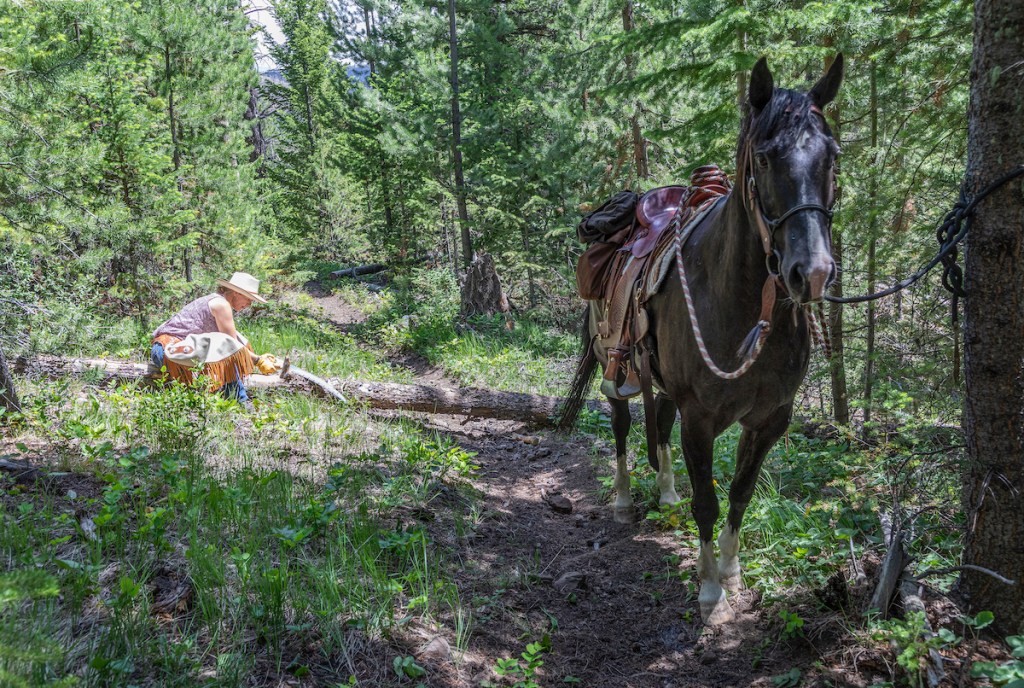
Wyoming Back Country Horsemen with its 7 local chapters around the state contribute heavily in clearing and maintaining trails in the backcountry , as well as working in partnership with the Forest Service and other nonprofit groups that are dedicated to preserving our public lands.
Doesn’t think or won’t go against her bosses. I know She’s in a tight bind as this is the way Government works. When I was in a management position during COVID they told us that we will get everything done without our the support staff in the office. We all nodded our heads in agreement but knew there was no way to do it. Guess what we didn’t. This is just to save face for the public.
Meanwhile, Congresswoman Hageman is voting to sell off public lands to help “solve” the problem. I’m sure John Barrasso and Lummis will do the same. It’s time to wake up people. These lands will be gone forever.
Sale of our public treasures is 100% the goal of the alt-right. Why the maga-faithful support this is a mystery. The red hat will not grant special access once the gates go up on your old favorite hiking, hunting or fishing spot. The ultra-wealthy hate the maga commoners more than most. Private playgrounds, free from trump’s peasants, is the end game.
Is the pronoun at the end of someone’s email harder to bear than a “no trespassing” sign in the area where you harvested your public lands elk a few years ago?